

FDA Regulatory Requirements for a Proprietary Blend Supplement Label
The legal framework for declaring proprietary blends is established under 21 CFR 101.36(c). According to federal regulations and standard guidance on proprietary blend definitions, a dietary supplement manufacturer may group dietary ingredients under an identified blend name to shield proprietary formulation ratios from direct competitor replication. However, this regulatory allowance does not provide total secrecy.
For Supplement Facts labeling purposes, dietary ingredients generally fall into two categories: nutrients with established Daily Values and other dietary ingredients for which no Daily Value has been established.
Nutrients with established Daily Values, such as vitamin C, calcium, and potassium, must be individually declared with their quantitative amounts and applicable % Daily Values. These dietary ingredients cannot be included within a proprietary blend as a means of withholding their individual amounts.
Other dietary ingredients for which no Daily Value has been established, such as certain botanicals, amino acids, and enzymes, may be grouped together as a proprietary blend. The total quantitative amount of the proprietary blend must be declared, and the dietary ingredients within the blend must be listed beneath the blend name in descending order of predominance by weight.
Total Quantitative Weight and Sub-Ingredient Order of Predominance
The cornerstone of blend compliance is the quantitative declaration of the total blend weight. The metric declaration—almost universally rendered in milligrams (mg), grams (g), or micrograms (mcg)—must accurately represent the combined mass of all sub-ingredients inside that specific blend per serving.
Brand owners cannot bypass the order-of-predominance rule. If a thermogenic formula contains 400 mg of green tea extract, 150 mg of caffeine anhydrous, and 5 mg of black pepper extract, the label must present them strictly in that sequence. Failing to list ingredients from highest weight to lowest weight constitutes misbranding under section 403 of the Federal Food, Drug, and Cosmetic Act. Following practical formatting guidelines for supplement panels prevents common sequencing errors during pre-press production.

Formatting the Daily Value Asterisk and Footnote Declarations
For proprietary matrices composed of ingredients lacking reference Daily Values, the “% Daily Value” column must not display an arbitrary number or be left entirely blank. Instead, FDA regulations dictate the precise use of typographic symbols:
- An asterisk (
*) or symbol must be placed in the “% Daily Value” column aligned with the proprietary blend entry. - A standardized footnote statement must appear at the bottom of the Supplement Facts panel:
* Daily Value not established.
If any ingredient inside the blend possesses an established % DV (for instance, if Vitamin E is mixed directly inside a botanical base), it cannot be concealed within the non-disclosed blend weight to hide its quantity. Standard nutrients with established Daily Values must show their quantitative amounts and % DV explicitly. Reviewing dietary supplement label template rules ensures typography, spacing, and footnote alignment adhere strictly to federal specifications.
Step-by-Step Guide to Formatting Blends on Supplement Facts Panels
Structuring a compliant Supplement Facts box requires adherence to precise layout parameters, line weights, indentations, and typographic hierarchy.
Designing a Compliant Proprietary Blend Supplement Label Layout
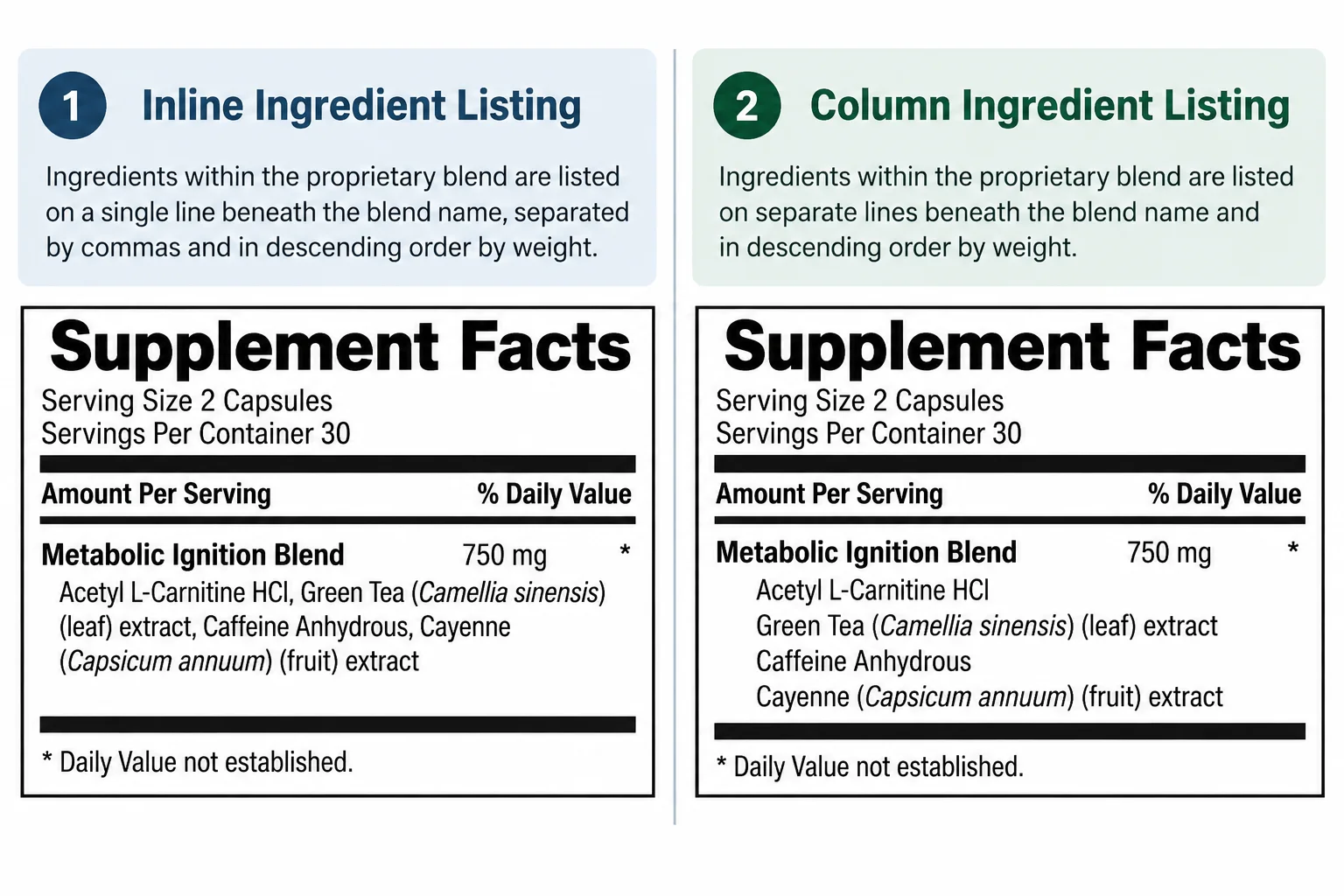
Proprietary blend ingredients may be presented in either an inline or column-style listing beneath the blend name. In either format, the dietary ingredients within the blend must be listed in descending order of predominance by weight. The inline format lists the ingredients together, separated by commas, while the column format displays each ingredient on a separate line.
Multi-Blend Architectures for Functional and All-in-One Formulas
Formulators building multi-benefit products—such as all-in-one greens, adaptogenic protein blends, and pre-workouts—frequently segment complex recipes into distinct, functional proprietary blends. A single SKU might contain:
- Organic Prebiotic Wholefoods Blend (3,000 mg)
- Adaptogenic Herb Blend (660 mg)
- Probiotic Blend (10 Billion CFU / 100 mg)
When formatting multi-blend architectures:
- Each blend must declare its own independent quantitative weight per serving.
- Sub-ingredients inside each blend must follow independent descending weight order for that specific sub-matrix.
- For dietary supplements containing live microbial ingredients, FDA has issued draft guidance describing conditions under which firms may declare quantity in colony forming units (CFUs) in addition to the quantitative amount by weight required by regulation.
- Applicable Supplement Facts formatting requirements, including hairline separation between dietary ingredient entries, must be followed based on the panel format and available label space.
Proprietary Blends vs. Full Disclosure: Efficacy, Margins, and Consumer Trust
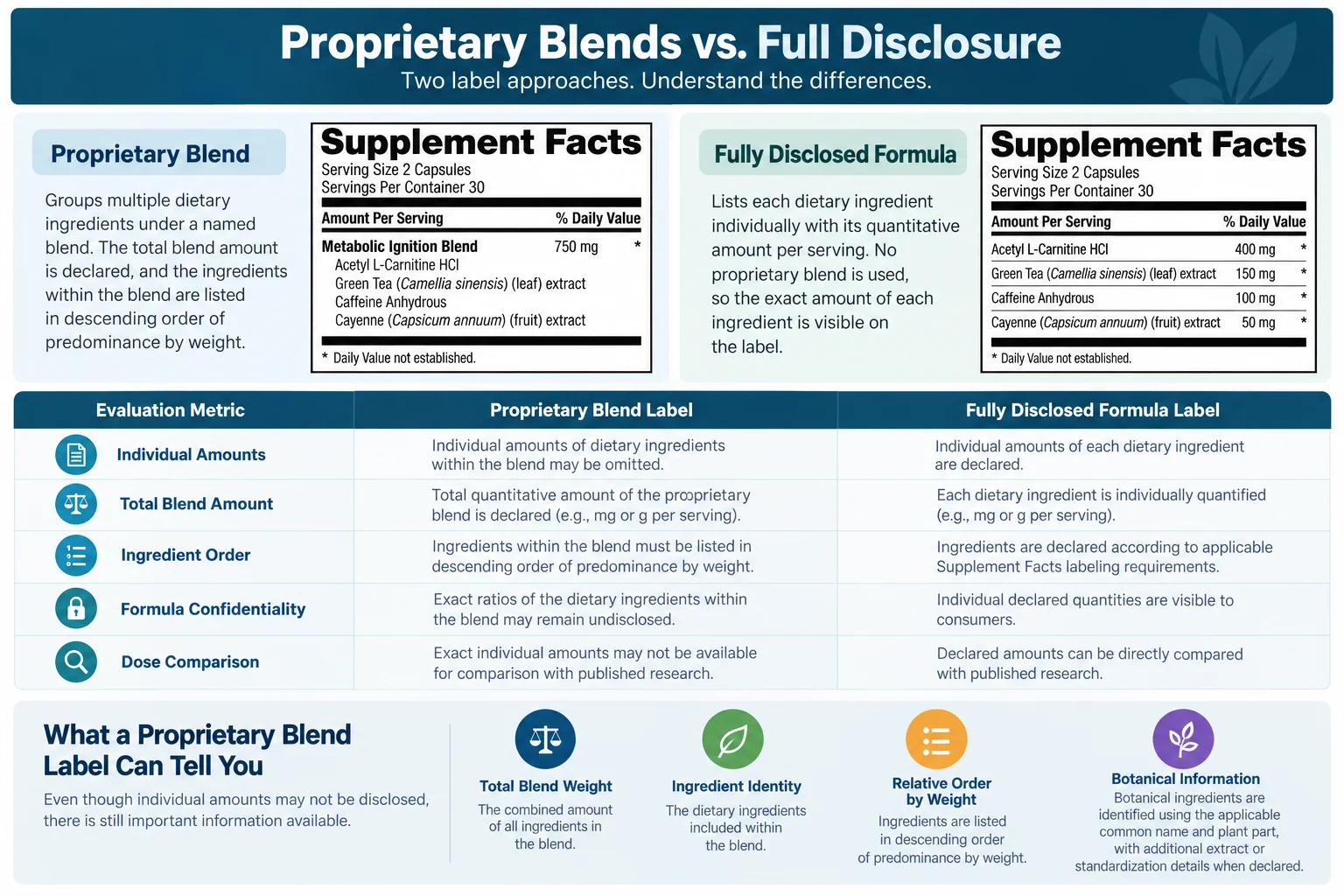
Proprietary blends provide less ingredient-level dose transparency because individual quantities of the dietary ingredients within the blend may be omitted. Fully disclosed formulas provide consumers with the quantitative amount of each individually declared dietary ingredient.
| Evaluation Metric | Proprietary Blend Label | Fully Disclosed Formula Label |
|---|---|---|
| Intellectual Property | Protects formulation ratios from direct cloning | Open formulation; easily copied by competitors |
| Dose Transparency | Total matrix weight only; sub-doses hidden | Exact milligram dosage listed for every active |
| Clinical Validation | Difficult for consumers to verify therapeutic doses | High ease of verification against clinical trials |
| Consumer Trust | Lower initial trust; perceived as “fairy dusted” | 2.5x higher consumer trust among informed buyers |
| Formulation Flexibility | Easy to tweak active ratios without changing label | Any ratio adjustment requires complete label re-printing |
| Flavor Masking Room | Easier to balance bitter botanicals and flavors | Stringent; fixed doses limit in-house masking space |
Evaluating Quality on a Proprietary Blend Supplement Label
Proprietary blends are sometimes criticized because the individual quantities of their components are not disclosed. Although the ingredient order shows relative predominance by weight, the label alone generally does not reveal the exact amount of each ingredient within the blend. As a result, consumers may not be able to compare individual ingredient quantities directly with amounts evaluated in published research.
To distinguish legitimate botanical formulations from under-dosed blends, quality audits examine:
- Standardized Extracts: The presence of specific marker compounds declared in the ingredient line (e.g., Ashwagandha (Withania somnifera) (root) extract, standardized to 5% withanolides).
- Positioning in the Descending List: If the primary claimed active is listed last in a 500 mg blend containing six ingredients, its inclusion rate may be well below the threshold for clinical effectiveness.
- Batch Production Records: Reviewing internal master manufacturing records against Certificates of Analysis (COAs) to verify active ingredient input rates.
Commercial Advantages and Formulation Confidentiality
Proprietary blends can serve a legitimate commercial purpose by allowing manufacturers to disclose the dietary ingredients within a blend without revealing the exact quantity of each individual component. This can provide a degree of formulation confidentiality while still meeting the applicable labeling requirements for proprietary blends.
For manufacturers and brand owners, this approach may help protect formulation ratios from being readily determined from the product label. However, the use of a proprietary blend does not eliminate other regulatory responsibilities related to formulation changes, product specifications, manufacturing controls, ingredient safety, or the substantiation of product claims.
Best Practices to Prevent Misbranding and Regulatory Violations
To maintain strict regulatory compliance and safeguard your brand against warning letters, internal review protocols must audit labels against established FDA and FTC benchmarks.
Allergen Declarations, Active Standardizations, and Testing Audits
- Food Allergen Labeling: Major food allergens present in a dietary supplement must be appropriately identified. Depending on how the allergenic ingredient is declared, the food source may appear parenthetically with the ingredient or in a “Contains” statement placed in accordance with FDA allergen-labeling requirements.
- Botanical Identifiers: Botanical dietary ingredients should be declared using the applicable common name and required plant-part information. When additional extract or standardization information is declared, it should accurately reflect the ingredient specifications.
- Product Specifications and Verification: Manufacturers must establish applicable finished-product specifications and verify that those specifications are met in accordance with dietary supplement CGMP requirements, including the applicable testing or examination requirements under 21 CFR Part 111.
Applicable warning requirements should also be evaluated separately from the Supplement Facts panel. For example, certain solid oral dietary supplements containing iron are subject to the specific warning statement required under 21 CFR 101.17(e).
Structure-Function Claims and Verifying Sub-Ingredient Potency
Dietary supplement structure/function claims must be truthful and not misleading, and the responsible firm must possess substantiation supporting the claim. Health-related advertising claims are also subject to FTC substantiation requirements.
Dietary supplement structure/function claims must be accompanied by the required FDA disclaimer and displayed in accordance with the placement and formatting requirements of 21 CFR 101.93.
Frequently Asked Questions About Proprietary Blends
Can individual ingredient weights be omitted from a proprietary blend?
Yes. Under 21 CFR 101.36(c), manufacturers are legally permitted to omit the individual quantitative milligram weights of Group 2 dietary ingredients inside a proprietary blend, provided the total combined metric weight of the blend is declared and all sub-ingredients are listed in strict descending order of weight predominance.
How do Daily Value percentages work for proprietary blends?
Because proprietary blends typically contain botanicals, herbs, or enzymes without established reference values, no percentage Daily Value (% DV) can be computed for the blend as a whole. An asterisk (*) is placed in the % DV column, referencing the mandatory footnote: * Daily Value not established. Any component with an established Daily Value (such as Zinc or Vitamin C) must be declared outside the proprietary blend with its own quantity and % DV.
What issues can result in FDA regulatory action involving proprietary blend labels?
Examples include:
- Omitting the total quantitative weight of the blend.
- Failing to list sub-ingredients in true descending order of predominance.
- Concealing standard nutrients with established Daily Values inside the blend without separate quantitative declaration.
- Failing to declare major food allergens contained within the blend.
- Making unapproved disease treatment or prevention claims on packaging.
Conclusion
Structuring a legally compliant proprietary blend requires balancing commercial formulation security with strict regulatory transparency. By declaring total aggregate weights, ordering sub-ingredients accurately by mass, properly placing Daily Value asterisks, and substantiating every marketing claim, brands can confidently scale their product lines while protecting their business from regulatory scrutiny.
Managing complex proprietary blend formulations manually can increase the risk of labeling and formatting errors. Panelgea® helps users create and format Supplement Facts panels using tools designed to support proprietary blends, ingredient organization, applicable Daily Value declarations, and editable vector exports. By streamlining panel development and review, Panelgea® can help teams maintain more consistent labeling workflows while retaining responsibility for verifying the accuracy and regulatory suitability of the finished label.