

Build an Supplement Facts Panel and an editable Template That Holds Up to Legal and FDA Regulatory Review
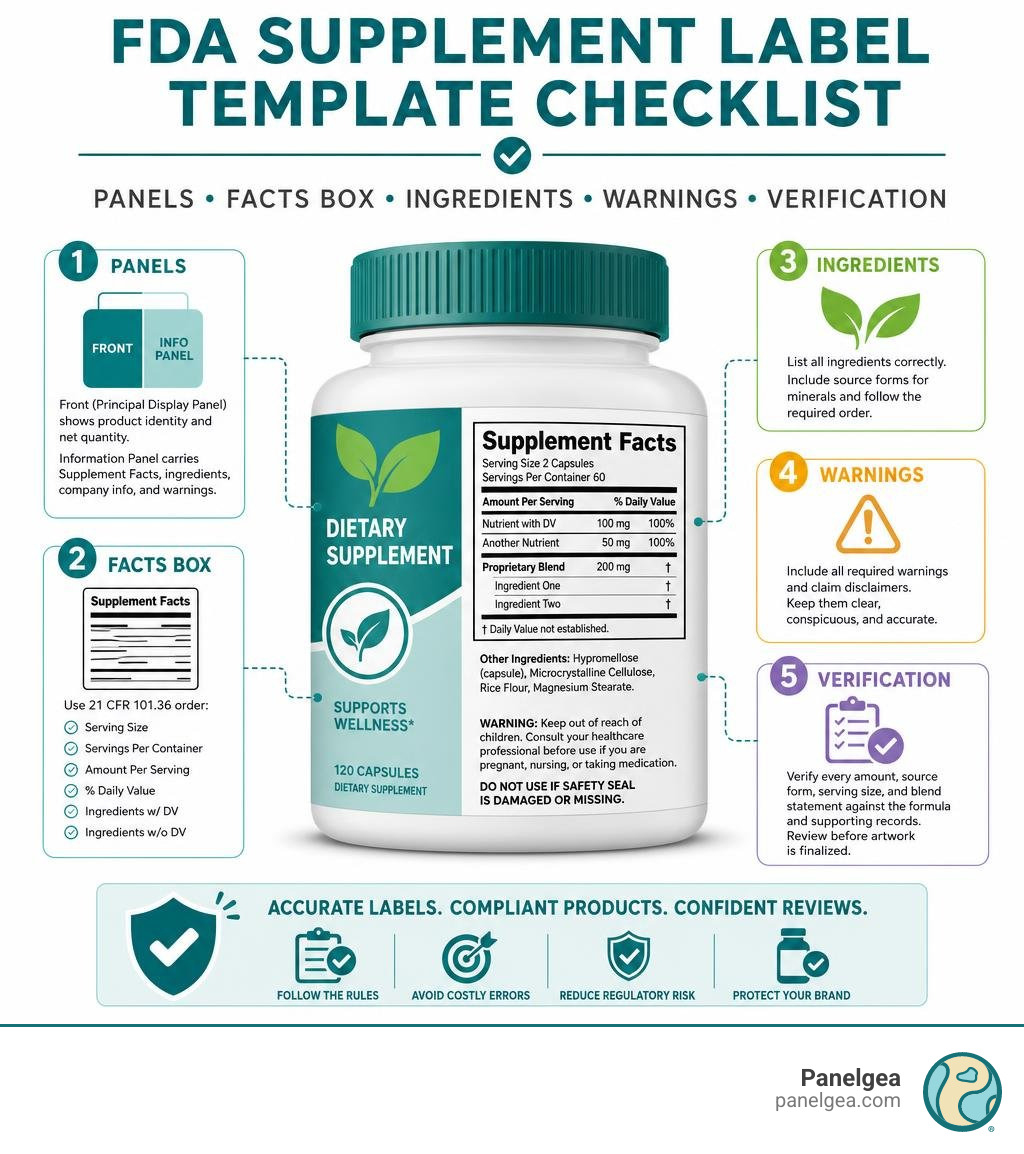
A compliant FDA supplement facts panel starts with the right panel structure, not graphic design. Automate the build the Supplement Facts box in the order required by 21 CFR 101.36: serving size and servings per container first, then amount and % Daily Value columns, followed by ingredients with established Daily Values and ingredients without them. Verify every amount, source form, serving-size statement, and proprietary-blend declaration against the formula and supporting records before sending artwork to print.
The rest of the label and packaging artwork matters, too. The front-facing Principal Display Panel (PDP) of the label needs the product identity and net quantity statement. The adjacent Information Panel generally carries the Supplement Facts panel, ingredient statement, business information, and required warnings or claim disclaimers.
Small errors can create large costs and liabilities to brand owners. Designers that are not experts in the regulations present a risk node to contend with. Manufacturers that assign label approval liability to the brand owner is another risk node. Consultants that have limited experience or that utilize tools that are not specifically structured for complex dietary supplement formulas or that are reliant on unvalidated spreadsheets is yet another risk node. Testing Labs that put together facts panels based on data generated, but do not provide editable files, requiring regeneration by a graphic designer is yet another risk node. Common problems include a serving size that conflicts with directions for use, old Daily Values, wrong alignment, wrong line thickness, minerals missing their source forms, and ingredients listed in the wrong order. A template should make the compliant choice the easy choice.
With structured FDA supplement label template development or reliable and compliant labeling tools, with integrated formulation management, and links claims substantiation, CPG teams can reliably turn complex formulas into accurate, print-ready facts panels for their labels.
Ever since Congress established the modern regulatory landscape through the Dietary Supplement Health and Education Act (DSHEA 1994), dietary supplements have occupied a unique regulatory space. They are regulated as foods, yet their labeling demands a level of technical precision that rivals over-the-counter pharmaceuticals. Today in 2026, the FDA routinely issues warning letters for avoidable labeling defects. An error as seemingly minor as an unrounded metric weight or an incorrectly formatted proprietary blend can trigger regulatory enforcement, product recalls, or costly repackaging runs.
To help prevent these issues, we will walk through the exact mechanics of formatting your packaging layout to comply fully with 21 CFR 101.36 and avoid costly compliance pitfalls.
Anatomy of an FDA Supplement Facts Panel Template Under 21 CFR 101.36
Building a compliant panel requires understanding its statutory hierarchy. Under 21 CFR 101.36, the Supplement Facts panel is not an open canvas—it is a rigid, federally structured grid designed to present quantitative nutrient declarations clearly and uniformly to consumers.
The panel divides dietary ingredients into two distinct classifications: Tier 1 (nutrients with established Daily Values) and Tier 2 (dietary ingredients without established Daily Values). Mixing these categories, altering their sequence, or misrepresenting their quantitative values undermines the legal validity of your label.
| Regulatory Feature | Tier 1 Dietary Ingredients | Tier 2 Dietary Ingredients |
|---|---|---|
| Definition | Vitamins, minerals, and macronutrients with established Daily Values (DVs). | Botanicals, herbs, amino acids, and specialty compounds lacking established DVs. |
| Listing Sequence | Fixed regulatory sequence dictated by 21 CFR 101.36(b)(2)(i). | Descending order by weight per serving below the dividing horizontal bar. |
| Quantitative Declaration | Metric weight or unit (e.g., mg, mcg) plus mandatory % Daily Value (% DV). | Metric weight per serving (e.g., mg, g) with an asterisk linking to the DV footnote. |
| Source Form Disclosure | Mandatory for minerals and optional/recommended for specific vitamin forms. | Listed by common or usual botanical/chemical name, including plant part. |
| Footnote Requirement | Standard reference footnote (e.g., “Percent Daily Values are based on a 2,000 calorie diet”). | Mandatory symbol reference: “* Daily Value (DV) not established.” |
Required Top-to-Bottom Element Sequence
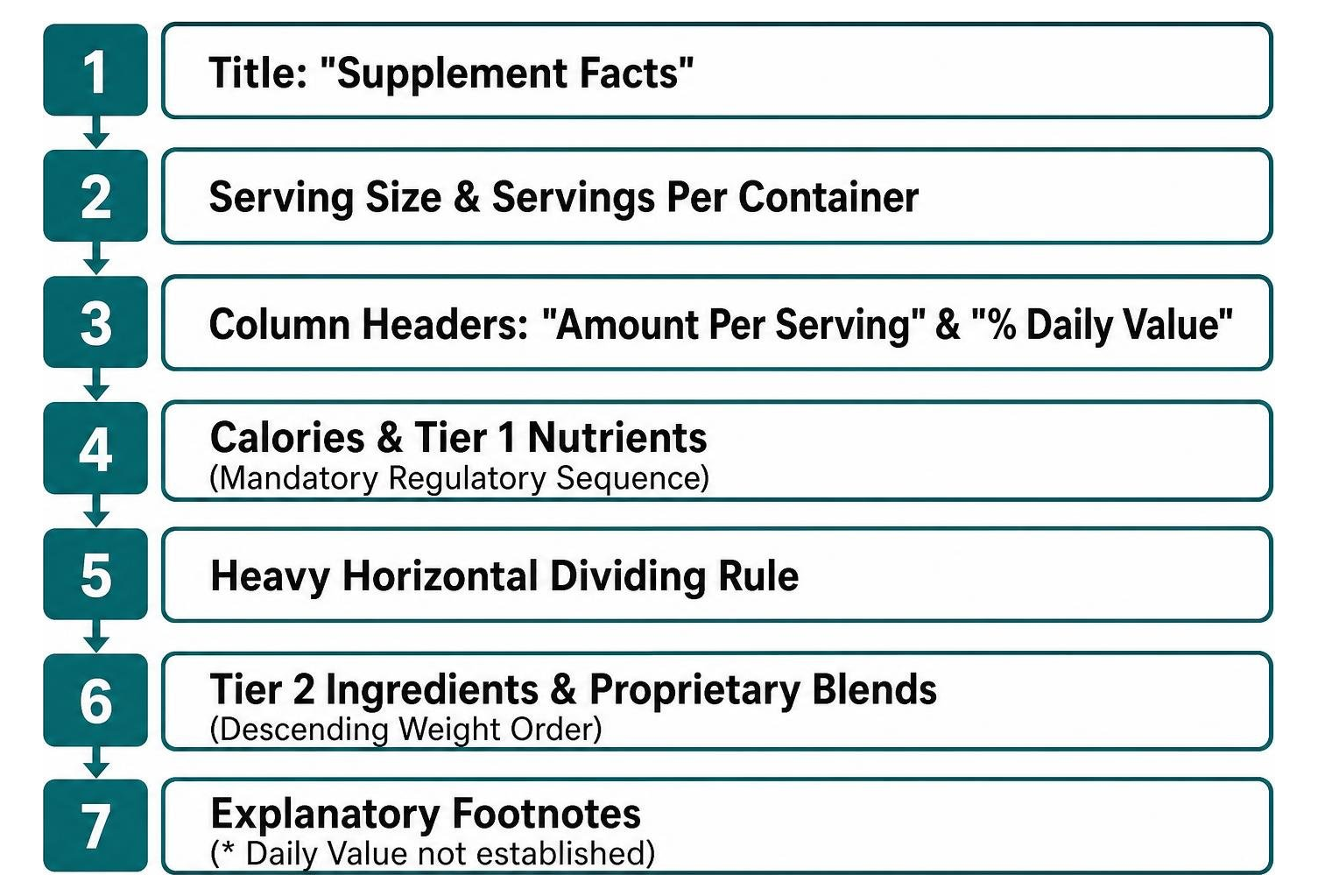
FDA inspectors routinely review Supplement Facts panels following a specific top-to-bottom sequence before and during FDA inspections. Deviating from this order violates 21 CFR 101.36:
- Panel Title: The header must read “Supplement Facts” in a bold, prominent typeface.
- Serving Size Statement: Declared as a common household measure followed by the metric weight equivalent.
- Servings Per Container: The total number of servings in the package, expressed as an exact count for discrete units or an approximation for bulk powders.
- Column Headings: Clear column headers stating “Amount Per Serving” (or “Amount Per [Unit]”) and “% Daily Value” (or “% DV”).
- Caloric and Macronutrient Disclosures: Calories must be declared if a serving contains 5 or more calories (optional if under 5).
- Tier 1 Nutrients: Listed in their mandatory statutory order.
- Heavy Horizontal Dividing Line: A bold line separating established Daily Value nutrients from non-established compounds.
- Tier 2 Dietary Ingredients: Listed in descending order of predominance by weight.
- Daily Value Footnote: Explanatory text referencing the percent Daily Value basis and indicating where Daily Values have not been established.
Declaring Tier 1 vs Tier 2 Dietary Ingredients
Tier 1 ingredients encompass all vitamins, minerals, and macronutrients for which the FDA has established reference values. Following the 2016 nutrition labeling rule (which became fully enforceable for all manufacturers in 2020), Daily Values were updated across several nutrients, including mandatory shifts from International Units (IU) to metric units (such as mcg DFE for folate and mcg RAE for vitamin A).
Tier 1 ingredients cannot be organized alphabetically or by descending weight; they must follow the specific regulatory sequence set out in 21 CFR 101.36(b)(2)(i):
- Total Calories
- Total Fat, Saturated Fat, Trans Fat
- Cholesterol
- Sodium
- Total Carbohydrate, Dietary Fiber, Total Sugars, Added Sugars
- Protein
- Mandatory and voluntary vitamins and minerals (Vitamin D, Calcium, Iron, Potassium, Vitamin A, Vitamin C, etc.)
Tier 2 ingredients—such as botanical extracts, probiotics, and amino acids—do not have established reference daily intakes (RDI). These compounds must appear below the heavy dividing bar, arranged in descending order by weight per serving. The quantitative weight must be stated explicitly, followed by an asterisk or reference symbol pointing to the standard footnote: “* Daily Value (DV) not established.”
For a deeper breakdown of how these specific rules apply across complex formulations, consult the official FDA Dietary Supplement Labeling Guide.
Rules for Structuring a Proprietary Blend in Your FDA Supplement Label Template
Proprietary blends allow brands and manufacturers to protect proprietary formulation ratios while still disclosing every active ingredient to the consumer. However, 21 CFR 101.36(c) establishes strict guardrails for blend formatting:
- Blend Identification: The blend must be clearly labeled using terms such as “Proprietary Blend,” “Energy Complex,” or a distinct trademarked blend name.
- Total Quantitative Weight: The total weight of the entire blend per serving must be declared on the primary blend line, followed by the metric unit (e.g., mg or g).
- Component Listing: The individual dietary ingredients composing the blend must be listed immediately below the blend title (indented) in descending order of predominance by weight.
- Nested Blends: If a proprietary blend contains a sub-blend, the nested ingredients must be enclosed in parentheses and listed in descending weight order. Flavor systems should also be verified whether or not the components present a nutritional value, in which case, it can’t be treated as a flavor only and as a blend requiring disclosure and nutritional calcs.
- The Tier 1 Isolation Rule: You cannot hide nutrients with established Daily Values inside a proprietary blend to avoid declaring their specific quantitative dose and % DV. If an ingredient contains a Tier 1 nutrient at a reportable level, that nutrient must be isolated, listed in the upper Tier 1 section, and assigned its appropriate % DV.
Container Placement and Typography Specifications
Beyond the internal text of the Supplement Facts box, the physical placement of the panel on the product container is strictly governed by FDA regulations under DSHEA.
Principal Display Panel vs Information Panel Placement
A compliant dietary supplement package is divided into two primary operational zones:
Principal Display Panel (PDP): This is the primary shelf-facing surface of the container. By law, the PDP must display two critical items:
- Statement of Identity: The common or usual name of the supplement (e.g., “Vitamin C Dietary Supplement” or “Herbal Energy Supplement”).
- Net Quantity of Contents: The total amount of product in the package, expressed in numerical count (e.g., “60 Vegetarian Capsules”) or, for liquids and powders, in both metric and imperial units (e.g., “Net Wt. 300 g (10.58 oz)”).
Information Panel: By default, the Information Panel must be situated directly to the right of the PDP as viewed by the consumer. This panel houses:
- The complete Supplement Facts box
- The “Other Ingredients” list (excipients, binders, flow agents, and flavorings)
- Major food allergen declarations (complying with FALCPA and the FASTER Act)
- The legal name and physical place of business of the manufacturer, packer, or distributor
The Supplement Facts panel must appear in a single, unbroken graphical box on the Information Panel. It cannot wrap around container corners or split across non-contiguous surfaces unless granted specific small-package exemptions.
Font Sizing, Hairline Borders, and Box Geometry
FDA inspectors verify typography with precision calipers and typographic gauges. If you are formatting your label artwork manually, verify that your design adheres to these exact structural rules:
- Hairline Borders: The entire Supplement Facts panel must be enclosed in a clear, unbroken hairline box with rules of at least 0.5-point line weight.
- Minimum Type Size: All standard nutrient names, amounts, and percentages inside the box must be set at a minimum type size of 6 points.
- Title Prominence: The “Supplement Facts” title must appear in a larger, bold font that visually dominates the panel (typically 9 points or larger).
- The Lowercase ‘o’ Rule: Under general FDA lettering guidelines, the minimum letter height for required Information Panel text outside the panel must be at least 1/16th of an inch, measured against the lowercase letter “o”.
- Aspect Ratio Constraints: Lettering cannot be compressed excessively. Characters must maintain a height-to-width ratio no greater than 3:1.
- Color and Contrast: The box must feature high contrast—dark text printed on a solid, neutral white or light background. Transparent panels placed over dark liquids or busy graphic patterns will fail inspection.
For practical walkthroughs on properly adjusting vector lines, font baselines, and nested formatting, consult our step-by-step label formatting tutorials.
Serving Size, Source Forms, and Mandatory Warnings
Serving size mistakes remain one of the most frequent reasons the FDA issues warning letters to dietary supplement brands. In one notable California case, an incorrectly declared serving size triggered an FDA warning letter that led to a $14,000 repackaging run and delayed the product’s retail launch by six weeks.
Serving Size Formatting and Rounding Rules
Under 21 CFR 101.36(b)(1)(i), a serving size must represent the maximum amount recommended for consumption per eating occasion, stated as a common household measure followed by its metric equivalent:
- Discrete Units: “Serving Size: 2 Capsules” or “Serving Size: 3 Tablets”
- Powders and Liquids: “Serving Size: 1 Scoop (14 g)” or “Serving Size: 1 Tablespoon (15 mL)”
A frequent compliance error is a mismatch between the serving size and the product’s directions for use. If your directions state “Take 2 capsules in the morning and 2 capsules in the evening,” but your Supplement Facts panel declares “Serving Size: 4 Capsules,” your label is technically misbranded. The directions describe two separate eating occasions of 2 capsules each, meaning the panel must declare “Serving Size: 2 Capsules.”
Furthermore, metric weights must follow the rounding conventions established in 21 CFR 101.9(g):
- Quantities under 2 grams must be expressed in decimal increments rounded to the nearest tenth (e.g., a measured 1.35 g serving must be declared as 1.4 g).
- Quantities of 5 grams or more must be rounded to the nearest whole integer (e.g., a measured 14.4 g scoop must be declared as 14 g).
Mineral Source Declarations and Iron Overdose Warnings
Under 21 CFR 101.36(b)(2)(i)(B), dietary minerals must disclose the specific source form alongside the elemental mineral name. Declaring simply “Magnesium 200 mg” is non-compliant; you must state the specific chemical form, such as “Magnesium (as Magnesium Glycinate) 200 mg” or “Magnesium (as Magnesium Oxide).”

Mandatory Iron Toxicity Warning
If your dietary supplement contains iron in any amount, federal law (21 CFR 101.17(e)) mandates a specific, verbatim warning statement. This text must be enclosed within a distinct hairline border box on the Information Panel:
“WARNING: Accidental overdose of iron-containing products is a leading cause of fatal poisoning in children under 6. Keep this product out of reach of children. In case of accidental overdose, call a doctor or poison control center immediately.”
Structure/Function Claims and Nutrient Content Claims
If your label includes structure/function claims (e.g., “Supports Immune Function”), it must carry the mandatory two-part FDA disclaimer enclosed in a box or set off by clear typography, linked via an asterisk to every claim:
“These statements have not been evaluated by the Food and Drug Administration. This product is not intended to diagnose, treat, cure, or prevent any disease.”
When making nutrient content claims, ensure your quantitative values meet the legal thresholds:
- “Good Source” Claim: Must provide 10% to 19% of the established Daily Value per serving.
- “High,” “Rich In,” or “Excellent Source” Claim: Must provide 20% or more of the established Daily Value per serving.
Any regulatory software available for use today should have these regulatory checks in place to advise of labeling options and requirements.
Quality Substantiation and Common Compliance Pitfalls
A Supplement Facts panel is more than artwork—it represents an enforceable legal warranty of your formula’s contents. Under 21 CFR Part 111 (Current Good Manufacturing Practice in Manufacturing, Packaging, Labeling, or Holding Operations for Dietary Supplements), every numerical value on your panel must be backed by rigorous analytical documentation.
Avoiding Warning Letter Triggers and Verification via DSLD
The National Institutes of Health (NIH) Office of Dietary Supplements, in collaboration with the FDA, USDA, CDC, and DOD, maintains the Dietary Supplement Label Database (DSLD). Cataloging over 200,000 dietary supplement labels, the DSLD serves as a comprehensive reference library for researchers, healthcare providers, and federal regulators tracking formulations on and off the market. While is this a minuscule representation of the labels in industry, it is a representative sampling to review against.
Federal inspectors routinely cross-reference label claims against scientific databases and analytical assays. To avoid enforcement actions, ensure your internal quality systems verify the following items:
- Certificate of Analysis (COA) Alignment: Finished-product testing must substantiate that active ingredients meet 100% of the declared label claim throughout the product’s shelf life.
- Excipient Separation: Processing aids, capsule shells, flow agents (e.g., magnesium stearate, silicon dioxide), and artificial colors must never appear inside the Supplement Facts box. They belong solely in the “Other Ingredients” statement below the panel border.
- Outdated Daily Values: Ensure you are not relying on pre-2016 reference standards. Legacy values (such as calculating Vitamin C against 60 mg rather than the current 90 mg standard) represent a straightforward path to an FDA misbranding citation.
Generating a Print-Ready FDA Supplement Label Template
Attempting to design Supplement Facts panels manually in general-purpose graphic software often introduces minor typographic and rounding errors that can compromise compliance.
Panelgea eliminates these risks. The SaaS platform automates the creation of 100% FDA-compliant Nutrition Facts and Supplement Facts panels for consumer packaged goods brands, provided adequate and correct ingredient data has been entered and approved for use. Panelgea’s automated engine handles:
- Integrated compliance checks for complex proprietary and nested botanical blends
- Real-time calculation against current reference values and USDA database nutrient entries
- Automated allergen detection and mandatory statement formatting
- Error-checking for mineral source forms and statutory line sequencing
- Clean, print-ready vector artwork export in fully editable SVG formats to drop into label or packaging artwork
Whether you are launching a single SKU or managing hundreds of complex formulations, you can review our flexible software subscription pricing to streamline your packaging workflow.
Frequently Asked Questions About Supplement Facts Panels
What is the difference between Tier 1 and Tier 2 dietary ingredients?
Tier 1 ingredients are dietary nutrients that have established Daily Values (% DVs) defined by the FDA, including vitamins, minerals, and macronutrients. They must appear in a fixed sequence established by 21 CFR 101.36(b)(2)(i). Tier 2 ingredients are substances without established reference values—such as botanicals, herbs, and amino acids—which must be listed below a heavy dividing bar in descending order by weight per serving, with an asterisk referencing the footnote: “* Daily Value (DV) not established.”
Can nutrients with Daily Values be hidden inside a proprietary blend?
No. Under FDA labeling regulations, if a dietary ingredient in your formulation provides a reportable amount of a nutrient with an established Daily Value (such as Vitamin C, Zinc, or Calcium), that nutrient cannot remain hidden within the proprietary blend. It must be listed in the Tier 1 section of the panel with its specific quantitative weight and % DV clearly declared.
Where must the Supplement Facts panel be placed on dietary supplement packaging?
The Supplement Facts panel must be placed on the Information Panel, which is legally defined as the surface immediately contiguous and to the right of the Principal Display Panel (the front face of the package). The entire panel must appear in an unbroken, continuous box and be accompanied by the ingredient list, allergen statements, and business contact information.
Conclusion
Formatting an FDA-compliant dietary supplement label requires strict attention to statutory sequence, typography, rounding rules, and quality substantiation. A visually polished label will not protect your brand if underlying serving sizes, Daily Values, or blend disclosures fail to meet federal standards.
Panelgea streamlines panel generation by integrating federal labeling rules directly into an automated software platform, helping you move from raw formulation to print-ready vector artwork quickly and accurately.
If your team is managing complex formulations, specialized botanical extracts, or multi-market labeling requirements, our specialists are here to assist. Explore our expert dietary supplement regulatory consulting to ensure your products remain fully compliant, audit-ready, and positioned for long-term retail success.