

An FDA supplement facts label template requires an unbroken hairline bounding box enclosing a strict vertical structure: an 8-point bold “Supplement Facts” title banner, serving metrics (serving size and servings per container), column headings for amount per serving and % Daily Value, Tier 1 core nutrients with established DVs, a heavy 3-to-4.5-point dividing bar, and Tier 2 dietary ingredients (such as botanicals and proprietary blends) with quantitative amounts. Inactive excipients must remain outside the panel border in a separate “Other ingredients” statement.
Conventional foods fall under 21 CFR 101.9, whereas dietary supplements operate under the dedicated framework of 21 CFR 101.36, established following the Dietary Supplement Health and Education Act of 1994 (DSHEA). Applying a standard food nutrition template to a dietary supplement is an immediate misbranding violation. Dietary ingredients carry unique declaration mandates that standard food nutrition tables cannot support.
| Feature / Regulation | Nutrition Facts (21 CFR 101.9) | Supplement Facts (21 CFR 101.36) |
|---|---|---|
| Governing Category | Conventional food and beverage items | Dietary supplements (vitamins, botanicals, etc.) |
| Non-DV Ingredients | Prohibited from the quantitative panel | Required in Tier 2 with quantitative amounts |
| Source Listing (e.g., forms) | Placed strictly in the ingredient statement | Permitted inside panel: e.g., Magnesium (as Glycinate) |
| Proprietary Blends | Not allowed; individual listing mandatory | Allowed; lists total weight and components by order |
| Zero-Value Nutrients | Mandatory declaration if present in trace levels | Omitted entirely unless declared with content |
| Heading Title | Mandatory: “Nutrition Facts” | Mandatory: “Supplement Facts” |
The distinct regulatory classification governs how compounds are displayed, grouped, and qualified. Understanding the rules outlined in 21 CFR 101.36 prevents basic structural errors before artwork goes to the plate maker. But this is also just the start. What you claim, whether on the label itself or in the overall presentation of said product to consumers, also applies and governs what the product must be identified as, and what other regulations then apply governing its manufacture.

Information Panel Placement and Package Geometry
The placement of your panel is governed by rigid spatial boundaries. The FDA requires the panel to sit either on the Principal Display Panel (PDP)—the front face consumers see on the retail shelf—or on the Information Panel directly to the right of the PDP. If the space immediately to the right is unusable due to bottle shape or container geometry, the panel must occupy the next available panel to the right.
Fitting a panel onto a curved bottle, pouch, or carton dieline requires advance planning. A standard 12-ingredient formula set at minimum compliant typography needs a footprint of roughly 1.5 × 3 inches of clean, uninhibited printable area. If your container dieline does not support this physical footprint with adequate border margins, the packaging must be resized, or alternative approved layouts—such as linear formats or tabular orientations—must be evaluated.
Anatomy of an FDA Supplement Facts Label Template: Mandatory Elements and Order
Building a compliant panel requires strict adherence to vertical hierarchy. You cannot arrange ingredients alphabetically, nor can you place botanical extracts above essential vitamins simply because they serve as your product’s primary marketing angle.
The sequence must follow this top-to-bottom order:
- Title Banner: Bold “Supplement Facts” centered or left-aligned across the panel width.
- Serving Metrics: Clear “Serving Size” followed immediately by “Servings Per Container”.
- Column Headings: Left-aligned “Amount Per Serving” paired with right-aligned “% Daily Value” (or “% DV”).
- Mandatory Core Nutrients (Tier 1): Calories (if 5 or more), macronutrients, and vitamins/minerals with established DVs listed in the FDA-specified order.
- Heavy Horizontal Divider: A distinct 3-point to 4.5-point bar separating standard nutrients from non-established compounds.
- Other Dietary Ingredients (Tier 2): Botanical extracts, amino acids, and specialized bioactives in descending order of predominance by weight.
- Proprietary Blends: Named blends disclosing total aggregate weight per serving, followed by indented botanical/chemical constituents.
- Footnote Section: Reference lines explaining the 2,000-calorie baseline and clarifying non-established Daily Values with standard symbols (*, †).
For a detailed review of standard structural layouts, explore FDA Supplement Facts Label Template: Required Elements reference sheet.
Serving Size and Quantitative Declarations in an FDA Supplement Facts Label Template
Serving size errors trip up more supplement manufacturers than almost any other panel element. The serving size must represent the maximum amount recommended for consumption per individual eating occasion on your label’s directions for use. If directions advise taking “1 to 2 capsules with breakfast and 2 capsules with dinner,” the serving size cannot arbitrarily be listed as “1 Capsule” to artificially depress calorie counts or inflate total servings per bottle.
Serving sizes must state the household measure first, followed by the metric equivalent in parentheses:
2 Capsules (1.4 g)1 Scoop (30 g)1 Dropper (1 mL)
Metric numbers follow standard rounding conventions under 21 CFR 101.9(g). For instance, amounts under 10 grams round to the nearest tenth of a gram (e.g., 1.35 g becomes 1.4 g), while quantities over 10 grams round to the nearest whole integer (e.g., 14.4 g becomes 14 g).
When documenting your quantitative nutrient values, if you run into questions regarding standard conversions or unit expressions (such as converting Folate from mcg to mcg DFE), reference our FAQ or Tutorials from your user accounts for more clear regulatory breakdowns.
Structuring Proprietary Blends in an FDA Supplement Facts Label Template
DSHEA provides a protected mechanism for brands to shield proprietary formulations through proprietary blends. However, this flexibility is strictly regulated:
- Naming and Total Weight: The blend must have an identified name (e.g., “Cognitive Support Blend”) and declare the total aggregate weight per serving.
- Descending Order: Every individual sub-ingredient within the blend must appear in descending order of predominance by weight.
- Indentation: Sub-ingredients must be indented beneath the blend header to clearly signify their relationship to the total weight metric.
- The Tier 1 Exclusion Rule: You cannot hide an ingredient with an established Daily Value (such as Vitamin C, Zinc, or Calcium) inside a proprietary blend to avoid listing its individual metric quantity or %DV. Any nutrient with an established DV present at nutritionally significant levels must be pulled into Tier 1.
- Footnote Notation: Proprietary blends require a symbol (typically
*or†) in the % Daily Value column that links to the bottom statement:* Daily Value not established.
Typography, Hairlines, and Bounding Box Formatting Rules
The FDA does not view typography as a stylistic preference; font size, stroke width, and visual contrast are enforceable legal requirements. When regulatory inspectors review a label, they verify structural spacing against strict typographical rules.
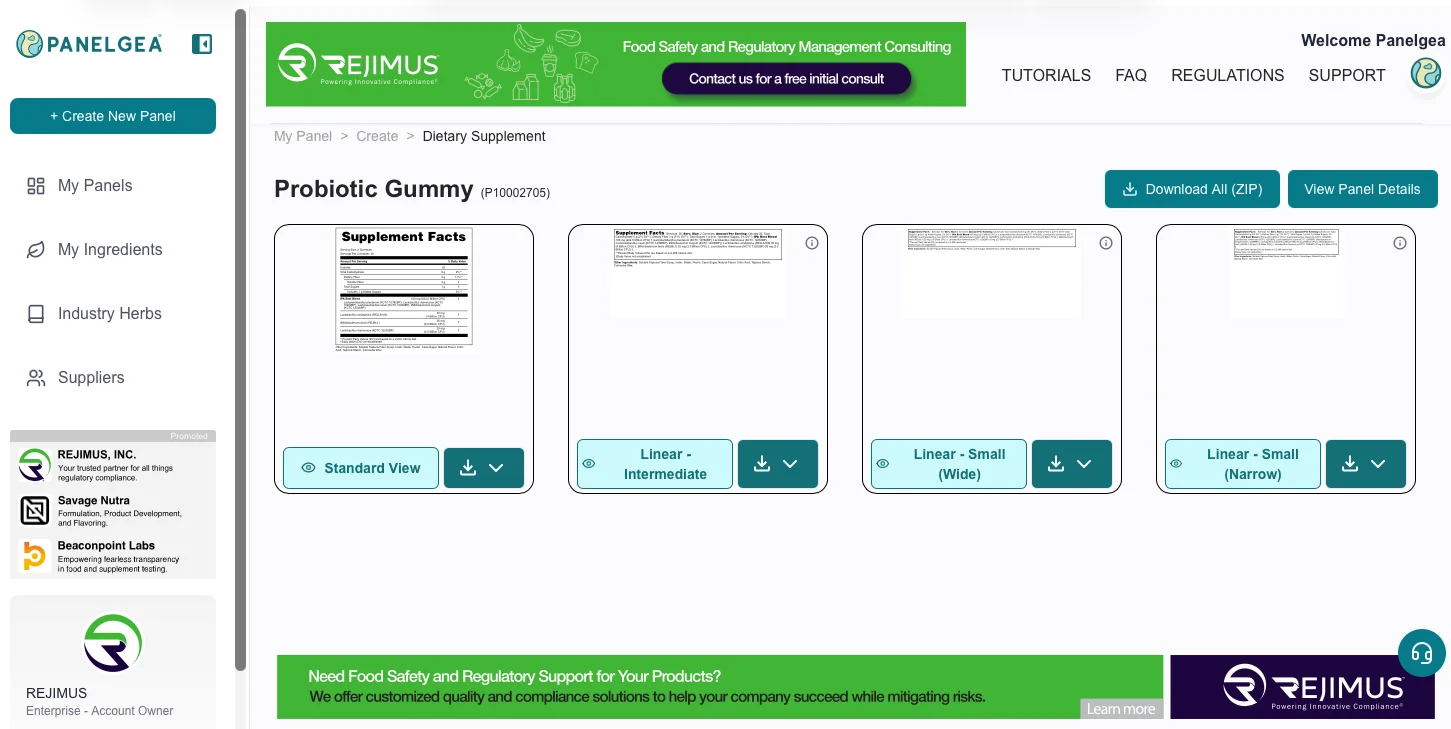
- The Bounding Box: The entire Supplement Facts panel must be enclosed within an unbroken border box constructed with a hairline rule of at least 0.5 points (commonly 1 point in production).
- Dividing Rules: Standard separating lines inside the panel require hairlines between 0.5 and 1 point. The heavy bar separating Tier 1 nutrients from Tier 2 non-DV bioactives must use a thick rule between 3 and 4.5 points.
- Visual Contrast: The panel must maintain sufficient contrast against its container background. While white backgrounds with dense black text offer the safest compliance standard, reverse-contrast layouts must ensure print registration never bleeds into thin hairlines.
Minimum Type Sizes and Line Weight Specifications
The regulatory minimums establish firm boundaries for pre-press artwork:
- “Supplement Facts” Title: Minimum 8-point bold (often scaled to 10–12 points depending on total packaging area).
- Column Headings: “Amount Per Serving” and “% Daily Value” must be a minimum of 8-point bold.
- Body Copy and Nutrients: All listed ingredients, quantitative amounts, and sub-ingredients must maintain an absolute floor of 6-point type.
- Small-Package Exemptions: If total available packaging space is under 12 square inches, type may drop to 4.5-point minimums with abbreviated headers (“Supp. Facts”), but this exemption must be supported by mathematical packaging area audits.
Opting for ultra-condensed sans-serif typefaces to squeeze long botanical names into narrow spaces often renders 6-point text visually equivalent to 4.5-point type, exposing brands to illegibility citations during shelf audits. If you want to eliminate manual typesetting headaches and generate production-ready vector SVG files with guaranteed sizing compliance, review our Pricing to explore automated platform options.
‘Other Ingredients’ and Excipient Formatting Below the Box
The inside of the Supplement Facts panel is reserved exclusively for active dietary ingredients. Excipients, binders, fillers, preservatives, flowing agents, and capsule shells must never appear inside the panel border.
Place the Other ingredients section immediately adjacent to or directly beneath the bottom border of the Supplement Facts panel:
- List all inactive excipients in strict descending order of predominance by weight (e.g., Other ingredients: Hypromellose (capsule), Microcrystalline Cellulose, Silicon Dioxide, Magnesium Stearate).
- Declare major food allergens immediately adjacent to the ingredient list pursuant to the Food Allergen Labeling and Consumer Protection Act (FALCPA) and the FASTER Act (covering milk, eggs, fish, crustacean shellfish, tree nuts, peanuts, wheat, soybeans, and sesame).
- Use clear common names for all capsule elements, artificial flavors, and certified color additives.
Manufacturing Alignment, cGMP Records, and Avoiding FDA Warning Letters
A visually perfect Supplement Facts panel remains non-compliant if it contradicts the physical batch data in your production facility. Under 21 CFR 111 (Current Good Manufacturing Practice in Manufacturing, Packaging, Labeling, or Holding Operations for Dietary Supplements), your label is an audited extension of your Master Manufacturing Record (MMR).
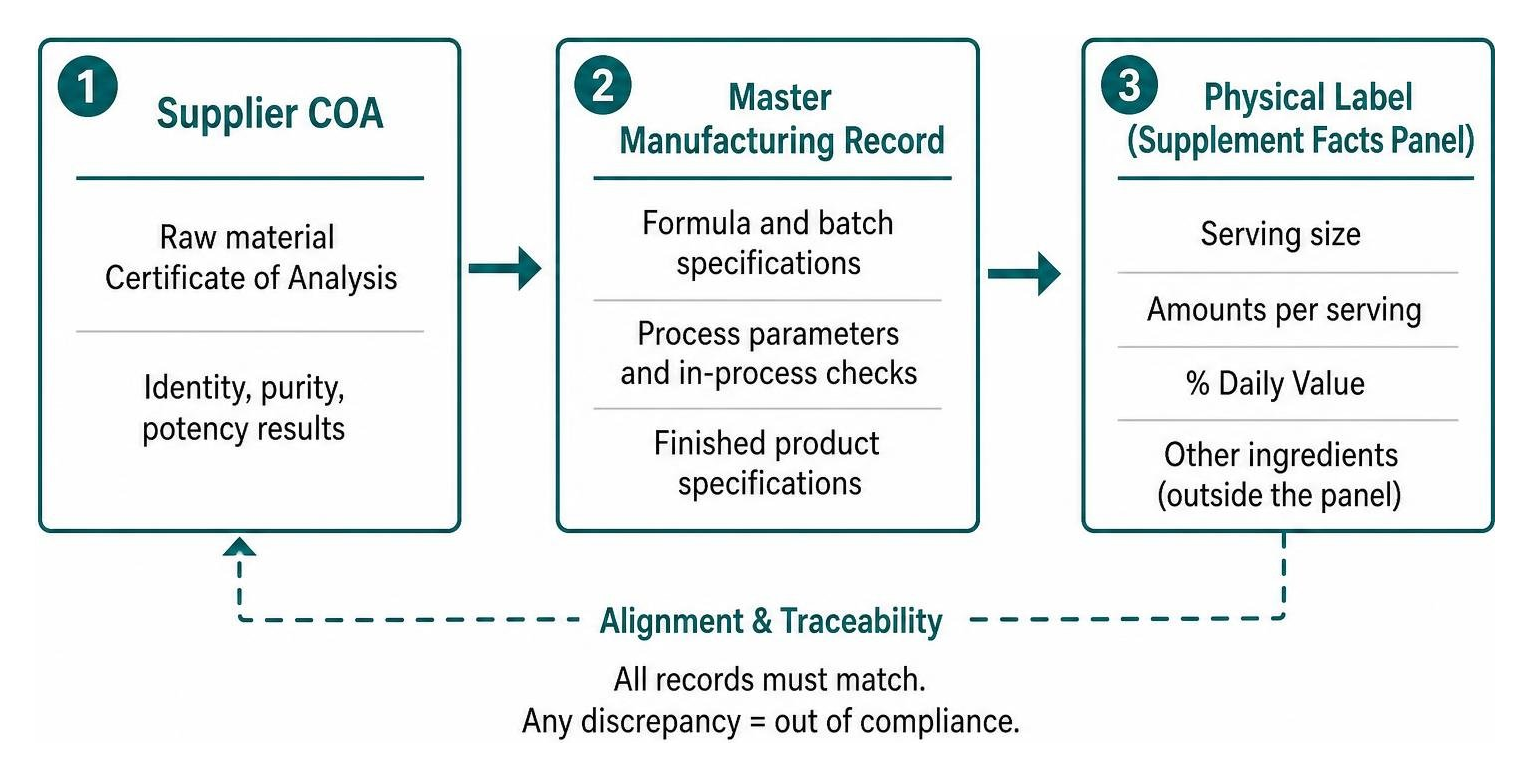
When an FDA investigator executes a facility inspection, they compare your printed label declarations against:
- The Master Manufacturing Record (MMR)
- Batch Production Records (BPRs)
- Raw material Certificates of Analysis (COAs)
- Finished product analytical release testing
If your label declares 200 mg of Magnesium (as Magnesium Glycinate), your MMR must demonstrate the exact raw input formulation required to yield 200 mg of elemental magnesium, fully supported by raw material assay specs and release verification testing.
Bridging the Master Manufacturing Record and Label Declarations
Maintaining absolute synchronization between product specifications and labeling artwork requires documented change control procedures:
- Elemental Calculations: Always calculate and declare the yield of the core elemental nutrient, not just the gross weight of the chelate or salt compound.
- Intentional Overages: If adding stability overages (e.g., dosing 115% of Vitamin C to ensure label claim potency through a 24-month expiration date), substantiate the excess through accelerated or real-time stability testing. Unsubstantiated overages can lead to regulatory citations or adulteration concerns.
- Audit Trails: Maintain complete revision records, including for those under 21 CFR Part 11 if using electronic record keeping software or spreadsheets, covering any formulation adjustments, vendor changes, or label updates.
If your technical team needs assistance harmonizing internal master batch records with retail packaging requirements, you can Contact Us directly to consult our regulatory labeling specialists.
Common 21 CFR 101.36 Labeling Violations and Warning Letter Triggers
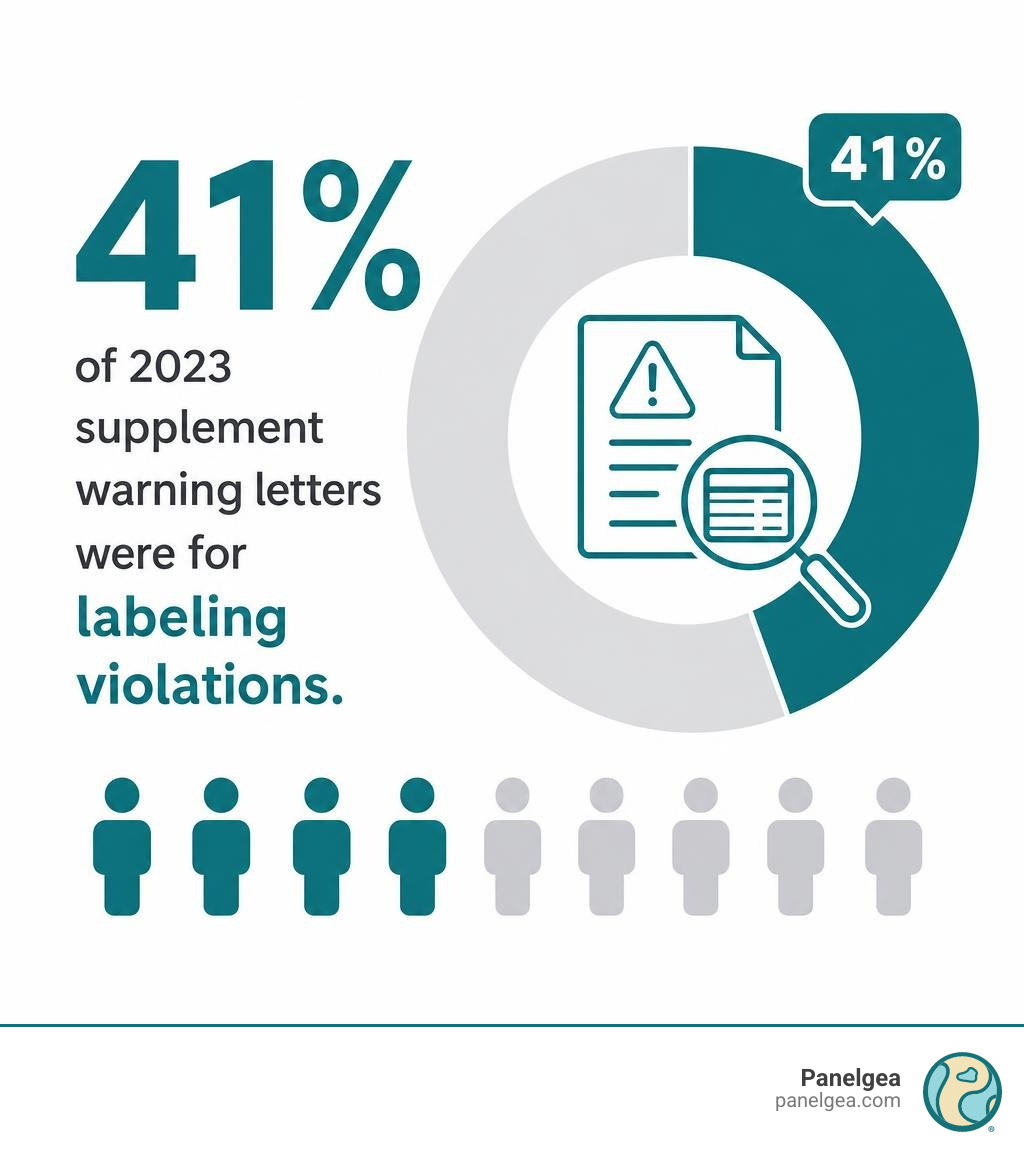
Labeling oversights represent a primary target during FDA compliance audits. In 2023, FDA warning letters hit 247 supplement brands, with 41% citing explicit labeling violations.
A supplement brand in California recently received an FDA warning letter—not because their product was unsafe, but because the serving size on their Supplement Facts panel was declared incorrectly. The reprint cost them $14,000 and delayed their retail launch by six weeks, not including the additional regulatory reviews and graphics design time.
The single most common reason a custom supplement carton goes back to die-stage rework is the supplement facts panel. Investing in a regulatory review at proof stage, can easily cost $1000-$2000 or more, but prevents a five-figure rework, delays and mitigates downstream legal challenges resulting from labeling inaccuracies.
The most frequent warning letter triggers include:
- Serving Size Mismatches: Recommending multiple daily servings in the directions for use while listing fractional amounts in the panel.
- Formatting Tier 1 Nutrients in Tier 2: Placing standardized vitamins or minerals among botanical extracts without declaring their individual %DV.
- Hidden Excipients: Including non-dietary binders, flow agents, or capsule materials inside the bordered panel.
- Omitted Mineral Forms: Listing elemental minerals without identifying their specific source form (e.g., listing “Zinc 15 mg” without specifying “as Zinc Picolinate”).
- Missing PPPA Safety Packaging: Omitting child-resistant closures for formulations exceeding 250 mg of elemental iron per container (mandated by 16 CFR 1700.14).
- Illegible Typography: Employing ultra-thin fonts, insufficient contrast, or body copy below 6 points.
Frequently Asked Questions About Supplement Facts Panels
What is the minimum point size required for Supplement Facts headings?
The main “Supplement Facts” title must appear in a bold typeface of at least 8-point size. For larger packaging formats, scale this heading proportionally to maintain clear visual hierarchy over the body copy.
Can dietary ingredients with established Daily Values be hidden inside proprietary blends?
No. Under 21 CFR 101.36(b)(2), any dietary ingredient that has an established Daily Value (such as essential vitamins and minerals) must be listed quantitatively in the upper Tier 1 section of the panel alongside its %DV. It cannot be concealed inside a proprietary blend.
What is the difference between dietary ingredients and ‘Other ingredients’?
Dietary ingredients provide active nutritional or physiological value (vitamins, minerals, botanicals, amino acids) and belong strictly inside the bordered Supplement Facts panel. “Other ingredients” consist of inactive excipients, tableting aids, preservatives, colors, and capsule shells, and must be placed immediately outside and below the panel border.
Conclusion
A compliant Supplement Facts panel requires precision across regulatory logic, mathematical formulas, and typography standards. Rather than risking manual design oversights, dieline redraws, and regulatory warning letters, modern supplement brands streamline their workflow with automated design tools and output that meets the current demands or labeling and novel packaging configurations.
Panelgea help to automates your entire label creation workflow and ensure compliance from start to finish. Our platform verifies complex proprietary blends, aligns ingredient amounts with current FDA standards, flags potential allergen conflicts, and exports clean, production-ready vector SVG files that drop straight into your packaging artwork. Build your supplement facts panels with speed, confidence, and complete regulatory compliance.