

Core Requirements for FDA Ingredient Labeling and Placement
Creating a compliant food label requires a precise understanding of federal regulations. The U.S. Food and Drug Administration (FDA) enforces strict rules to ensure consumers receive transparent, standardized information about the products they buy.
Order of Predominance and FDA Ingredient Labeling Rules
The cornerstone of U.S. food formulation transparency is codified under eCFR :: 21 CFR 101.4 — Food; designation of ingredients.. Every food product consisting of two or more ingredients must bear a comprehensive ingredient list.
The primary rule is simple: ingredients must be listed by their common or usual name in descending order of predominance by weight. This calculation must be based on the actual weight of each ingredient as it goes into the batch during manufacturing, not its finished volume or dry weight after processing (unless specific reconstitution rules apply).
When formulating your label, several critical nuances arise:
- Common or Usual Name: You cannot invent fanciful marketing terms for basic ingredients. Granulated white sugar must be declared as “sugar” (or “cane sugar” / “beet sugar”), not “crystallized cane nectar.”
- Reconstituted Ingredients: When water is added to bring a concentrated or dehydrated ingredient back to single strength (for instance, reconstituting tomato paste into tomato puree), list the water and the concentrate separately at their weight positions in the master formula. Some ingredients may be declared by a class name, such as milk, whey, or cream. For those, 21 CFR 101.4(c) lets you place the ingredient by the combined weight of the concentrate plus the water needed to reach single strength. Any water beyond that amount must be declared separately as “water.”
-
- List the water and the concentrated ingredient separately at their appropriate weight positions in the master formula.
- List the reconstituted ingredient by its standard name (e.g., “reconstituted tomato puree”) according to the total weight of the water plus concentrate.
- Multi-Component Sub-Ingredients: When you use a pre-formulated composite ingredient—such as chocolate chips, soy sauce, or enriched flour—you must break down its constituent parts. The FDA permits two approaches:
-
- Parenthetical Declaration: Name the primary component followed by a parenthetical list of its sub-ingredients in descending order (e.g.,
Enriched Flour (wheat flour, niacin, reduced iron, thiamine mononitrate, riboflavin, folic acid)). - Dispersed Declaration: Disperse all sub-ingredients individually throughout the main ingredient statement by their specific contribution to the total batch weight.
- Parenthetical Declaration: Name the primary component followed by a parenthetical list of its sub-ingredients in descending order (e.g.,
Failing to properly unpack composite raw materials is one of the most frequent errors that triggers warning letters. For a deeper look into common startup pitfalls, check out our guide on avoiding critical mistakes on ingredient labels. To reference the foundational federal standards, review the official FDA Food Labeling Guide.
PDP, Information Panel, and Net Quantity Standards
Where you place your ingredient statement is just as important as how you write it. Federal regulations identify two primary locations for mandatory label information:
- Principal Display Panel (PDP): The portion of the package most likely to be displayed, presented, shown, or examined under customary conditions of retail sale.
- Information Panel: The panel immediately contiguous and to the right of the PDP as viewed by the consumer. If the top of the container is the PDP, the information panel is any adjacent side panel.
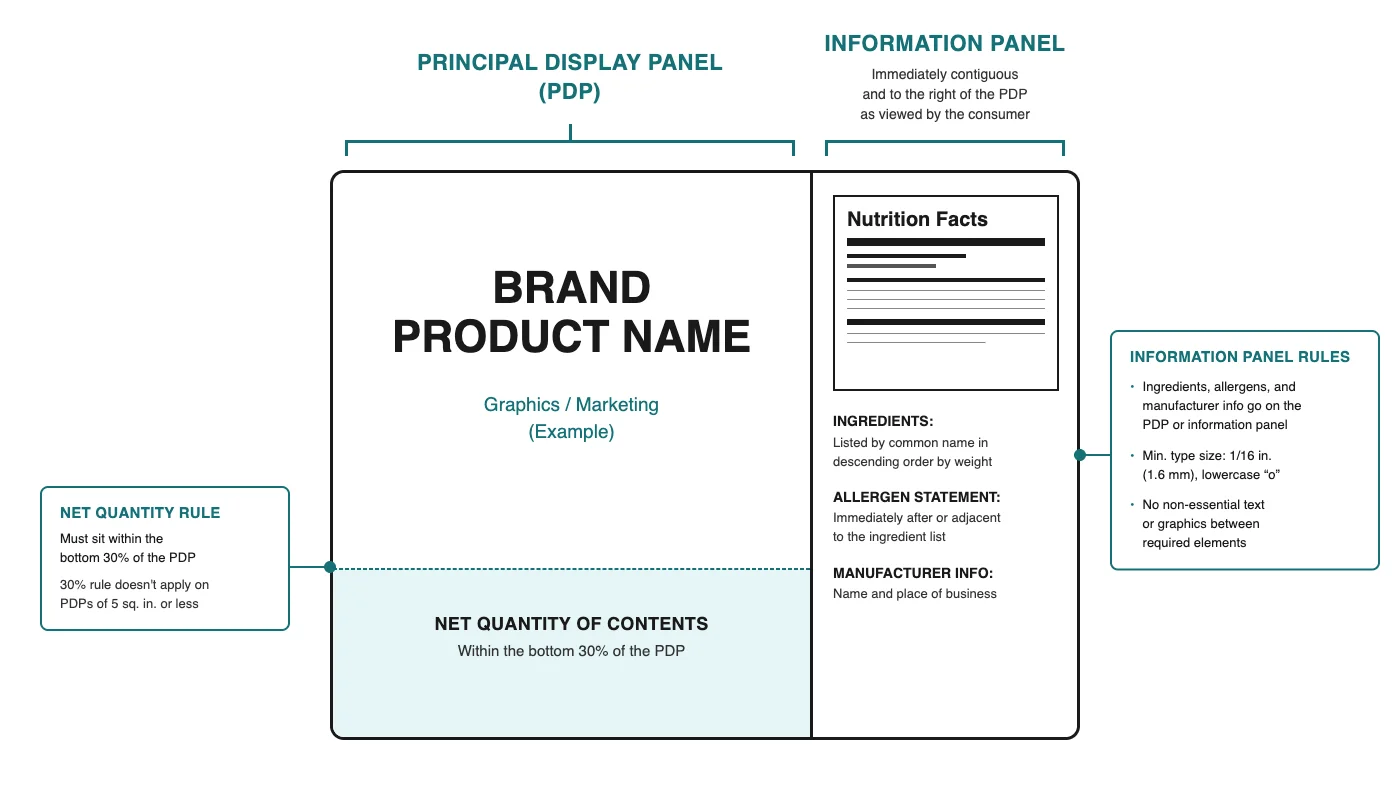
To maintain compliance, follow these placement and typography parameters:
- Type Size: All mandatory statements on the information panel—including the ingredient declaration, allergen statements, and manufacturer contact info—must be set in a type size no less than 1/16 inch (1.6 mm) in height, based on the lower-case letter “o”. The lettering cannot be more than three times as high as it is wide and must contrast prominently against the background.
- Intervening Material: The FDA strictly prohibits non-essential text or graphics from being inserted between mandatory elements on the information panel. You cannot wedge marketing slogans, recipes, or decorative vignettes between the Nutrition Facts panel and the ingredient statement.
- Net Quantity of Contents: The net quantity statement must appear on the PDP within the bottom 30 percent of the panel area (except on packages where the PDP is 5 square inches or less). The type size of the net quantity declaration scales with the total area of the PDP:
- 5 sq. inches or less: Minimum 1/16 inch type
- Over 5 to 25 sq. inches: Minimum 1/8 inch type
- Over 25 to 100 sq. inches: Minimum 3/16 inch type
- Over 100 to 400 sq. inches: Minimum 1/4 inch type
- Over 400 sq. inches: Minimum 1/2 inch type
- Name and Place of Business: The label must state the name of the manufacturer, packer, or distributor, along with the city or town, state, and ZIP code. The street address is also required unless the business is listed in a current city or telephone directory. If the entity listed is not the actual manufacturer, a qualifying phrase such as “Manufactured for…” or “Distributed by…” is mandatory.
For more information on structuring these core panels, explore our comprehensive breakdown on navigating FDA food labeling requirements.
How to Declare Specialized Ingredients, Blends, and Minor Additives
Not all ingredients behave uniformly in a recipe. The FDA has established specific provisions for minor components, processing aids, and functional ingredient categories.
The 2 Percent Threshold and Quantifying Statements
Batching small-scale functional additives—such as leavening agents, natural flavors, spices, salt, and preservatives—often results in minor formulation fluctuations. To provide operational flexibility without sacrificing consumer safety, 21 CFR 101.4(c) provides the 2 percent rule.
If an ingredient is present in an amount of 2 percent or less by weight of the total formulation, it does not have to appear in strict descending order of predominance. Instead, you may group these minor ingredients at the very end of the ingredient list following a clear quantifying preamble:
"Contains 2 percent or less of...""Contains less than 2% of...""Contains 1.5% or less of..."(or 1.0%, 0.5% depending on your threshold)
Incidental Additives and Processing Aids: Under 21 CFR 101.100(a)(3), incidental additives that are present in a food at insignificant levels and have no technical or functional effect in the finished food are exempt from declaration. However, this exemption never applies to major food allergens. If an incidental processing aid contains protein derived from one of the nine major allergens (milk, eggs, peanuts, tree nuts, wheat, fish, crustacean shellfish, soy, or sesame), it must be declared.
Fats, Oils, Leavening Agents, and Dough Conditioners
Certain functional ingredients are governed by specific class-naming conventions under 21 CFR 101.4(b).
1. Fats and Oils
Fats and oils must always be declared by their specific source name (e.g., “soybean oil,” “palm oil,” “beef tallow”). If a product uses a blend of vegetable oils where the exact composition changes based on market availability, the FDA permits an “and/or” declaration. This applies only when fats and oils are not the predominant ingredient, meaning their combined weight is less than the weight of the most predominant ingredient that isn’t a fat or oil:
- Allowed:
"vegetable oil (contains one or more of the following: soybean oil, canola oil, sunflower oil)"
- Hydrogenation: If an oil is hydrogenated, the term “hydrogenated” must precede the specific oil name (e.g., “hydrogenated coconut oil”). The regulation also provides for “partially hydrogenated,” but FDA has determined that partially hydrogenated oils are no longer Generally Recognized as Safe, so they should not appear in current formulations.
2. Functional Bakery Ingredients
Leavening agents, yeast nutrients, dough conditioners, and firming agents may be identified by their general functional category name, followed by a parenthetical list of the specific chemical agents used.
| Functional Category | Declaration Format Example |
|---|---|
| Leavening Agents | Leavening (sodium acid pyrophosphate, sodium bicarbonate, monocalcium phosphate) |
| Yeast Nutrients | Yeast Nutrients (calcium sulfate, ammonium phosphate) |
| Dough Conditioners | Dough Conditioners (l-cysteine hydrochloride, ascorbic acid, azodicarbonamide) |
| Firming Agents | Firming Agent (calcium chloride) |
Special Product Categories and Category-Specific Exemptions
Certain product categories operate under modified or supplementary labeling frameworks.
Dietary Supplement vs. Conventional FDA Ingredient Labeling
Dietary supplements fall under a distinct regulatory category governed by the Dietary Supplement Health and Education Act (DSHEA) and 21 CFR 101.36.
- Supplement Facts vs. “Other Ingredients”: Active dietary ingredients listed within the Supplement Facts panel do not need to be duplicated in the bottom ingredient statement. Instead, non-dietary excipients (such as cellulose, magnesium stearate, and silica) are declared below the panel under the heading “Other ingredients:”.
- Botanical Naming Conventions: Botanical ingredients must be identified using their standardized common name as recognized in the reference guide Herbs of Commerce. The declaration must also specify the part of the plant used (e.g., leaf, root, aerial parts, bark). If an herb is not listed in Herbs of Commerce, the Latin binomial name (genus and species) must be provided in parentheses.
- Proprietary Blends: You may list a proprietary blend under a collective name in the Supplement Facts panel, provided you state the total metric weight of the entire blend and list each constituent ingredient in descending order of predominance by weight.
For an end-to-end walkthrough on supplement packaging compliance, read our guide to dietary supplement label compliance and review the official FDA Dietary Supplement Labeling Guide.
Imitation Foods, Juices, and Soft Drink Bottle Exemptions
The FDA also enforces specific labeling protocols for unique food formats:
Imitation Foods (21 CFR 101.3(e))
A food that is a substitute for and resembles another food, but is nutritionally inferior (containing lower levels of essential nutrients like protein, vitamins, or minerals), must bear the word “Imitation” in the same font size and prominence immediately preceding the name of the food being imitated (e.g., “Imitation Crab Meat”). If a substitute food is formulated to be nutritionally equivalent, it can use an appropriate descriptive name without the “imitation” label.
Juice Beverage Labeling (21 CFR 101.30)
Any beverage that purports to contain fruit or vegetable juice (through text, vignettes of fruit, or descriptive flavor claims) must declare the total percentage of juice near the top of the information panel. Only the brand name, product name, logo, or UPC may appear above it.
- The declaration must state:
"Contains __% juice"or"__% juice". - Calculations for juices reconstituted from concentrate must use the standard Brix values specified in 21 CFR 101.30(h)(1).
Soft Drink Bottle Exemptions (21 CFR 101.4(d))
Some soft drink bottles get special labeling exemptions. This applies to bottles without a paper, plastic foam jacket, or foil label, and to reusable bottles with a label lithographed onto the surface:
- The ingredient statement, the name and place of business, and the statement of identity may appear on the top of the bottle closure, in that order of priority.
- Type on the closure may be as small as 1/32 inch. If the name and address are placed on the side of the closure, they must be at least 1/16 inch.
- Neither the bottle nor the closure needs Nutrition Facts. A multiunit retail package or a vending machine may still need nutrition labeling.
Soft drinks in cans, or in nonreusable bottles with paper or foil labels, don’t qualify for these exemptions. The one exception is that the name and address may appear on the closure or can lid instead of the label.
Step-by-Step Guide to Formatting an FDA-Compliant Ingredient Statement
Formatting an ingredient declaration requires precision. Follow this standard five-step procedure:
Step 1: Reconcile Your Master Batch Sheet
Calculate the incoming weight of every raw ingredient used in the commercial batch. Ensure you account for added water and verify whether dry concentrates are reconstituted during the cook cycle.
Step 2: Unpack All Composite Sub-Ingredients
Obtain formal specification sheets from raw material suppliers for every compound ingredient (e.g., sprinkles, seasonings, flavor bases). Identify every individual sub-ingredient, carrier, preservative, and incidental additive.
Step 3: Sort in Descending Order of Predominance
Rank the primary ingredients based on gross incoming weight. If you choose to disperse sub-ingredients throughout the main list rather than using parentheses, recalculate the net weight percentage of each individual compound across the entire batch.
Step 4: Apply 2% Threshold Exceptions
Identify functional components that constitute 2.0% or less of the total batch weight. Group these ingredients at the end of the statement behind an appropriate quantifying lead-in phrase.
Step 5: Declare Allergens and Review Formatting
Verify that all major allergens (Milk, Eggs, Fish, Crustacean Shellfish, Tree Nuts, Wheat, Peanuts, Soybeans, and Sesame) are clearly declared. You can declare them parenthetically within the ingredient list, or in a “Contains” statement placed immediately after or adjacent to the ingredient list, in type no smaller than the ingredient list. Tree nuts, fish, and crustacean shellfish must be identified by specific type (e.g., almond, cod, shrimp). Confirm that the font size meets the 1/16-inch minimum height requirement.
For detailed rules on calculating nutrient profiles and rounding numbers on your facts box, explore our comprehensive guide on nutrition facts label requirements and FDA rounding rules.
Frequently Asked Questions About FDA Ingredient Labeling
What type size is required for FDA ingredient statements?
The baseline requirement across all standard information panels is a minimum type size of 1/16 inch (1.6 mm), measured against the lowercase letter “o”. A narrow exemption under 21 CFR 101.2(c)(2) allows 1/32 inch (0.8 mm). It applies only to individual serving-size packages that are served with meals in restaurants, institutions, or on passenger carriers and are not sold at retail. The package must also have 3 square inches or less available for labeling, with too little space to print the required information at 1/16 inch. Other small retail packages must still meet the 1/16-inch minimum unless FDA has established an alternative under 21 CFR 101.2(f).
How do you declare added water used to reconstitute dry ingredients?
Water added to bring a concentrated or dehydrated material back to its single-strength state must be accounted for by weight. In most cases, list “water” and the concentrate separately at their positions in descending order. For ingredients that may be declared by a class name (such as milk or whey), 21 CFR 101.4(c) lets you position the ingredient by the combined weight of the concentrate and its reconstitution water. Any water beyond single strength must still be listed as “water.”
When can spices and flavors be declared by a general class name?
Under 21 CFR 101.22, spices, natural flavors, and artificial flavors may be declared collectively as “spices,” “natural flavor,” or “artificial flavor” without naming each specific botanical or chemical extract. However, specific exemptions apply:
- Onion powder, garlic powder, and celery powder are considered foods rather than spices and must be declared by their common names.
- Spices that also impart color (such as paprika, turmeric, and saffron) must be declared as “spice and coloring” or by their specific common names.
- Any spice or flavor that contains one of the nine major food allergens cannot rely on class naming and must disclose the source allergen.
Conclusion
Developing an FDA-compliant ingredient statement requires strict attention to detail across formulation batching, supplier documentation, typography, and allergen rules. A single naming oversight or formatting error can result in misbranded inventory, costly packaging redesigns, or product recalls.
At Panelgea, we built our compliance platform to help consumer packaged goods (CPG) brands, food manufacturers, and dietary supplement formulators automate this complex process. Our system integrates real-time USDA database values, automated allergen detection, proprietary blend controls, and exportable, print-ready SVG artwork designed to meet all 21 CFR Part 101 formatting rules.
If your team is managing complex formulations or preparing a new product for commercial retail distribution, schedule a consultation with our regulatory specialists to ensure your labels are accurate, compliant, and market-ready.