

Core Elements of FDA Dietary Supplement Packaging
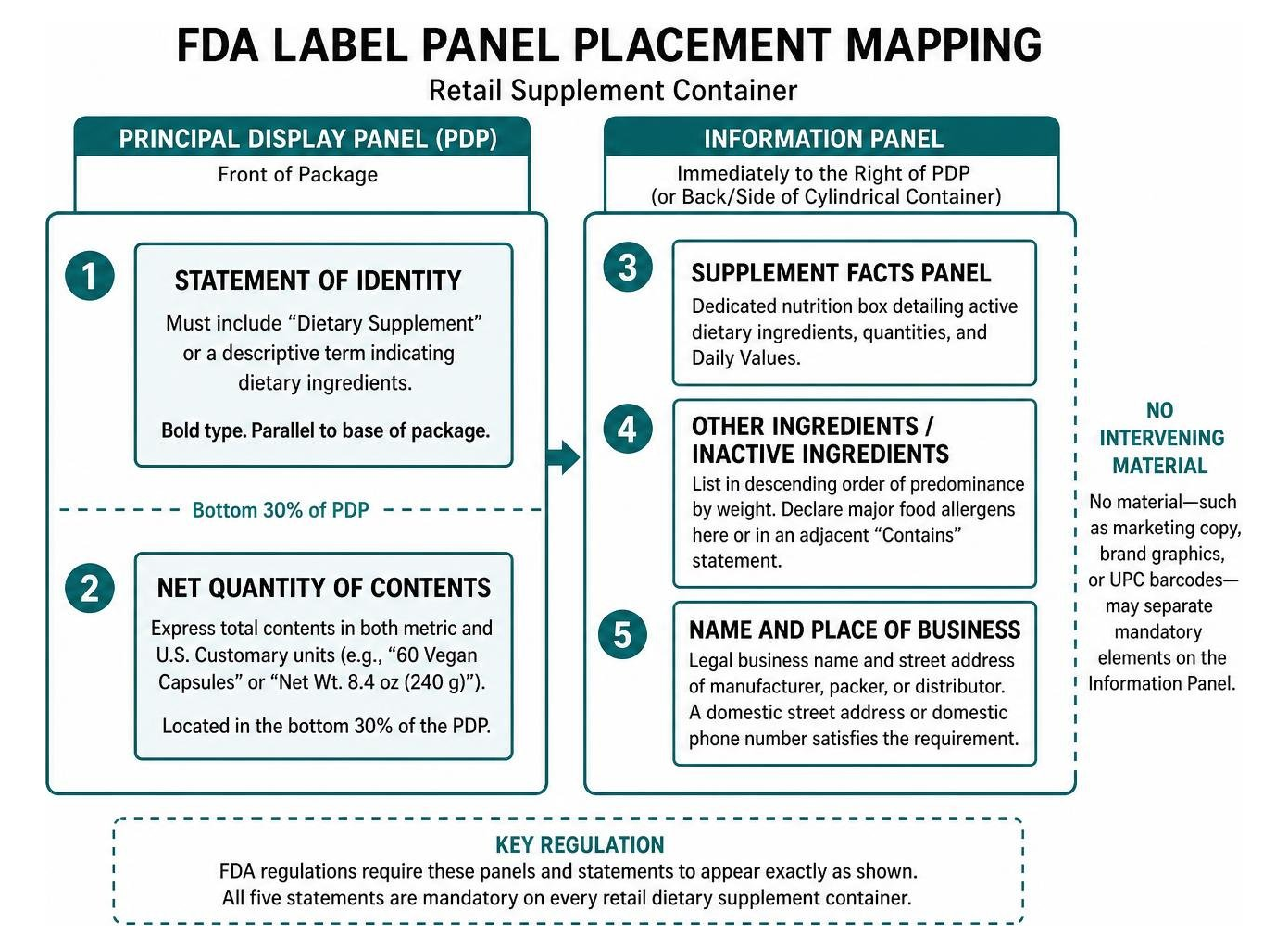
Designing compliant supplement packaging requires placing specific legal statements on the correct package panels. The FDA divides retail packaging into two primary areas: the Principal Display Panel (PDP) and the Information Panel.
The PDP is the front of the package that consumers see on store shelves or in primary product listings. The Information Panel sits immediately to the right of the PDP (or on the back/side of cylindrical containers). Under FDA regulations, no intervening material—such as marketing copy, brand graphics, or UPC barcodes—may separate mandatory elements on the Information Panel.
Following established industry labeling standards ensures these panels work together seamlessly.
Mandatory Label Statements and Panel Placement
Every retail supplement container must present five fundamental statements across its panels:
- Statement of Identity (PDP): Must clearly identify the product using the term “Dietary Supplement” or a descriptive term indicating the dietary ingredients (e.g., “Herbal Supplement” or “Vitamin C Dietary Supplement”). It must appear in bold type parallel to the base of the package.
- Net Quantity of Contents (PDP): Located in the bottom 30 percent of the PDP, expressing total contents in both metric and U.S. Customary units (e.g., “60 Vegetarian Capsules” or “Net Wt. 8.4 oz (240 g)”). For cylindrical containers, the PDP area is calculated as 40 percent of the height multiplied by the circumference.
- Supplement Facts Panel (Information Panel): The dedicated nutrition box detailing active dietary ingredients, quantities, and Daily Values.
- Other Ingredients / Inactive Ingredients (Information Panel): Listed directly beneath or adjacent to the Supplement Facts box in descending order of predominance by weight. Major food allergens (milk, eggs, fish, crustacean shellfish, tree nuts, peanuts, wheat, soybeans, and sesame) must be declared here or in an adjacent “Contains” statement.
- Name and Place of Business (Information Panel): The legal business name and street address of the manufacturer, packer, or distributor. A domestic street address or a domestic phone number satisfies the requirement for adverse event reporting under the Dietary Supplement and Nonprescription Drug Consumer Protection Act.
Understanding Structure-Function Claims and Disclaimers
Supplement brands frequently describe how their products support physiological wellness. These statements fall under three distinct regulatory claim categories:
- Structure/Function Claims: Describe how an ingredient affects or maintains the structure or function of the human body (e.g., “Supports joint flexibility” or “Promotes restful sleep”). These do not require pre-approval, but the brand must possess scientific substantiation that the claim is truthful and not misleading.
- Disease Claims (Prohibited): Explicit or implicit claims to diagnose, treat, cure, mitigate, or prevent a disease (e.g., “Treats osteoarthritis” or “Cures insomnia”). Making disease claims causes the supplement to be legally classified and regulated as an unapproved new drug.
- Nutrient Content & Health Claims: Claims describing nutrient levels (e.g., “High in Vitamin C”) or FDA-authorized relationships between a substance and disease risk (e.g., calcium and osteoporosis), which must meet explicit statutory criteria.
If you make a structure/function claim on your packaging, you must meet two non-negotiable requirements:
- Mandatory Disclaimer: The statement must be accompanied by the exact statutory text, linked by an asterisk or prominent marker: “This statement has not been evaluated by the Food and Drug Administration. This product is not intended to diagnose, treat, cure, or prevent any disease.” The disclaimer must appear inside a boxed boundary or be set apart with distinct typography to ensure prominence.
- 30-Day FDA Notification: Under Section 403(r)(6) of the FD&C Act, brand owners must submit written notification to the FDA within 30 days after first marketing the product bearing the structure/function claim.
Supplement Facts Label FDA Guidelines: Step-by-Step Formatting
Formatting your panel according to federal guidelines requires strict adherence to graphic and typographic rules codified in 21 CFR § 101.36 requirements. The Supplement Facts panel must be enclosed within a distinct hairline box border and set in black or single-color ink on a high-contrast white or neutral background.
Typography and Layout Rules Under Supplement Facts Label FDA Guidelines
A compliant panel requires precise typographic hierarchy, leading, and rule weights:
- Panel Title: “Supplement Facts” must appear in the largest type size on the panel, spanning the width of the box in bold type.
- General Body Type: All nutrient names, quantitative amounts, and percentages must be set in at least 8-point font with at least 1 point of leading (line spacing) so characters do not touch.
- Headings and Footnotes: Column headers (such as “Amount Per Serving” and “% Daily Value”) and bottom footnotes may be reduced to a minimum of 6-point type.
- Dividing Bars: A heavy horizontal bar (7 points thick) must separate the serving information from the active ingredient listings, and another heavy bar must appear directly beneath the last listed dietary ingredient before the footnotes. Light hairline rules separate individual ingredient lines.
- Calories and Servings: “Calories,” when required to be declared, should appear at the top of the nutrient list but does not need to be bolded. “Serving Size” and “Servings Per Container” must appear at the top of the Supplement Facts panel, using appropriate consumer units (e.g., “2 Capsules,” “1 Scoop (10 g)”).
Listing (b)(2) Nutrients and (b)(3) Other Dietary Ingredients
The FDA categorizes dietary ingredients into two groups, each subject to different structural rules:
1. (b)(2) Dietary Ingredients (Nutrients with Established RDIs or DRVs)
These include calories, total fat, carbohydrates, dietary fiber, added sugars, protein, vitamins, and minerals. When present at measurable levels, vitamins and minerals must follow a strictly mandated listing order:
Vitamin A → Vitamin C → Vitamin D → Vitamin E → Vitamin K → Thiamin → Riboflavin → Niacin → Vitamin B6 → Folate → Vitamin B12 → Biotin → Pantothenic Acid → Choline → Calcium → Iron → Phosphorus → Iodine → Magnesium → Zinc → Selenium → Copper → Manganese → Chromium → Molybdenum → Chloride → Sodium → Potassium → Fluoride
Quantitative amounts for vitamins and minerals must represent the elemental weight of the active nutrient (e.g., 500 mg Calcium), not the gross weight of the compound (e.g., 1,250 mg Calcium Carbonate). If you need help calculating elemental values and formatting your layout, review our step-by-step labeling tutorials.
2. (b)(3) Other Dietary Ingredients (Nutrients Without Established Daily Values)
Botanicals, amino acids, enzymes, and bioactives lacking an established Reference Daily Intake (RDI) or Daily Reference Value (DRV) must be listed below the heavy horizontal bar that follows the (b)(2) nutrients.
These ingredients must state:
- The common or usual name.
- The quantitative amount per serving by weight (metric units).
- A symbol (such as an asterisk
*) in the “% Daily Value” column that references the mandatory footnote:* Daily Value not established.
Rules for Proprietary Blends and Source Ingredients
Many dietary supplements feature custom formulas marketed as proprietary blends. Under 21 CFR 101.36(c), proprietary blends allow manufacturers to protect confidential formulation ratios while maintaining consumer transparency.
To declare a proprietary blend correctly:
- List the blend under a descriptive name or the term “Proprietary Blend”.
- State the total quantitative weight of the combined blend on the main line.
- Indent the individual dietary ingredients directly beneath the blend title in descending order of predominance by weight.
- Place an asterisk in the % Daily Value column pointing to “Daily Value not established.”
- If the blend contains (b)(2) nutrients (like Vitamin C), those nutrients cannot be hidden inside the blend total; their individual elemental weights and % DVs must be declared explicitly on separate lines.
For botanical ingredients, identify the standardized common name (SCN), Latin binomial, and specific plant part used. For botanical extracts, the ingredient declaration should follow the appropriate naming sequence and include the standardization and extract ratio, when applicable: SCN (Latin binomial) (plant part) extract (standardization) (ratio).
Example: Ashwagandha (Withania somnifera) (root) extract (5% withanolides) (10:1).
Source ingredients can be declared directly inside the panel in parentheses immediately after the nutrient name—for example, Vitamin C (as ascorbic acid) or Calcium (as calcium carbonate). Declaring source forms parenthetically within the panel eliminates the need to repeat those active ingredients in the “Other Ingredients” section below the box.
Modern Regulatory Updates and Packaging Exemptions
Packaging formats vary from large protein powder tubs to single-serve sachets and compact travel bottles. The FDA provides specific layout allowances depending on total available labeling surface area.
| Package Classification | Surface Area Threshold | Minimum Font Size Rules | Permitted Layout Modifications |
|---|---|---|---|
| Standard Packaging | > 40 sq. in. | 8 pt body / 6 pt footnotes | Standard vertical box format; full linear rules |
| Intermediate Packaging | 12 to 40 sq. in. | 6 pt (4.5 pt if >16 ingredients on 20–40 sq. in.) | Tabular (horizontal) display; two-column layouts |
| Small Packaging | < 12 sq. in. | 4.5 pt body and footnotes | All-uppercase text allowed; linear layout; panel omission permitted if phone/website provided (and no claims made) |
Small and Intermediate Package Supplement Facts Label FDA Guidelines
When designing labels for space-constrained containers, brand owners can leverage specialized regulatory exemptions:
- Packages Under 12 Square Inches: May use a continuous linear string format (running text separated by bullets or slashes) instead of a structured vertical box. All-uppercase lettering is permitted across the panel. If no nutrition, structure/function, or health claims are made anywhere on the packaging, the Supplement Facts panel may be omitted entirely from the immediate container, provided an address, phone number, or website is supplied for consumers to request nutrition details.
- Intermediate Packages (12 to 40 Square Inches): When vertical height is limited, panels may be displayed in a tabular format (side-by-side columns separating nutrients and amounts). Type sizes may be reduced to 6-point font, or 4.5-point font for formulas containing more than 16 dietary ingredients on packages between 20 and 40 square inches.
The 2016 Labeling Overhaul and Unit Conversions
The FDA’s comprehensive nutrition labeling revisions modernized nutrient values and standard units of measure across all dietary supplements. You can explore further regulatory analysis and regulatory updates on our blog alongside the official Subpart C nutrition guidelines.
Key changes that impact modern supplement facts panels include:
- Required Nutrient Declarations: Vitamin D, potassium, and added sugars replaced vitamin A, vitamin C, and calories from fat among the nutrients required to be declared under the updated requirements. Vitamin A and vitamin C may be declared voluntarily unless their declaration is otherwise required, such as when a claim is made about the nutrient.
- Added Sugars: Added sugars must be declared when applicable and appear beneath Total Sugars in the required nutrient listing order.
- Updated Units of Measure: FDA updated the units of measure for folate, niacin, vitamin A, vitamin D, and vitamin E.
- Vitamin A: Declared in micrograms (mcg) of Retinol Activity Equivalents (RAE), rather than International Units (IU).
- Vitamin D: Declared in micrograms (mcg), rather than IU. The equivalent amount in IU may also be declared voluntarily in parentheses following the mcg declaration.
- Vitamin E: Declared in milligrams (mg) of alpha-tocopherol rather than IU.
- Folate: Declared in micrograms of Dietary Folate Equivalents (mcg DFE). When folic acid is added or a claim is made about folate, the amount of folic acid must also be declared parenthetically in micrograms (mcg).
- Niacin: The Daily Value is based on Niacin Equivalents (NE), while the quantitative amount declared on the Supplement Facts panel is expressed in milligrams (mg).
Quality Control, CGMP Compliance, and FDA Submissions
A compliant label design is only half the battle. Under 21 CFR Part 111 (Current Good Manufacturing Practices for Dietary Supplements), label control is a critical quality assurance operation.

21 CFR Part 111 Label Verification and Batch Control
Under CGMP regulations, supplement brand owners and contract manufacturers must maintain strict operational controls around packaging and label management:
- Master Manufacturing Records (MMRs): Every product formulation must have an MMR that includes an exact, approved copy of the product label.
- Label Revision Control: Quality Control (QC) units must assign distinct version numbers to label artwork to prevent outdated panels from entering production.
- Incoming Label Inspection: Printed label rolls and cartons must be quarantined and verified against approved physical proofs before being released to the packaging line.
- Batch Reconciliation: Manufacturing teams must reconcile the number of labels issued against the number of finished units produced to detect packaging mix-ups. Learn more about our labeling background and how we help brands maintain audit-ready documentation.
NDI 75-Day Notifications and the Dietary Supplement Label Database
Before marketing a dietary supplement containing a New Dietary Ingredient (NDI)—defined as any dietary ingredient not marketed in the United States prior to October 15, 1994—manufacturers must submit an NDI notification to the FDA at least 75 days prior to introducing the product into interstate commerce. The submission must document the safety history and scientific evidence substantiating that the ingredient is reasonably expected to be safe under its labeled conditions of use.
The Dietary Supplement Label Database (DSLD), developed by the NIH Office of Dietary Supplements with input from federal partners, is a publicly available database containing information from more than 200,000 dietary supplement labels marketed in the United States. The database includes both currently marketed and off-market products and provides information such as label images, ingredient names and forms, amounts of dietary ingredients, serving information, and other statements appearing on product labels. The DSLD can be used to research and compare dietary supplement label information, but inclusion in the database does not indicate FDA approval or demonstrate that a product or its labeling complies with applicable regulatory requirements.
Frequently Asked Questions About Supplement Labeling
Do dietary supplements need FDA pre-market approval?
No. Under DSHEA, dietary supplements are regulated as a specialized category of food rather than pharmaceutical drugs. They do not require FDA pre-market evaluation or approval before entering retail distribution. However, brand owners are legally responsible for ensuring that their products, labels, and manufacturing facilities comply fully with all applicable provisions of 21 CFR Part 101 and 21 CFR Part 111.
Where do inactive ingredients and excipients belong on the label?
Ingredients that are not dietary ingredients, such as capsule components, binders, fillers, flow agents, colors, flavors, and other excipients, are generally declared outside the Supplement Facts panel in an ingredient statement, commonly presented as “Other Ingredients.” These ingredients are generally listed in descending order of predominance by weight.
How is serving size determined for dietary supplements?
For dietary supplements, serving size is based on the maximum amount recommended on the label for consumption per eating occasion. For example, if the directions state “Take 2 capsules twice daily,” the serving size is 2 capsules, because two capsules are recommended for each eating occasion, rather than four capsules representing the total daily intake. Serving size should be expressed using an appropriate unit for the product, such as tablets, capsules, packets, teaspoonfuls, or other suitable measures.
Conclusion
Navigating the landscape of FDA dietary supplement labeling requires precision at every step—from elemental nutrient calculations and proprietary blend formatting to CGMP batch reconciliation. Overlooking a single typographic rule or failing to declare an allergen can lead to costly product recalls, warning letters, and brand erosion.
At Panelgea, we eliminate the complexity of dietary supplement labeling. Our automated SaaS platform simplifies panel generation with integrated 21 CFR 101.36 formatting rules, automatic allergen detection, and instant export to production-ready, editable vector formats.
Ensure your products are shelf-ready and fully compliant from day one—generate FDA-compliant supplement facts labels with Panelgea today.