
What Brands Need to Know About Nutrition Facts Label Requirements
1. Core FDA Nutrition Facts Label Requirements for US Packaged Foods
Federal nutrition facts label requirements mandate that US packaged food labels declare 14 core nutrients, base serving sizes on Reference Amounts Customarily Consumed (RACCs), and follow strict visual typography and rounding rules. Codified under 21 CFR 101.9, these regulations establish exact standards for nutrient declarations, graphic hierarchy, and panel placement. For manufacturers, referencing the official FDA Food Labeling Guide is essential to ensure that baseline Reference Daily Intakes (RDIs) and Daily Reference Values (DRVs)—calculated against a standardized 2,000-calorie reference diet—remain fully compliant across retail channels. While the statutory foundation rests on the landmark Nutrition Labeling and Education Act (NLEA) of 1990, the FDA overhauled this framework in 2016 to align with modern public health research.
Mandatory Nutrients Under Nutrition Facts Label Requirements
Under the updated provisions of 21 CFR 101.9, the FDA mandates the declaration of 14 core nutrients alongside total caloric value. These nutrients must appear in an exact sequence:
- Total Fat (in grams and % DV)
- Saturated Fat (in grams and % DV)
- Trans Fat (in grams; no % DV established)
- Cholesterol (in milligrams and % DV)
- Sodium (in milligrams and % DV)
- Total Carbohydrate (in grams and % DV)
- Dietary Fiber (in grams and % DV)
- Total Sugars (in grams; no % DV established)
- Added Sugars (indented beneath Total Sugars, in grams and % DV)
- Protein (in grams; % DV required only if a protein claim is made or if the product is intended for infants and young children)
- Vitamin D (in micrograms and % DV)
- Calcium (in milligrams and % DV)
- Iron (in milligrams and % DV)
- Potassium (in milligrams and % DV)
Voluntary nutrients (such as soluble fiber, insoluble fiber, sugar alcohols, or other essential vitamins and minerals) may be added beneath potassium, but once declared—or if a marketing claim is made about them—they become subject to mandatory formatting and testing thresholds.
Typography, Layout, and Information Panel Rules
The graphic design of a Nutrition Facts panel is strictly regulated. The FDA mandates distinct visual elements to prevent deceptive practices and maintain legibility across packaging formats:
- Minimum Type Size: The smallest lettering anywhere within the panel must be at least 1/16th of an inch (1.5875 mm) tall, measured by the height of a lowercase letter “o”.
- Visual Prominence: “Calories” must appear in large, bold font (typically at least 16-point font on standard packages, with the numerical calorie value set at 22-point bold or larger). “Nutrition Facts” must be set in the largest title font, and “Serving size” must be bolded.
- Separators and Hairline Rules: The panel relies on a hierarchy of line weights, including 0.5-point hairline rules separating individual nutrients, a 3-point rule below the serving size information, and a heavy 7-point bar separating calories from nutrient listings.
- Panel Placement and Intervening Material: Under 21 CFR 101 General Provisions, the Nutrition Facts panel must reside on either the Principal Display Panel (PDP) or the Information Panel (the area immediately contiguous and to the right of the PDP). Non-mandatory graphics, marketing copy, and UPC barcodes are strictly prohibited from being inserted between mandatory elements on the Information Panel.
2. Serving Size Standards, RACCs, and Dual-Column Mandates
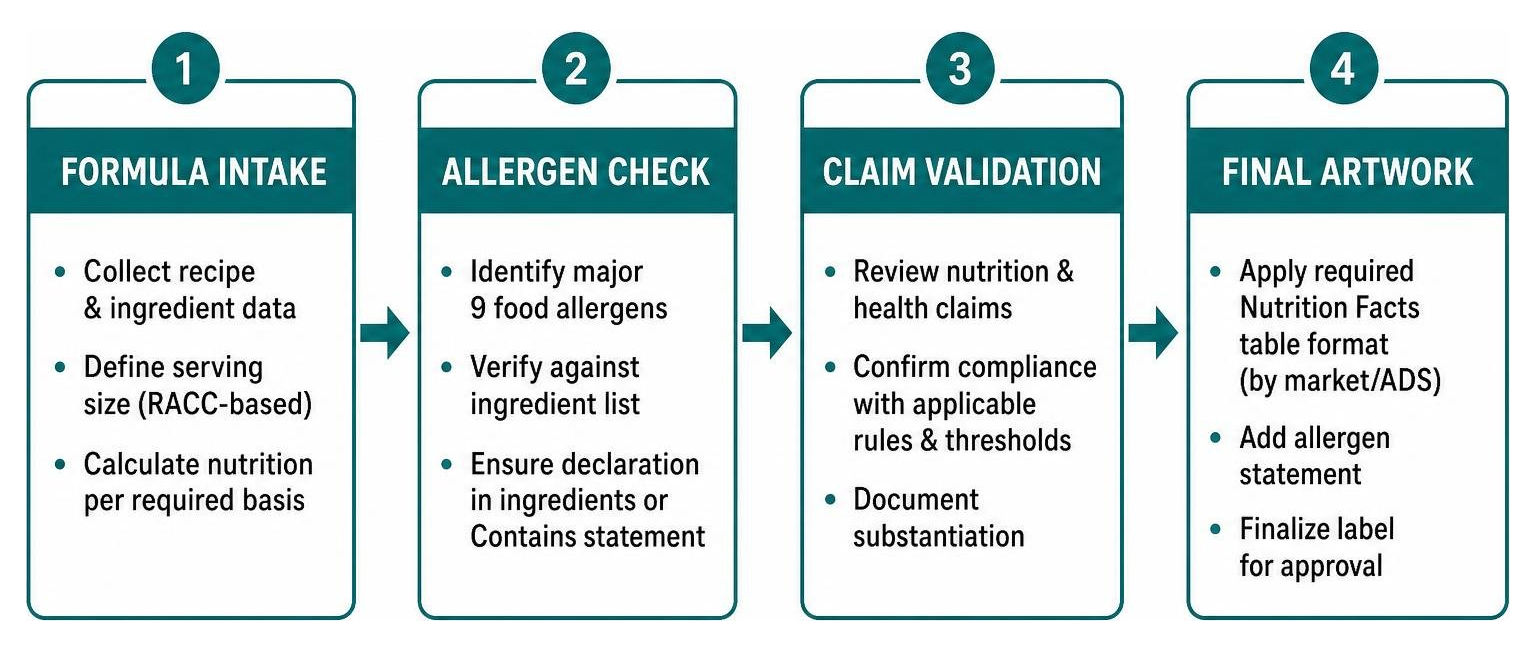
Serving sizes are not marketing suggestions; they are legally bound to Reference Amounts Customarily Consumed (RACCs) outlined in 21 CFR 101.12. When the FDA issued its comprehensive overhaul in the Federal Register 2016 Final Rule, it updated RACCs across dozens of food categories to reflect actual modern eating habits rather than aspirational portions.
To prevent errors, modern CPG teams choose to build accurate nutrition labels fast by automating RACC portion formulas, dual-column triggers, and household measure conversions directly from their base recipe data.
Single-Serving Containers and Household Unit Hierarchy
If an individual package contains less than 200% of the applicable RACC, federal law dictates that the entire container must be labeled as a single serving. For example, because the RACC for carbonated soft drinks is 12 fluid ounces (360 mL), a 20-ounce (591 mL) bottle contains roughly 167% of the RACC and must be declared as a single serving: “1 bottle”.
Serving sizes must follow a strict household unit hierarchy:
- Common Household Measures: Standard cups, tablespoons, or teaspoons (or fractional increments such as 1/4 cup or 1/2 tsp).
- Discrete Units: Natural units such as “1 slice,” “2 cookies,” or “1 piece” for solid items, followed by the parenthetical metric weight (e.g.,
1 slice (28g)). - Metric Conversions: Liquid measures must pair fluid ounces with milliliters (e.g.,
1 cup (240 mL)or1 fl oz (30 mL)). Solid measures must pair ounces with grams (e.g.,1 oz (28 g)).
Mandatory Dual-Column Labeling Triggers
Under 21 CFR § 101.9 e-CFR, packaged foods that contain at least 200% and up to and including 300% of the applicable RACC must present a dual-column panel.
The first column lists the nutrient breakdown “Per Serving” based on the RACC, while the second column shows the complete nutritional payload “Per Unit” or “Per Package”. This rule ensures consumers purchasing grab-and-go snack bags, pint ice creams, or multi-serving canned soups can evaluate both the baseline dietary metric and the full caloric consequence of consuming the entire container in one sitting.
3. Caloric Calculations, Sugar Alcohols, and Mathematical Rounding
Caloric values are computed using either specific Atwater factors, general 4-4-9 caloric factors (4 kcal/g for protein and carbohydrates, 9 kcal/g for fat), bomb calorimetry minus protein corrections, or verified laboratory assays. Non-digestible soluble carbohydrates are assigned a caloric factor of 2 kcal/g, while sugar alcohols have distinct, regulated caloric densities (e.g., erythritol is assigned 0 kcal/g, whereas xylitol is 2.4 kcal/g, maltitol is 2.1 kcal/g, and sorbitol is 2.6 kcal/g).
Rounding rules introduce mathematical nuances across every nutrient tier:
| Nutrient Category | Reported Range | FDA Permitted Rounding Rule |
|---|---|---|
| Calories | < 5 kcal | Express as 0 |
| 5 – 50 kcal | Round to nearest 5 kcal increment | |
| > 50 kcal | Round to nearest 10 kcal increment | |
| Total Fat / Saturated Fat | < 0.5 g | Express as 0 g |
| 0.5 g – < 5 g | Round to nearest 0.5 g increment | |
| ≥ 5 g | Round to nearest 1 g increment | |
| Trans Fat | < 0.5 g | Express as 0 g |
| ≥ 0.5 g | Round to nearest 0.5 g increment | |
| Sodium / Potassium | < 5 mg | Express as 0 mg |
| 5 – 140 mg | Round to nearest 5 mg increment | |
| > 140 mg | Round to nearest 10 mg increment | |
| Carbohydrates / Sugars / Protein | < 0.5 g | Express as 0 g |
| 0.5 g – < 1 g | Express as “Contains less than 1 g” or round to 1 g | |
| ≥ 1 g | Round to nearest 1 g increment |
Fat Rounding and the 0.5g Trans Fat Threshold
A well-known nuance of FDA rounding occurs with fat content. If a single serving contains less than 0.5 grams of trans fat or saturated fat, the label declares it as 0 g (provided no nutrient content claims are made on the package).
If a multi-serving container contains 0.45 g of trans fat per serving and contains 18 servings, the label will state 0 g of trans fat per serving, even though the total product delivers 8.1 grams of cumulative trans fat. If zero-level nutrients are omitted on simplified layouts, manufacturers must include the disclaimer: “Not a significant source of trans fat.”
Added Sugars and Two-Year Recordkeeping Protocols
The 2016 mandate established a 10% Daily Reference Value (50 grams per day on a 2,000-calorie diet) for added sugars. Because standard analytical laboratory tests (such as HPLC sugar profiles) cannot chemically distinguish between naturally occurring monosaccharides and those introduced via high-fructose corn syrup, honey, or fruit juice concentrates, the FDA enforces compliance through manufacturing records.
Under 21 CFR 101.9(g)(10), manufacturers must maintain written formulation, production, and batch records for at least two years after the product enters interstate commerce. This is critical for fermented products (such as kombucha or sourdough bread) and baked goods subject to non-enzymatic browning (Maillard reaction), where added sugars degrade during processing.
4. Specialty Categories, Claims, and Small Business Exemptions
Labeling rules extend beyond standard FDA-regulated packaged goods. Navigating multi-agency jurisdictions requires careful oversight of shared boundaries:
- Meat and Poultry (USDA-FSIS): Products containing more than 2% cooked poultry or 3% raw meat fall under the jurisdiction of the USDA’s Food Safety and Inspection Service (FSIS). While FSIS harmonized its nutrition panel format with the FDA’s 2016 updates, meat labels often require prior label approval or strict compliance with specific generic labeling guidelines.
- Allergen Declarations: Under the Food Allergen Labeling and Consumer Protection Act (FALCPA) and the FASTER Act, manufacturers must declare the major 9 food allergens (milk, eggs, fish, crustacean shellfish, tree nuts, wheat, peanuts, soybeans, and sesame) using plain language within the ingredient statement or in a dedicated “Contains” statement.
- For brands balancing cross-agency filings and complex recipe portfolios, engaging expert labeling consulting provides the regulatory support needed to prevent misbranding.
Alcohol, Caffeine, and Inter-Agency Jurisdiction
Alcoholic beverages are regulated primarily by the Department of the Treasury’s Alcohol and Tobacco Tax and Trade Bureau (TTB), not the FDA. As a result, wines (above 7% ABV), malt beverages, and distilled spirits are exempt from mandatory Nutrition Facts panels, though the TTB permits voluntary “Statements of Nutritional Aspects” (declaring calories, carbs, protein, and fat per serving).
For caffeine-containing foods and sodas, added caffeine must be declared in the ingredient list, but quantitative milligram declarations remain voluntary under current federal law.
Nutrient Content Claims, Health Claims, and Small Business Rules
Making a label claim introduces specific regulatory requirements:
- Nutrient Content Claims: Descriptors such as “Low Fat” (≤ 3g fat per RACC), “High Fiber” (≥ 20% DV), or “Sodium Free” (< 5mg sodium per RACC) are strictly defined by 21 CFR 101.13 and trigger mandatory nutrition disclosures.
- FDA Authorized Health Claims: Requires Significant Scientific Agreement (SSA) to state a relationship between a substance and disease risk (e.g., soluble fiber and coronary heart disease risk).
- Small Business Exemptions: Under the Small Business Nutrition Labeling Exemption, food manufacturers with fewer than 100 full-time equivalent employees that produce fewer than 100,000 units of a specific product annually in the US are exempt from mandatory nutrition labeling—provided the label makes no nutrient content claims, health claims, or other nutritional marketing statements.
Frequently Asked Questions About Nutrition Facts Label Requirements
What are the 14 mandatory nutrients required on a US Nutrition Facts label?
The 14 mandatory nutrients that must be listed on a standard FDA Nutrition Facts panel are Total Fat, Saturated Fat, Trans Fat, Cholesterol, Sodium, Total Carbohydrate, Dietary Fiber, Total Sugars, Added Sugars, Protein, Vitamin D, Calcium, Iron, and Potassium.
When is a food manufacturer legally required to use dual-column labeling?
A food manufacturer must use dual-column labeling when an individually packaged product contains between 200% and 300% of the Reference Amount Customarily Consumed (RACC). The label must display one column for the single-serving RACC amount and a second column showing the nutritional values for the entire package.
Why does a product with 0g trans fat on the label still contain trans fat?
Under FDA rounding rules, if a single serving contains less than 0.5 grams of trans fat, the manufacturer must declare it as “0 g” on the label. To confirm whether trans fat is present in trace amounts, consumers can check the ingredient list.
Conclusion: Mastering Food Label Compliance at Scale
Managing label compliance across growing product catalogs requires precision. Between tracking updated RACCs, applying exact rounding thresholds, verifying allergen statements, and monitoring international front-of-package mandates, manual label design carries significant regulatory risk.
At Panelgea®, we simplify this process by automating compliant Nutrition Facts and Supplement Facts creation for US foods, beverages, and dietary supplements. It is so easy, it is so easy your Agentic AI Agent can do it for you. By connecting directly with verified USDA nutrient databases, running instant conflict checks on proprietary blends, and generating print-ready, editable vector SVG artwork, we help food brands scale with confidence and stay fully compliant.