

Federal food allergen labeling requirements center on the mandatory identification of the nine major food allergens recognized by U.S. law. Under the Food Allergen Labeling and Consumer Protection Act (FALCPA) and the FASTER Act, packaged foods must declare milk, eggs, peanuts, tree nuts, wheat, fish, crustacean shellfish, soybeans, and sesame using plain English source names. Allergens must appear either parenthetically within the ingredient list or in a dedicated “Contains” statement, with no safe exposure threshold permitted for intentionally added allergenic proteins.
For the more than 33 million Americans living with food allergies—including nearly 6 million children under the age of 18—every meal requires vigilance. Epidemiological data indicates that nearly 11 percent of U.S. adults (10.8 percent) have a convincing food allergy, while nearly 19 percent believe they react adversely to certain foods. Every 10 seconds, a food allergy reaction sends someone in the U.S. to the emergency room.
Because there is no cure for food allergies, strict dietary avoidance is the primary defense against potentially life-threatening anaphylaxis. This reality places a massive responsibility on consumer packaged goods (CPG) brands, commercial kitchens, and ingredient processors.
When food labels are inaccurate or ambiguous, the consequences are immediate. Undeclared allergens represent the leading cause of food product recalls in the United States, historically accounting for up to 46 percent of all recalls reported in single quarters. For food manufacturers and label designers, mastering federal labeling rules is not just a regulatory obligation under the U.S. Food and Drug Administration (FDA)—it is a core public safety baseline.
Understanding Federal Food Allergen Labeling Requirements and the Big 9
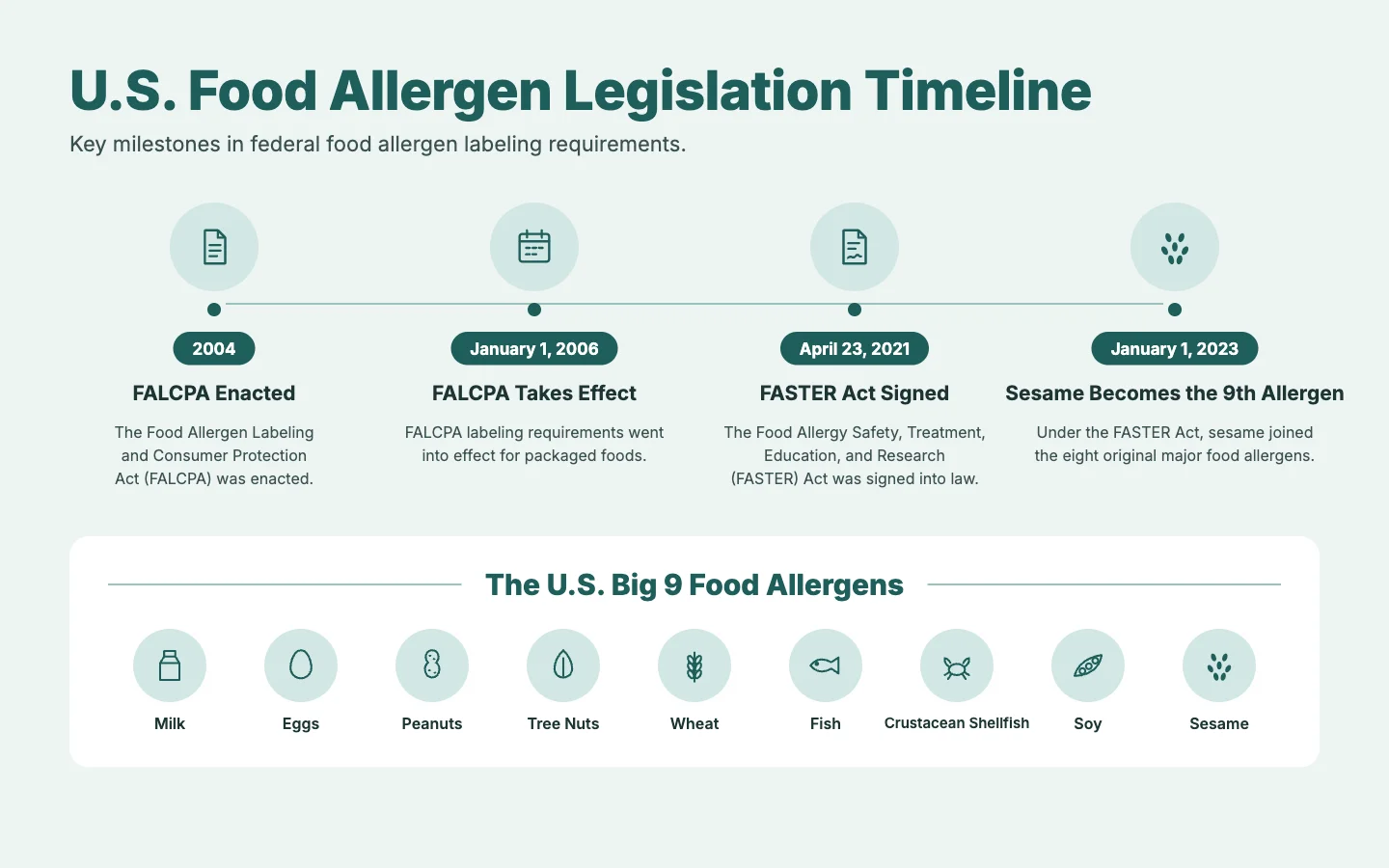
The modern regulatory landscape for allergen disclosure began with the passage of the Food Allergen Labeling and Consumer Protection Act (FALCPA) of 2004, which took effect on January 1, 2006. FALCPA established clear statutory rules requiring that packaged foods regulated under the Federal Food, Drug, and Cosmetic (FD&C) Act declare the presence of major food allergens using plain, common English names.
Congress established FALCPA because the eight original food groups accounted for roughly 90 percent of all documented food allergies and serious allergic reactions in the United States.
The framework expanded significantly on April 23, 2021, when the Food Allergy Safety, Treatment, Education, and Research (FASTER) Act was signed into law. Effective January 1, 2023, the FASTER Act officially declared sesame as the ninth major food allergen.
As detailed in the official FDA Food Allergies Overview, the FDA enforces strict zero-threshold policies: federal law does not establish safe exposure limits or minimum thresholds for major allergens. If an allergenic protein from one of the designated food sources is intentionally added to a product—even in trace amounts—it must be properly declared.

The following table summarizes the “Big 9” major food allergens, their allowable statutory source terms, typical derivatives, and mandatory declaration rules:
| Major Allergen | Statutory Common/Usual Name | Common Derivatives & Synonyms | Specific Declaration Rules |
|---|---|---|---|
| Milk | Milk | Whey, casein, caseinates, sodium caseinate, lactalbumin, ghee, curds, butter | Must state “Milk” plainly; non-cow sources (e.g., goat milk, sheep milk) must also declare “milk” (e.g., “goat milk”). |
| Eggs | Egg | Albumin/ovalbumin, egg yolk, egg whites, lysozyme, mayonnaise, meringue | Must use the term “Egg” or “Eggs”; non-chicken eggs (e.g., duck, quail) must specify the avian species. |
| Peanuts | Peanut(s) | Peanut butter, peanut flour, hydrolyzed peanut protein, peanut meal | Must declare “Peanut” or “Peanuts”. Peanuts are legumes grown underground and are distinct from tree nuts. |
| Tree Nuts | Specific nut type (e.g., Almond, Walnut, Pecan, Cashew, Pistachio, Macadamia) | Nut pastes, nut butters, marzipan, nut flours, praline, nut milks | Generic term “tree nuts” is **not** permitted alone. The specific nut type must always be declared. Coconut is no longer considered a tree nut for allergen labeling (FDA Edition 5, 2025). |
| Wheat | Wheat | Spelt, durum, semolina, farina, emmer, einkorn, kamut, graham flour, bulgur | Any species of the genus Triticum must be declared using the common term “Wheat”. |
| Fish | Specific fish species (e.g., Cod, Salmon, Tuna, Bass, Tilapia, Pollock) | Fish sauce, surimi, gelatin, anchovy paste, fish oil containing residual protein | Generic term “fish” is not permitted alone. The specific common or usual species name must be explicitly declared. |
| Crustacean Shellfish | Specific crustacean species (e.g., Crab, Lobster, Shrimp, Prawn, Crawfish) | Shrimp paste, crab extract, lobster stock, crustacean-derived seafood flavorings | Generic term “shellfish” is not permitted alone. Must name the specific crustacean species. Excludes mollusks. |
| Soybeans | Soy, Soybean(s), or Soya | Tofu, edamame, soy protein isolate, soy lecithin, textured vegetable protein | The terms “soy”, “soybean”, “soybeans”, or “soya” are acceptable synonyms. Highly refined soy oil is exempt. |
| Sesame | Sesame | Tahini, sesame paste, sesame seed oil, benne/benne seed, gingelly | Must declare “Sesame,” even when present in “spices” or “natural flavors”—either parenthetically or in a “Contains” statement. |
The Evolution from the Big 8 to the Big 9
When FALCPA was drafted in 2004, clinical data supported eight primary allergen groups. Between 1997 and 2011, childhood food allergies rose by approximately 50 percent, with sesame allergy estimated to affect more than 1.5 million Americans (roughly 0.5 percent of the population).
Before the FASTER Act, sesame was often hidden under ambiguous label terms such as “spices”, “seasoning mix”, or “natural flavors.” Consumers with severe sesame allergies faced continuous uncertainty. Following the implementation of the FASTER Act in 2023 and reiterated in the FDA’s Guidance for Industry: Questions and Answers Regarding Food Allergen Labeling (Edition 5) published in January 2025, sesame now carries the exact same mandatory disclosure status as peanuts, milk, and wheat.
Specific Source Naming Rules for Species and Nut Types
A frequent compliance error involves using collective or broad category names rather than specific biological source designations. Under FALCPA and the FD&C Act, three major allergen categories require specific common or usual source naming:
- Tree Nuts: You cannot simply declare “Contains: Tree Nuts.” The label must list each specific nut present (e.g., almonds, pecans, walnuts, cashews, hazelnuts, macadamia nuts, pistachios, or pine nuts). Under FDA’s January 2025 guidance (Edition 5), only 12 tree nuts require allergen labeling; coconut, chestnut, shea nut, and several others were removed from the list, though they must still appear by their common names in the ingredient list.
- Fish: You cannot simply declare “Contains: Fish.” You must specify the precise market type of jawless, bony, or cartilaginous fish (e.g., Atlantic cod, salmon, albacore tuna, flounder, snapper).
- Crustacean Shellfish: The label must specify the exact crustacean variety (e.g., shrimp, blue crab, spiny lobster, crawfish). Molluscan shellfish (such as clams, oysters, and mussels) fall outside the mandatory statutory definition of crustacean shellfish, though manufacturers frequently declare them voluntarily.
To avoid missteps during packaging development, brands should review common ingredient declaration mistakes to ensure all compound ingredients and multi-species products conform strictly to source-naming mandates.
Mandatory Allergen Declarations vs. Precautionary Statements
The FDA permits two distinct methods for declaring major food allergens: parenthetically within the ingredient list, or in a separate “Contains” statement (both explained below).
When designing compliant labels, brands can reference the FDA Food Labeling Guide for specific layout requirements:
- Placement: Allergen information must appear on the same panel as the ingredient declaration—typically the Information Panel (immediately to the right of the Principal Display Panel, or PDP) or directly on the PDP itself.
- Type Size: Under 21 CFR 101.2, required label text, including ingredient lists and allergen statements, must generally use a minimum type size of at least one-sixteenth (1/16) inch in height (based on the lower-case letter “o”), though very small packages may qualify for a 1/32-inch minimum. The lettering must be prominent, conspicuous, and contrast clearly against the packaging background.
- No Intervening Material: The FDA strictly prohibits placing non-required text, graphic vignettes, promotional claims, or marketing slogans between the ingredient list and the “Contains” statement.
- All-Inclusive “Contains” Rule: If a brand chooses to use a “Contains” statement, that statement must list all major food allergens present in the product, even if those allergens are already named in the ingredient list. A brand may not selectively list some allergens in the ingredients and others solely in the “Contains” line.
For complex packaging layouts, reviewing general strategies for navigating FDA food labeling rules ensures visual clarity across all primary and secondary display panels.
“Contains” Statements vs. Parenthetical Ingredient Declarations
Choosing between parenthetical listing and a standalone “Contains” statement depends largely on label architecture:
- Parenthetical Format: Ideal when space is limited. The common food source is inserted in parentheses immediately following the technical ingredient name—for example, casein (milk), flour (wheat), or albumin (egg). If the common name of the allergen is already part of the ingredient name (e.g., “peanut butter” or “skim milk”), no parenthetical clarification is required.
- “Contains” Statement Format: Placed immediately below or adjacent to the ingredient list in equal prominence. The word “Contains” must be capitalized, followed by the specific allergen sources (e.g., “Contains: Almonds, Milk, Sesame, and Soy.”).
Incidental additives and processing aids that contain allergenic proteins—such as wheat starch dusting agents on conveyor belts or soy lecithin pan-release oils—are not exempt from major allergen labeling and must be captured through one of these two declaration formats.
Precautionary Allergen Labeling and Advisory Claims
Many food labels display advisory language such as:
- “May contain peanuts”
- “Manufactured in a shared facility that also processes tree nuts”
- “Packaged on equipment that handles milk and soy”
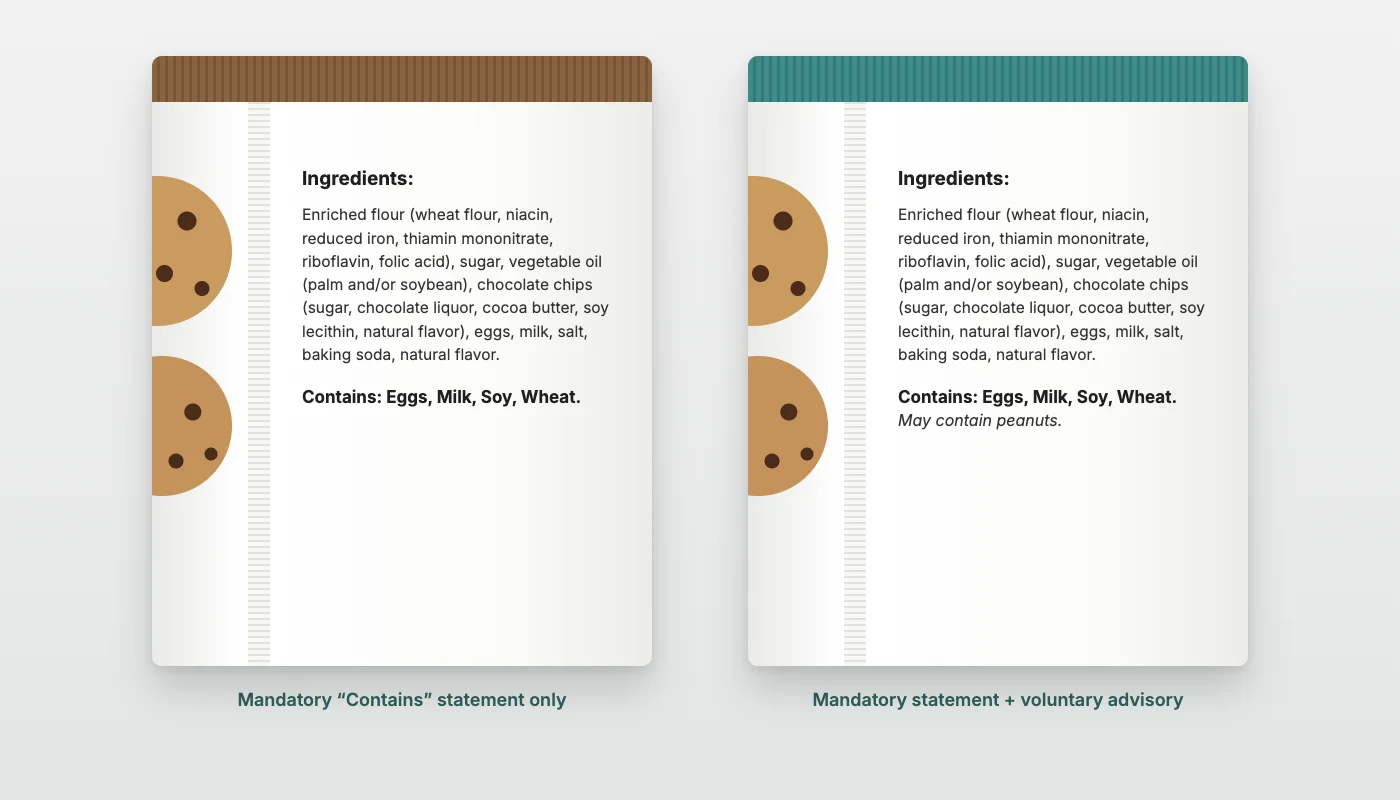
These warnings represent Precautionary Allergen Labeling (PAL). Unlike mandatory FALCPA disclosures, precautionary statements are entirely voluntary and are not formally standardized by the FDA.
However, under federal law, voluntary statements must be truthful and not misleading. Most importantly, the FDA has clarified that precautionary advisory statements must never be used as a substitute for Current Good Manufacturing Practices (CGMP).
A manufacturer cannot neglect thorough sanitation protocols and rely on a “may contain” statement to shield against regulatory liability. Precautionary labeling should only be used when unavoidable cross-contact remains possible despite strict compliance with preventive controls.
Brands evaluating advisory language should also review broader FDA warning label requirements to prevent conflicting or non-compliant on-pack statements.
Product Exemptions, Non-FALCPA Allergens, and Special Formulations
Federal allergen labeling rules vary depending on the governing agency and the nature of the agricultural or processed food item:
| Product Category | Governing Agency | Primary Regulatory Authority | Major Allergen Declaration Status |
|---|---|---|---|
| Packaged Foods & Beverages | FDA | FD&C Act / FALCPA / FASTER Act | Mandatory for Big 9 major allergens. Zero-threshold rule applies. |
| Dietary Supplements | FDA | FD&C Act / 21 CFR Part 111 | Mandatory across all dietary ingredients and inactive excipients. |
| Meat & Poultry Products | USDA FSIS | Federal Meat & Poultry Inspection Acts | FSIS strongly encourages FALCPA compliance; undeclared allergens prompt Class I FSIS recalls. |
| Processed Egg Products | USDA FSIS | Egg Products Inspection Act | Regulated by USDA; ingredient lists must disclose all formulation components clearly. |
| Alcoholic Beverages | TTB | Federal Alcohol Administration Act | Voluntary allergen disclosure rules; TTB alignment with FDA source naming conventions. |
| Raw Agricultural Commodities | FDA / USDA | Agricultural Marketing Act | Exempt from FALCPA labeling when sold in their raw, natural, unprocessed state. |
Non-FALCPA allergens—such as mustard, celery, molluscan shellfish, and lupin—cause significant clinical reactions worldwide and are mandated on food labels in the European Union (Canada also requires mustard and molluscs). However, under U.S. federal law, they are not classified as major food allergens. They generally appear by their common or usual names in the ingredient statement (though some, such as mustard seed, may legally fall under collective terms like “spices”), but they do not require special source-naming declarations or mandatory “Contains” inclusion.
Regarding gluten, the FDA established a formal gluten-free labeling standard in 2013 (21 CFR 101.91). While wheat is a major FALCPA allergen that must always be declared, a food carrying a voluntary “gluten-free,” “no gluten,” or “without gluten” claim must contain less than 20 parts per million (ppm) of gluten.
Applying Food Allergen Labeling Requirements to Supplements and Bulk Foods
Allergen mandates extend beyond traditional retail packaged foods:
- Dietary Supplements: Allergen labeling applies fully to dietary supplements. If a supplement contains an allergen within a proprietary blend, binder, capsule shell (e.g., fish gelatin), or filler (e.g., lactose), the source must be declared within the Supplement Facts panel, in the “Other ingredients” list, or in a “Contains” statement. When designing compliant supplement panels, brands must align with core nutrition facts label requirements.
- Bulk Food Containers: Bulk shipping containers, master cartons, and wholesale food packages distributed to institutional buyers, restaurants, or secondary processors must feature conspicuous allergen declarations on outer labels. Certain shipments for further processing may qualify for labeling exemptions under 21 CFR 101.100(d), so confirm requirements with each customer.
- Airline and Institutional Catering: Packaged snacks and meals served on commercial airlines and transport carriers fall squarely under FDA jurisdiction and must comply with all FALCPA and FASTER Act mandates.
- Biotechnology & Genetically Engineered Ingredients: When an engineered protein or novel crop ingredient is derived from one of the Big 9 allergens (e.g., a corn line engineered to express a peanut protein), the donor allergen source must be declared on the finished product label.
Highly Refined Oils and the FDA Exemption Petition Process
FALCPA explicitly exempts highly refined oils derived from major food allergens (such as highly refined peanut oil or highly refined soybean oil) and any ingredients derived from them. Clinical studies demonstrate that the industrial refining process—which includes degumming, neutralizing, bleaching, and deodorizing at high temperatures—removes allergenic proteins, rendering the finished oil safe for allergic individuals. Cold-pressed, expeller-pressed, or unrefined nut and seed oils, however, retain active proteins and must be declared.
Manufacturers may petition the FDA for an allergen labeling exemption if scientific testing confirms an ingredient contains no residual allergenic protein.
Under Section 403(w)(6) and (7) of the FD&C Act, companies can file an exemption petition showing that the ingredient does not cause an allergic response that poses a risk to human health, or submit a notification showing that the ingredient contains no allergenic protein (or that FDA has previously determined it does not cause an allergic response).
Ingredients like milk-derived lactose or butter-derived ghee must be labeled as containing “milk” unless FDA has accepted an exemption petition or notification for that specific ingredient.
FSMA Preventive Controls and Supply Chain Allergen Management
The Food Safety Modernization Act (FSMA) transformed allergen control from a reactive packaging check into an active, facility-wide preventive system. Under the Current Good Manufacturing Practice, Hazard Analysis, and Risk-Based Preventive Controls for Human Food rule (21 CFR Part 117), food facilities must establish and implement a written Food Safety Plan.
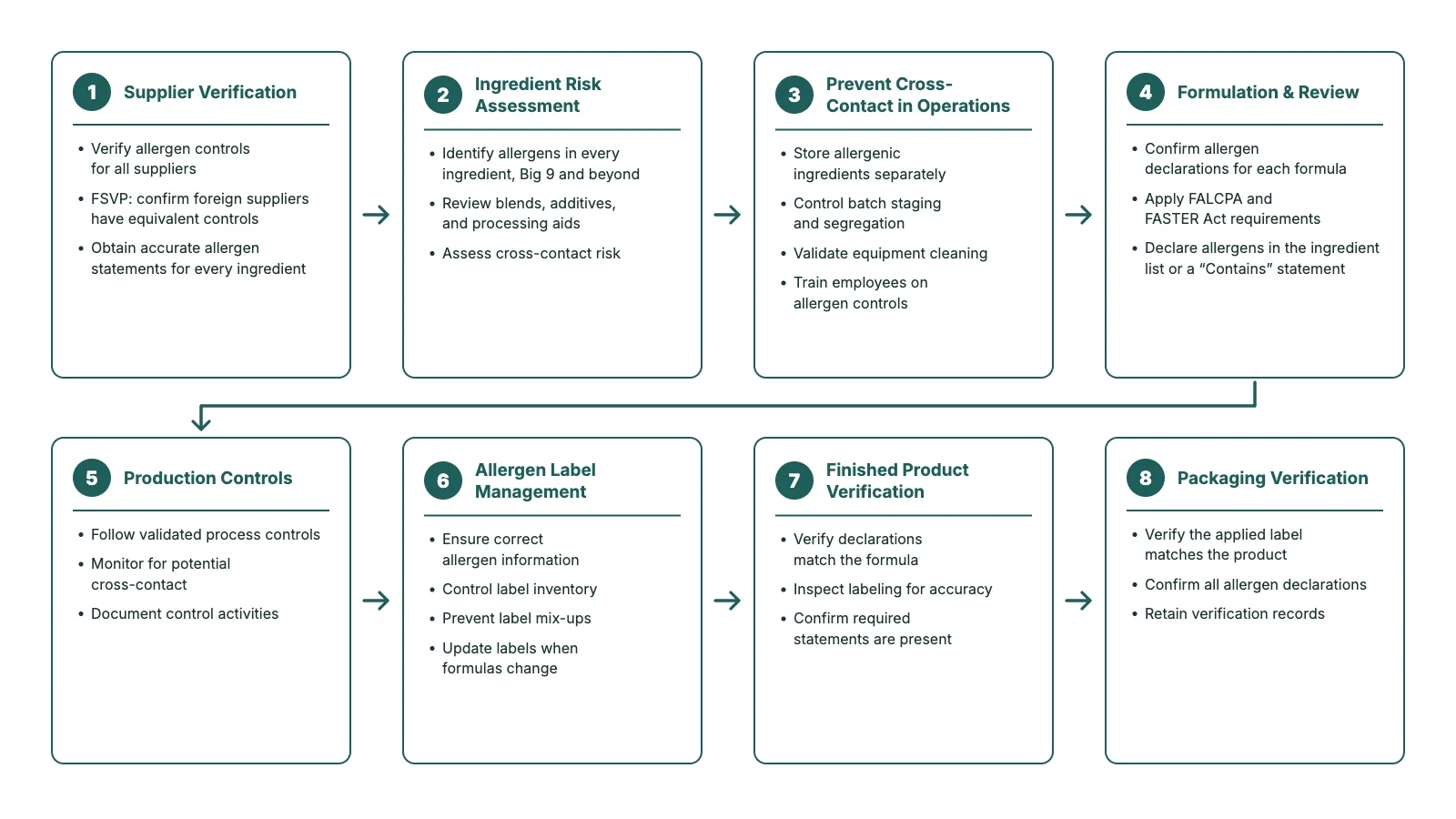
A comprehensive Food Safety Plan includes dedicated Allergen Preventive Controls designed to:
- Prevent allergen cross-contact during storage, batch staging, processing, and sanitation.
- Ensure accurate label application, verifying that finished packaging matches the actual formulation inside the container.
Supply chain visibility is critical. Under the Foreign Supplier Verification Program (FSVP), U.S. importers and brand owners must verify that overseas ingredient suppliers implement equivalent allergen preventive controls.
Brands should obtain updated Supplier Specification Sheets, Certificates of Analysis (COAs), and written allergen disclosure statements for every raw material lot.
Utilizing automated nutrition facts software for allergen management enables formulation teams to cross-reference multi-source supplier inputs against real-time regulatory databases, preventing accidental omissions.
Avoiding FDA Recalls Under Federal Food Allergen Labeling Requirements
Failing to declare a major allergen constitutes misbranding under Section 403 of the FD&C Act and can render the product adulterated under Section 402. Undeclared allergens routinely trigger Class I recalls—the most serious recall classification, reserved for situations where exposure will cause serious adverse health consequences or death.
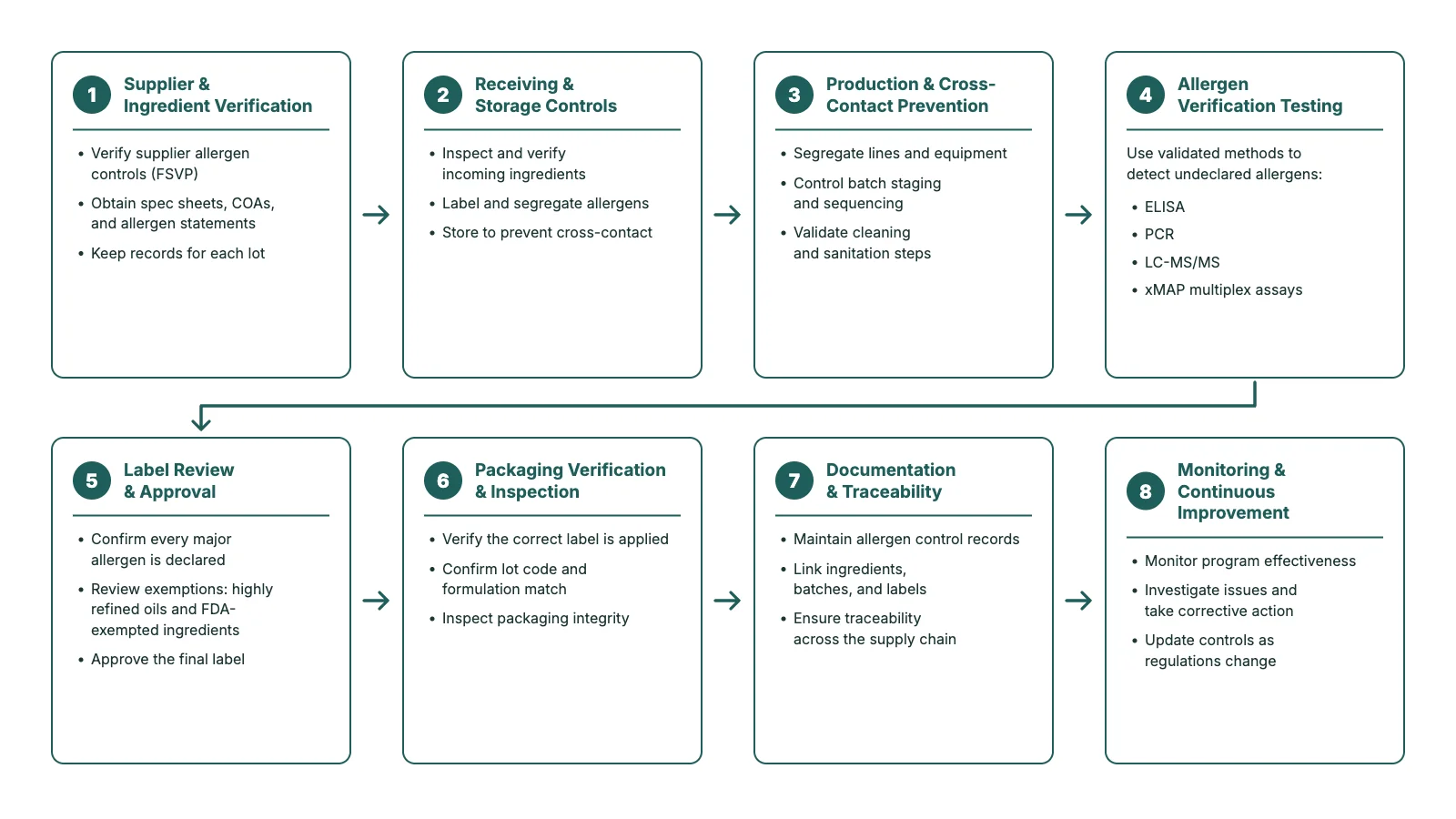
During routine and targeted facility inspections, the FDA employs advanced analytical tools to detect undeclared proteins:
- Enzyme-Linked Immunosorbent Assays (ELISA): Highly sensitive antibody-based assays used to detect trace food proteins.
- Polymerase Chain Reaction (PCR): DNA-based identification of allergenic plant and animal species.
- Liquid Chromatography–Mass Spectrometry (LC-MS/MS): High-resolution protein profiling.
- xMAP Multiplex Assays: Bead-based technology capable of screening for up to 16 food allergens simultaneously in a single sample run.
Facilities flagged for undeclared allergens face public FDA Warning Letters, mandatory recall directives, product seizures, import alerts (preventing overseas goods from clearing U.S. customs), and potential civil or criminal injunctions.
For additional statutory nuances, manufacturers can review the latest guidance outlined in the FDA Questions and Answers Regarding Food Allergen Labeling (Edition 5).
Frequently Asked Questions About Allergen Labeling
Are molluscan shellfish required to be declared as a major allergen?
No. Under FALCPA, only crustacean shellfish (such as crab, lobster, shrimp, and crawfish) are classified as major food allergens. Molluscan shellfish—including oysters, clams, mussels, scallops, squid, and octopus—are not statutory major allergens in the United States.
However, they must still be declared by their common or usual names in the ingredient statement (e.g., “oyster extract” or “clams”). Many manufacturers choose to include molluscan shellfish in their voluntary allergen warnings as a helpful safety measure for consumers.
Do “may contain” statements satisfy FDA compliance if a product has allergen cross-contact?
No. Advisory statements such as “may contain peanuts” or “processed in a shared facility” do not satisfy or bypass FDA requirements. The FDA maintains that precautionary statements cannot be used in lieu of strict Current Good Manufacturing Practices (CGMP) and preventive allergen controls.
If a facility has not implemented rigorous equipment sanitation and scheduling controls, advisory labeling will not protect the business from regulatory action or product liability if cross-contact occurs.
How must sesame be declared when present inside generic spice blends or natural flavors?
Following the implementation of the FASTER Act, sesame can no longer be hidden under collective terms such as “spices,” “seasoning mix,” or “natural flavorings.” If a spice blend or flavoring contains sesame (such as ground sesame seed, tahini, or sesame extract), the label must explicitly disclose the allergen.
This must be done either by naming sesame parenthetically in the ingredient declaration—for example, Seasoning (spices, salt, sesame)—or by listing sesame in a dedicated Contains: Sesame statement immediately following the ingredients.
Conclusion
Mastering federal food allergen labeling requirements is a fundamental responsibility for any consumer packaged goods brand, ingredient supplier, or dietary supplement manufacturer. With more than 33 million Americans relying on food labels to avoid severe allergic reactions, precision in ingredient source naming, panel layout, and cross-contact prevention is critical.
Building an audit-ready allergen management workflow requires tight collaboration between regulatory teams, R&D formulators, and supply chain managers. By eliminating manual data entry, standardizing supplier verification, and maintaining strict adherence to FALCPA, the FASTER Act, and FSMA preventive controls, food companies can protect consumer health and avoid costly recalls.
To streamline panel development, eliminate formatting errors, and ensure end-to-end regulatory compliance, explore our automated labeling tools or partner directly with our specialists through Panelgea consulting services.