

Calculate Like a Regulator by Mastering Food Label Rounding Standards
Calculate FDA Rounding Rules for Your Nutrition Facts Panel Correctly
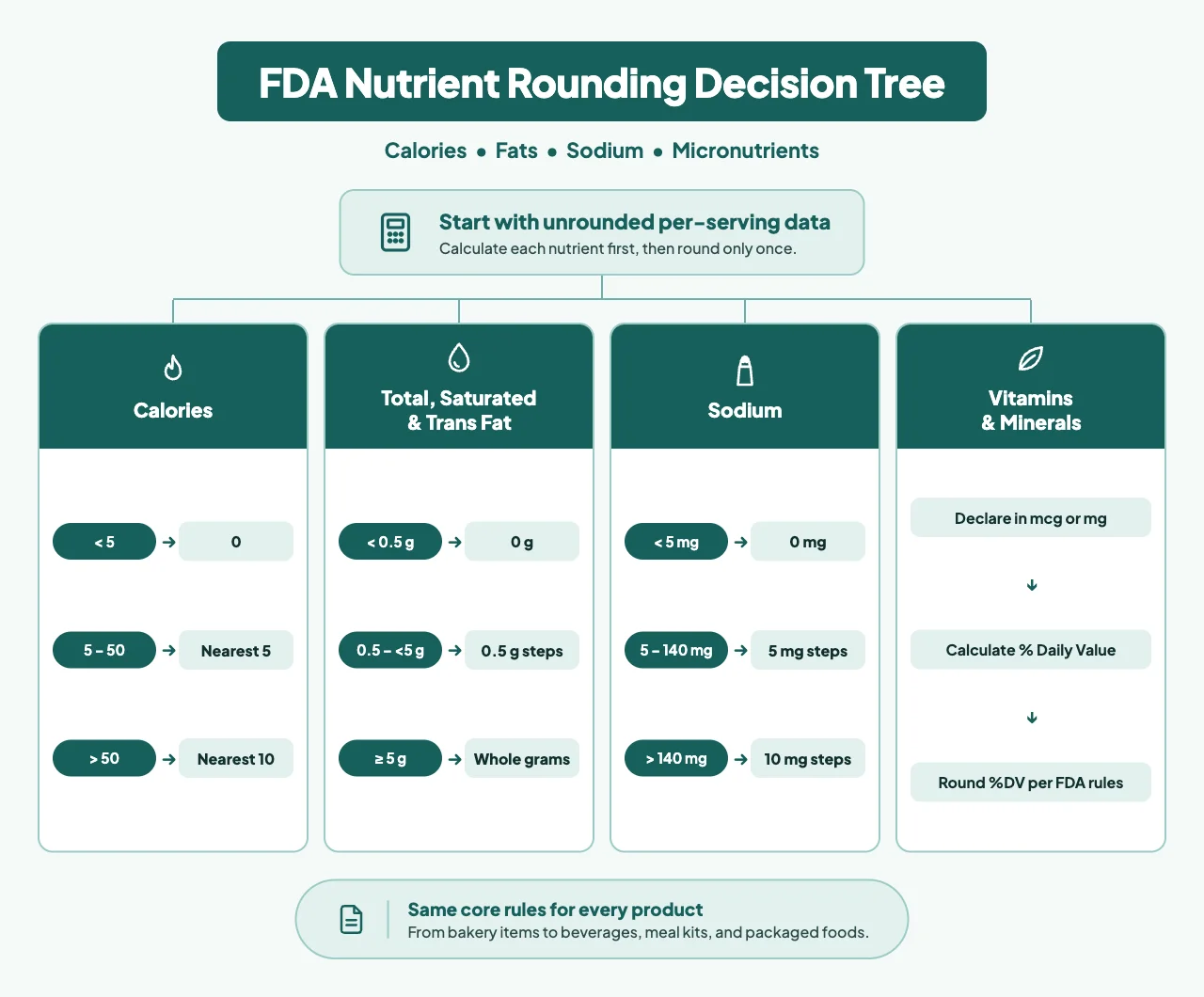
To apply FDA rounding rules for your Nutrition Facts panel, calculate each nutrient from unrounded per-serving data first, then round each value only once using its required increment. For example:
- Round calories under 5 to 0; round 5 to 50 calories to the nearest 5, and values above 50 to the nearest 10.
- Round total fat, saturated fat, and trans fat under 0.5 g to 0 g; use 0.5 g increments below 5 g and whole grams at 5 g or more.
- Round sodium under 5 mg to 0 mg; use 5 mg increments from 5 to 140 mg and 10 mg increments above 140 mg.
- Declare vitamin D, calcium, iron, and potassium in their required units (mcg or mg), then calculate %DV and round it using the vitamin and mineral %DV increments.
>
These are not ordinary spreadsheet rules. FDA requirements in 21 CFR 101.9 set nutrient-specific zero cutoffs, display increments, and %DV conventions. The same core rules apply whether you make a bakery item, beverage, meal kit, or packaged food; only the underlying recipe, serving size, and data source change.
Related content about fda rounding rules for your nutrition facts panel:
- FDA labeling requirements for food
- nutrition facts label requirements
- nutrition facts panel size requirements
Core FDA Rounding Rules for Your Nutrition Facts Panel
Under 21 CFR 101.9(c), the Food and Drug Administration enforces explicit declaration thresholds for mandatory nutrients. In the regulatory world, standard school arithmetic takes a back seat to consumer readability and analytical precision limits. Applying the formal Food Labeling Guide requires you to align every calculated nutrient amount with precise regulatory brackets.
| Nutrient | Insignificant Amount (Declare as 0) | Intermediate Increment Bracket | Upper Increment Bracket |
|---|---|---|---|
| Calories | < 5 kcal | 5 to 50 kcal: nearest 5 kcal | > 50 kcal: nearest 10 kcal |
| Total Fat | < 0.5 g | .5 to 5 g: nearest 0.5 g | ≥ 5 g: nearest 1 g |
| Saturated Fat | < 0.5 g | .5 to 5 g: nearest 0.5 g | ≥ 5 g: nearest 1 g |
| Trans Fat | < 0.5 g | .5 to 5 g: nearest 0.5 g | ≥ 5 g: nearest 1 g |
| Cholesterol | < 2 mg | 2 to 5 mg: “less than 5 mg” | > 5 mg: nearest 5 mg |
| Sodium | < 5 mg | 5 to 140 mg: nearest 5 mg | > 140 mg: nearest 10 mg |
| Total Carbohydrate | < 0.5 g | 0.5 to < 1 g: "less than 1 g" or 1 g | ≥ 1 g: nearest 1 g |
| Dietary Fiber | < 0.5 g | 0.5 to < 1 g: "less than 1 g" or 1 g | ≥ 1 g: nearest 1 g |
| Total Sugars | < 0.5 g | 0.5 to < 1 g: "less than 1 g" or 1 g | ≥ 1 g: nearest 1 g |
| Added Sugars | < 0.5 g | 0.5 to < 1 g: "less than 1 g" or 1 g | ≥ 1 g: nearest 1 g |
| Protein | < 0.5 g | 0.5 to < 1 g: "less than 1 g" or 1 g | ≥ 1 g: nearest 1 g |
| Potassium | < 5 mg | 5 to 140 mg: nearest 5 mg | > 140 mg: nearest 10 mg |
| Vitamin D | %DV < 2% may be declared as 0 | Nearest 0.1 mcg | Same |
| Calcium | %DV < 2% may be declared as 0 | Nearest 10 mg | Same |
| Iron | %DV < 2% may be declared as 0 | Nearest 0.1 mcg | Same |
Applying FDA Rounding Rules for Your Nutrition Facts Panel to Calories and Macronutrients
Macronutrients require close attention to tier thresholds. If a laboratory assay reports 46.2 calories per serving, standard commercial instinct might prompt a brand to write 46 calories. However, 21 CFR 101.9 mandates rounding to the nearest 5-calorie increment between 5 and 50 calories, making 45 calories the only legal declaration. Above 50 calories, the rule expands to 10-calorie intervals (for example, 94 calories becomes 90 calories, whereas 95 calories rounds up to 100 calories).
For fats, values below 0.5 g are declared as 0 g. From 0.5 g up to 4.99 g, round to the nearest 0.5 g increment (such as 3.24 g rounding to 3 g and 3.26 g rounding to 3.5 g). At 5.0 g and above, round to the nearest 1 g whole integer. When managing sugar regulations and dietary fiber, values under 0.5 g drop to 0 g, amounts between 0.5 g and less than 1 g may be declared as “less than 1 g” or rounded to 1 g, and amounts of 1 g or more round to whole numbers.
>
How FDA Rounding Rules for Your Nutrition Facts Panel Apply to Micronutrients and %DV
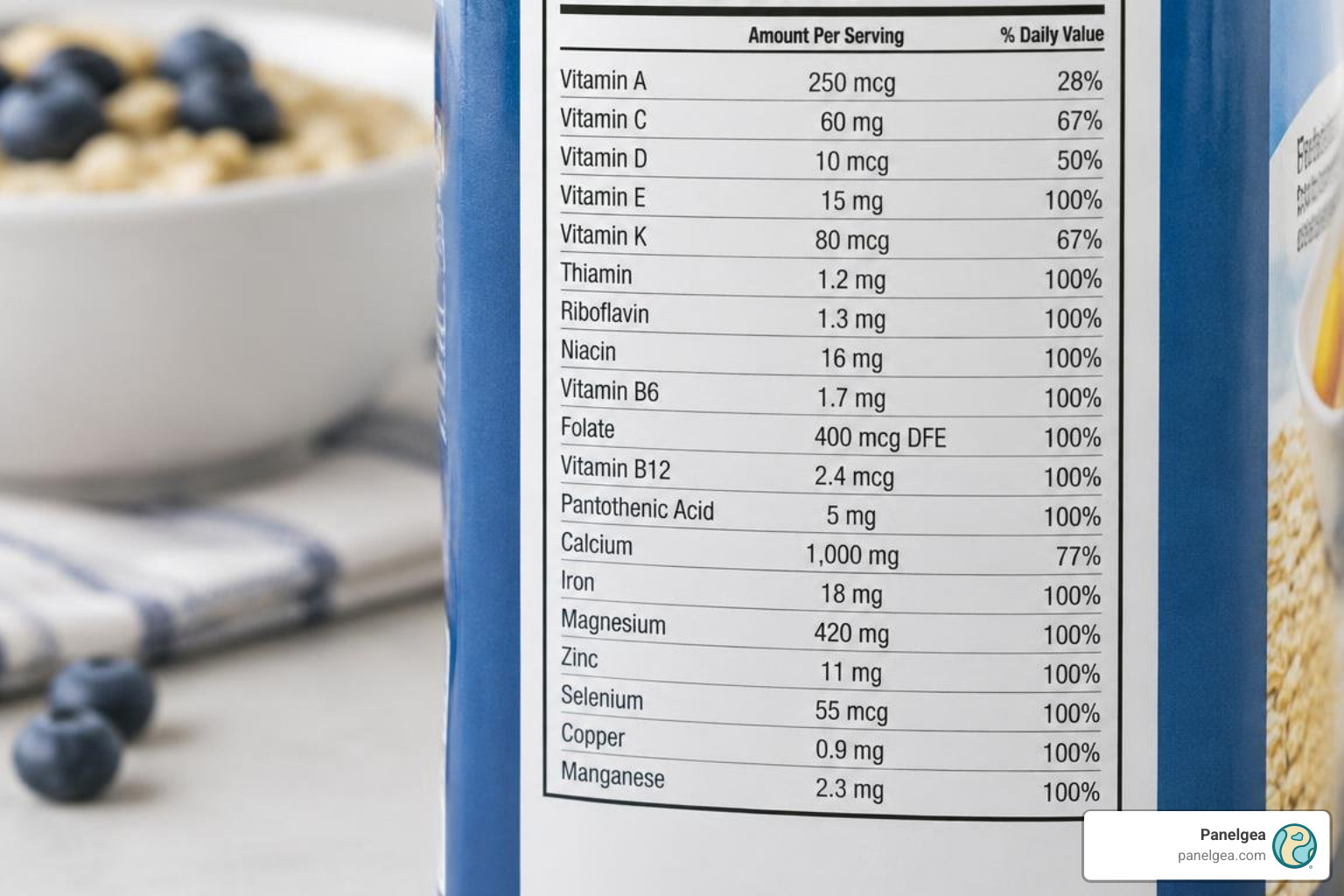
Under FDA’s 2016 final rule, manufacturers must declare mandatory vitamins and minerals—Vitamin D, Calcium, Iron, and Potassium—using both quantitative weights (mcg or mg) and Percent Daily Value (%DV).
Quantitative rounding for micronutrients follows distinct brackets:
- Vitamin D, calcium, and iron: Under 21 CFR 101.9(c)(8)(iii), declare the amount per serving using the units and level of significance shown in the RDI table: mcg for vitamin D, mg for calcium and iron. Zeros after a decimal point may be dropped. Additional decimal places may be used when whole units can’t express a small amount (for example, 0.4 mg iron).
- Potassium (mg): Values under 5 mg round to 0. From 5 to 140 mg, round to the nearest 5 mg. Above 140 mg, round to the nearest 10 mg.
FDA permits %DV to be calculated from either the declared (rounded) amount or the actual unrounded amount. Using unrounded values keeps your %DV consistent with your underlying data, so it’s the more precise practice. For vitamins and minerals, round the resulting percentage as follows:
- < 2% DV: May be declared as 0% or expressed with an asterisk pointing to an “insignificant amount” statement.
- ≤ 10% DV: Round to the nearest 2% increment (e.g., 2%, 4%, 6%, 8%, 10%).
- > 10% to 50% DV: Round to the nearest 5% increment (e.g., 15%, 20%, 25%).
- > 50% DV: Round to the nearest 10% increment (e.g., 60%, 70%, 80%).
Insignificant Amounts and Halfway Rounding Conventions
Under 21 CFR 101.9(f)(1), an “insignificant amount” is an amount small enough to be declared as zero. The one exception is total carbohydrate, dietary fiber, and protein, where it is an amount small enough to be declared as “less than 1 g.” For instance:
- Total fat, saturated fat, trans fat, and sugars containing less than 0.5 g per serving are declared as 0 g. Total carbohydrate, dietary fiber, and protein under 0.5 g may be declared as 0 g; under 1 g, they may be declared as “less than 1 g.”
- Sodium and potassium containing less than 5 mg per serving are declared as 0 mg.
- Cholesterol containing less than 2 mg is declared as 0 mg.
For values that fall exactly halfway between two allowable increments, the standard convention is to round up. Total fat of exactly 3.25 g is declared as 3.5 g, and sodium of exactly 7.5 mg is declared as 10 mg.
Step-by-Step Calculation Protocols Across Food Sectors
A frequent compliance error involves rounding individual ingredient contributions before summing them together. Doing this compounds arithmetic drift and distorts final label figures.
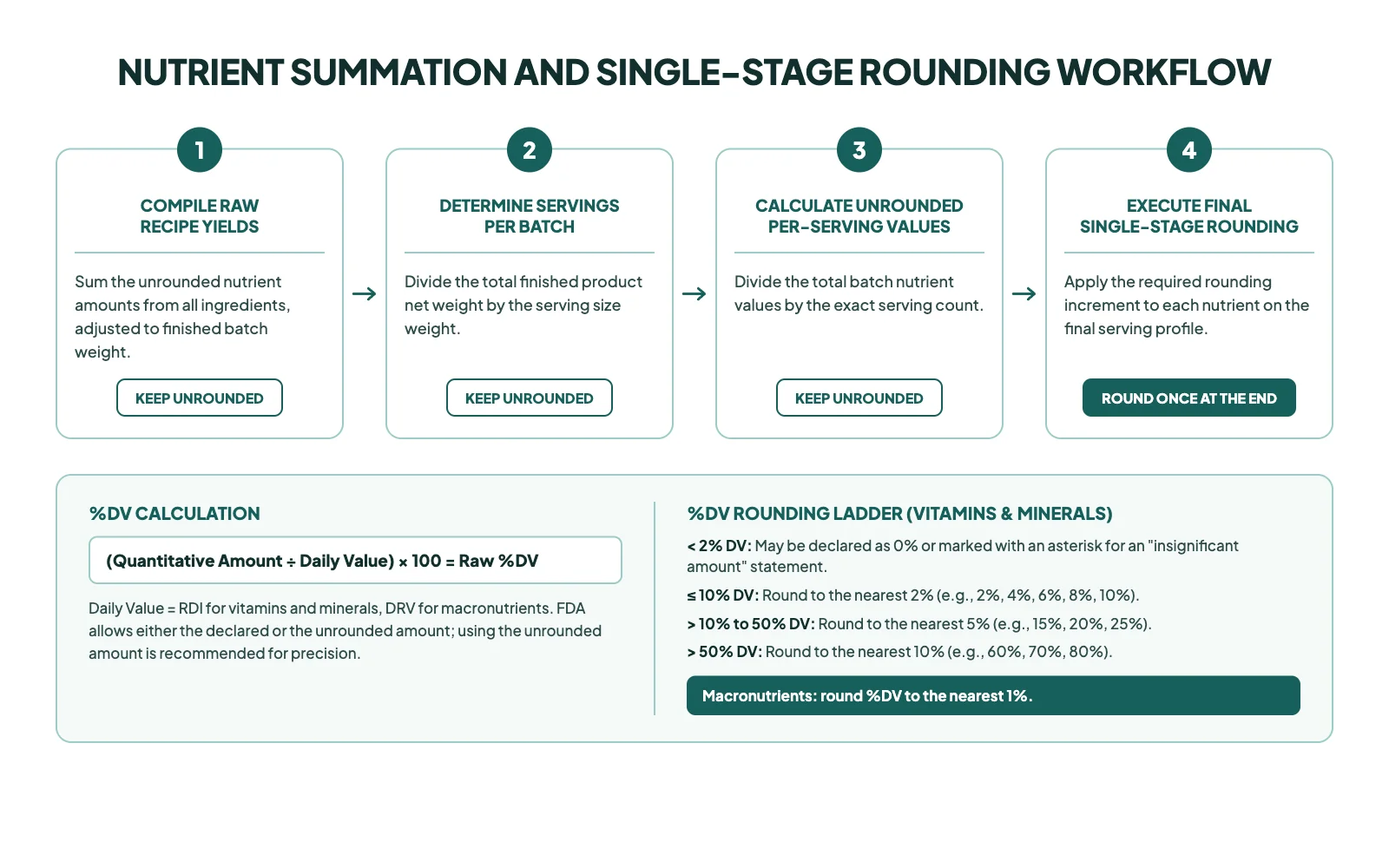
- Compile Raw Recipe Yields: Aggregate total unrounded nutrient weights across all raw materials across the finished batch weight.
- Determine Servings Per Batch: Divide total finished product net weight by the single serving size weight.
- Calculate Unrounded Per-Serving Metrics: Divide the total batch nutrient values by the exact serving count.
- Execute Final Single-Stage Rounding: Apply the specific rounding increment to each nutrient value on the final serving profile.
By keeping complete decimal precision throughout calculation, brands avoid regulatory format mismatches when mastering label requirements.
Sector Specifics: Bakeries, Meal Kits, and Food Service
Different food sectors encounter distinct operational hurdles when applying federal rounding tables:
- Commercial Bakeries: Bake loss removes moisture and concentrates nutrients by weight. A formula calculated from raw batter may show 0.44 g total fat per 55 g serving, which is declared as 0 g. After baking, the same 55 g serving of finished muffin may contain 0.52 g fat and must be declared as 0.5 g. Always calculate from finished-product weight.
- Meal Kit Companies: Multi-component kits combine raw and prepared items, so sum each component’s unrounded values before rounding the total. A kit with 143 mg total sodium is declared as 140 mg. Rounding the spice blend, protein, and sauce separately first can produce a different, incorrect total.
- Prepared Foods and Food Service: Restaurants and grab-and-go operators covered by menu labeling rules (21 CFR 101.11) must round calorie declarations to the nearest 5 calories at 50 calories or less and to the nearest 10 calories above 50, preventing misbranded menu claims when navigating food labeling rules.
>
Serving Size and Reference Amount (RACC) Rounding
Under 21 CFR 101.12(b), the FDA established Reference Amounts Customarily Consumed (RACCs) to define legal serving sizes. Translating raw product weights into declared household measures involves strict rounding protocols outlined in 21 CFR 101.9(b) and the FDA Serving Size Guidance:
- Household Measurements: Must be expressed in common household units (e.g., cups, tablespoons, teaspoons, or discrete units like pieces or slices). Cups are rounded to 1/4 or 1/3 increments; teaspoons are rounded to 1/8, 1/4, 1/2, 3/4, 1, or 2 tsp.
- Metric Parentheticals: The exact gram or milliliter weight must accompany the household measure, rounded to the nearest whole gram (e.g., “1 piece (43 g)”). For small units between 2 and 5 g, round to the nearest 0.5 g; below 2 g, round to the nearest 0.1 g.
- Servings Per Container: Containers with between 2 and 5 servings must round to the nearest 0.5 serving and include the qualifier “about” (e.g., “about 3.5 servings”). Containers containing 200% to 300% of the RACC require dual-column labeling to present per-serving and per-package nutrition side-by-side, aligning with packaging size requirements.
FDA Compliance Testing and Nutrient Tolerances (21 CFR 101.9(g))
When the FDA collects retail samples to verify label accuracy, inspectors use specialized statistical sampling plans rather than testing a single box. The Guide for Developing and Using Nutrition Databases establishes how the agency analyzes a composite of 12 individual retail units taken from 12 distinct shipping cases using official AOAC International methods.
Class I, Class II, and Third Group Nutrient Tolerances
To account for natural agricultural variability and shelf-life degradation, the FDA evaluates laboratory assays under three distinct regulatory classes defined in 21 CFR 101.9(g):
- Class I Nutrients (Added/Fortified): Added vitamins, minerals, protein, dietary fiber, or potassium in fortified foods. The composite laboratory analysis must equal at least 100% of the declared label value.
- Class II Nutrients (Naturally Occurring): Indigenous vitamins, minerals, protein, total carbohydrate, dietary fiber, other carbohydrates, polyunsaturated fat, or monounsaturated fat. The composite analysis must equal at least 80% of the declared label value.
- Third Group Nutrients (Undesirable/Restricted): Calories, total fat, saturated fat, trans fat, cholesterol, sodium, and sugars. The composite laboratory analysis must not exceed 120% of the declared value.
Frequently Asked Questions About Nutrition Facts Rounding
When should nutrient amounts be declared as zero on the label?
A nutrient may be declared as zero when its amount per serving falls below these thresholds in 21 CFR 101.9:
- Calories: Less than 5 kcal.
- Fats (Total, Saturated, Trans): Less than 0.5 g.
- Cholesterol: Less than 2 mg.
- Sodium & Potassium: Less than 5 mg.
- Carbohydrates, Fiber, & Sugars: Less than 0.5 g.
- Protein: Less than 0.5 g.
Is percent Daily Value calculated from rounded or unrounded values?
FDA allows either. Under 21 CFR 101.9(d)(7)(ii) and (c)(8)(iii), %DV may be calculated by dividing either the declared (rounded) amount or the actual unrounded amount by the nutrient’s Daily Value (the DRV or RDI). Using unrounded values is the more precise practice and keeps %DV consistent with your data. After calculating, round macronutrient %DV to the nearest 1%. Round vitamin and mineral %DV to the nearest 2% for values up to and including 10%, the nearest 5% for values above 10% through 50%, and the nearest 10% for values above 50%.
Can manufacturers list more precise decimal values than FDA increments allow?
No. Listing unmandated decimal precision (such as writing “3.4 g Total Fat” or “12.8 mg Sodium”) is a format violation under 21 CFR 101.9. Even if your laboratory assay provides high-precision data, displaying non-standard increments misbrands your product panel during regulatory reviews.
Conclusion
Mastering federal rounding protocols is essential for protecting your food brand against compliance notices and packaging redesign costs. Manual spreadsheet rounding frequently leads to compounding errors, truncated %DV ladders, and non-compliant decimal displays across product lines.
At Panelgea, we eliminate compliance risk by automating panel creation through our SaaS platform. Built specifically for consumer packaged goods (CPG) brands, food manufacturers, and dietary supplement formulators, Panelgea applies real-time USDA database values, complex proprietary blend calculations, automated allergen detection, and dynamic 21 CFR 101.9 display increments. Generate compliant, print-ready, exportable editable SVG facts panels with complete regulatory confidence using an automated nutrition label generator.