
Sizing Up Nutrition Facts Panel Size Requirements for Modern Food Packaging
Start With the Package Space, Then Choose the Right Nutrition Facts Format
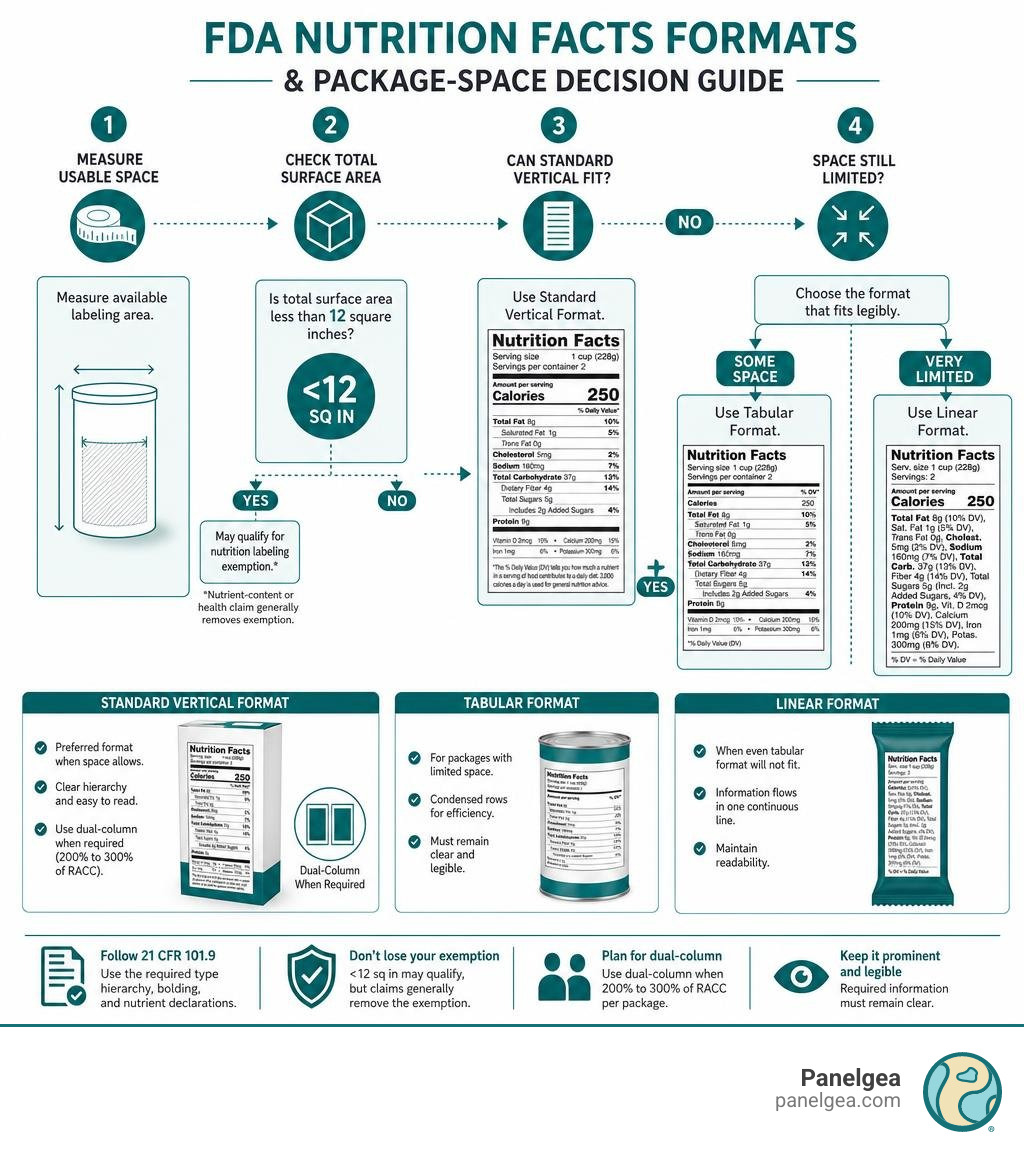
For U.S. foods, nutrition facts panel size requirements are driven mainly by available label space and the label format needed to fit required information legibly. Start by measuring usable package surface area, then select the standard vertical format when it fits. If space is limited, use the FDA-permitted tabular format; use a linear format only when even the tabular display will not fit.
Key rules to plan around:
- Use the required FDA type hierarchy, rules, bolding, and nutrient declarations in 21 CFR 101.9.
- Treat packages with less than 12 square inches of total surface area available for labeling carefully. They may qualify for a nutrition-labeling exemption, but a nutrient-content or health claim generally removes that exemption.
- Build room for a dual-column panel when an individually packaged product contains 200% to 300% of its applicable reference amount customarily consumed (RACC).
- Do not let optional graphics consume space needed for mandatory information. FDA rules require required label information to remain prominent and legible.
There is no single universal Nutrition Facts panel width and height that works for every package so if that is all you are getting from your software or designer, you’ll need a resources with more options and compliance fully integrated. The compliant size depends on the packaging, the food type and its required nutrients, serving-size rules, package geometry, and whether a standard, tabular, linear, or dual-column display applies. Getting these decisions right before artwork is approved helps prevent crowded labels, reprints, and compliance risk.
I am Brandon M Griffin, CEO of REJIMUS, INC., with more than 23 years of leadership in food, dietary supplement, cosmetic, and OTC regulatory strategy. Our work on nutrition facts panel requirements includes helping CPG teams turn complex formulations into compliant, production-ready Nutrition and Supplement Facts panels. We built software to streamline what we do, and have now put that forward to customers to use to ensure the same great quality labeling.
Understanding FDA Nutrition Facts Panel Size Requirements and Layout Formats
When setting up food packaging, regulatory compliance starts by evaluating your container’s geometry and calculating printable surface area. Under the 21 CFR 101.9 nutrition labeling specifications, the U.S. Food and Drug Administration (FDA) requires nutrition data to be presented in a standardized visual hierarchy. This structure ensures that consumers can quickly spot key nutritional benchmarks like calories, serving sizes, and daily values across different brands on retail shelves.
Understanding how much surface area your label possesses dictates whether you must use a standard vertical layout or qualify for alternative formats. For growing food companies and established CPG brands alike, the ability to build accurate nutrition labels fast eliminates guesswork and prevents costly packaging revisions down the line.
| Format Type | Typical Application | Minimum Available Space Threshold | Key Layout Characteristics |
|---|---|---|---|
| Standard Vertical | Standard boxes, cans, large bottles | > 40 sq. in. available label space | Full vertical stack; distinct hair lines, thick bars, large calorie type. |
| Tabular (Horizontal) | Intermediate packages, wide wrappers | ≤ 40 sq. in. (or vertical height < 3 in.) | Two-column split placing core nutrients side-by-side to save vertical height. |
| Linear (String) | Narrow pouches, small bars, tubes | ≤ 40 sq. in. when tabular cannot fit | Continuous horizontal paragraph format separated by bullets or semicolons. |
| Dual-Column | Grab-and-go multi-serving snacks/drinks | 200% to 300% of standard RACC | Parallel vertical columns detailing “Per Serving” and “Per Container” metrics. |
Standard Vertical Display Dimensions and Minimum Font Sizes
The standard vertical display is the default format seen on consumer goods. Its dimensions are primarily governed by strict typographical and rule-line parameters established in the FDA nutrition label revision final rule.
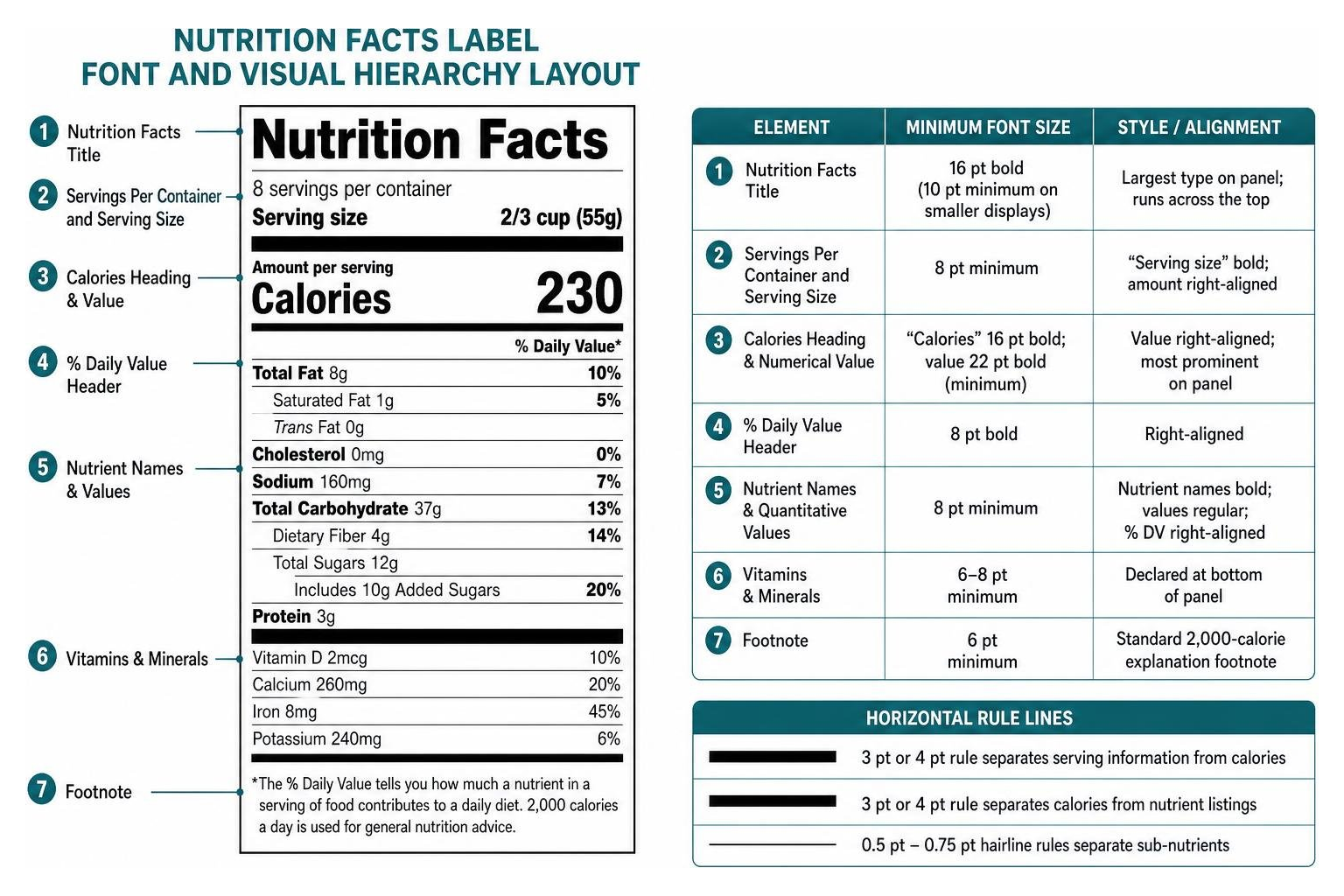
The FDA enforces strict font sizing, leading, and graphical hierarchy for standard vertical panels:
- “Nutrition Facts” Title: Must be set in the largest type size on the panel, typically no less than 16-point bold (or at least 10-point on smaller displays), running across the top.
- “Servings Per Container” and “Serving Size”: Set in a minimum of 8-point type, with “Serving size” bolded.
- “Calories” Heading & Numerical Value: The word “Calories” must be set in at least 16-point bold type, and the numerical caloric value must be prominent in at least 22-point bold type.
- Nutrient Names and Quantitative Values: Core mandatory nutrients (e.g., Total Fat, Saturated Fat, Sodium, Total Carbohydrate, Protein) must be set in a minimum of 8-point type, with primary headings set in bold. Quantitative values (e.g., “8g”, “150mg”) are set in regular 8-point font.
- Percent Daily Values (% DV): Set in 8-point bold font, right-justified within the column.
- Vitamins and Minerals: Declared at the bottom of the panel in a minimum of 6-point to 8-point type.
- Footnote: The standardized 2,000-calorie explanation footnote must be displayed in a minimum of 6-point type.
- Horizontal Rule Lines: A heavy 3-point or 4-point rule separates the serving information from the calories, and another thick rule separates the calories from the nutrient listings. Sub-nutrients are separated by 0.5-point to 0.75-point hairline rules.
Dual-Column Layout Specifications for Multi-Serving Containers
When packaging food products that can easily be consumed in a single sitting or shared across multiple occasions, dual-column labeling rules apply. According to the FDA serving size final rule, individually packaged foods containing at least 200% and up to 300% of the Reference Amount Customarily Consumed (RACC) must implement a dual-column display.
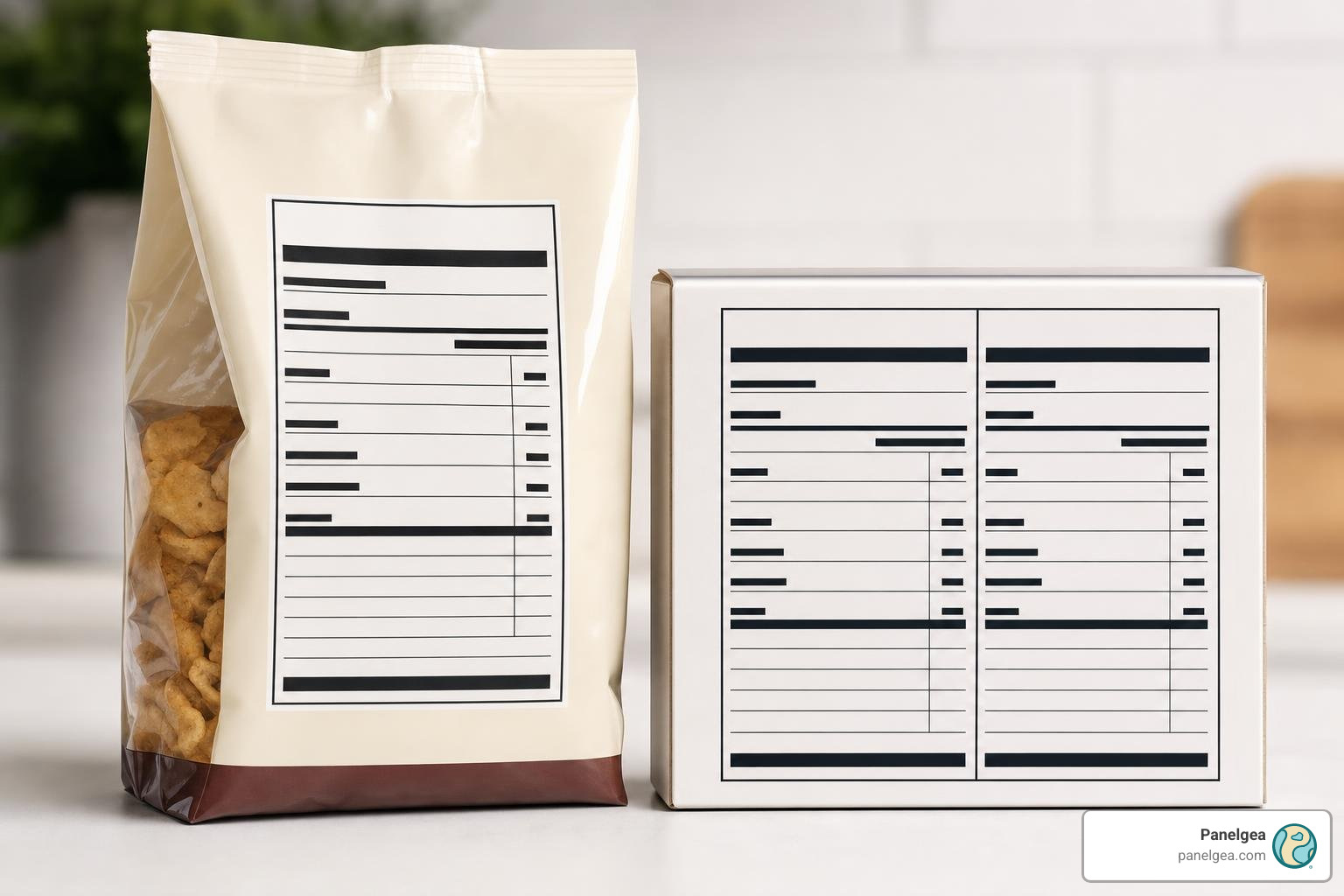
A dual-column panel displays side-by-side columns: one for “Per Serving” and one for “Per Package” (or “Per Container”). This expands the overall width of the panel significantly. While standard vertical panels typically require a width of 2 to 2.5 inches, a dual-column panel often requires a minimum width of 3.5 to 4.5 inches to accommodate the parallel columns, two sets of quantitative values, and corresponding % DV calculations without compressing the typography below the mandatory 8-point minimums.
Calculating Package Surface Area and Placement on the Information Panel
The placement of the Nutrition Facts panel is legally linked to your container’s display surfaces. Under 21 CFR 101.2, mandatory food information must appear either on the Principal Display Panel (PDP) or the designated Information Panel.
The Information Panel is defined as the surface immediately contiguous and to the right of the Principal Display Panel as viewed by the consumer facing the front of the package.
When organizing your label architecture, follow these mandatory information panel placement criteria:
- The Nutrition Facts panel, ingredient declaration, allergen statements, and manufacturer contact info must be grouped together without intervening non-mandatory material.
- Marketing graphics, promotional vignettes, recipe suggestions, and corporate slogans cannot be placed between required information blocks.
- If the surface immediately to the right of the PDP is unusable (such as a seam, lid, or folded flap), the information panel moves to the next usable panel to the right.
Principal Display Panel Area Formulas for Packaging Shapes
Determining your available label space requires calculating the Principal Display Panel (PDP) area according to the 21 CFR 101.1 principal display panel definitions. The mathematical formula depends on the shape of your container:
- Rectangular Packages: Area = Height × Width of the chosen display side.
- Cylindrical or Nearly Cylindrical Containers: Area = 40% of (Height × Circumference). The resulting value represents the 40-percent rule, which defines the viewable curved surface area of cans, jars, and bottles.
- Irregularly Shaped Packaging: Area = 40% of the total surface area of the container, unless an obvious single display face exists (e.g., the flat top lid of a round deli tub or triangular cheese wedge).
When measuring total surface area, FDA regulations dictate that certain structural elements must be excluded: tops, bottoms, can flanges, container shoulders, bottle necks, and crimped package seals. For step-by-step guidance on calculating printable label space across unconventional package shapes, check out our nutrition panel tutorials.
Aligning Nutrition Facts Panel Size Requirements on Limited Space Packages
When a package has a total surface area available for labeling of 40 square inches or less, the manufacturer is not forced to crowd a full standard vertical panel onto the artwork. The FDA recognizes that cramming full-sized panels onto small bottles or snack wrappers would lead to unreadable typography or eliminate space for the mandatory ingredient list.
Under the 40-square-inch rule:
- If the package cannot accommodate a standard vertical panel (including required 8-point type sizes and line leading), you can shift to a tabular display.
- If a package has insufficient vertical space (typically less than 3 inches in continuous vertical height) to place a standard vertical panel, alternative tabular designs are permissible even if total surface area exceeds 40 square inches.
- Non-mandatory marketing text and brand designs cannot be used to justify a lack of space. The FDA considers only mandatory labeling elements when determining whether a package has sufficient room for standard formats.
For brands planning custom packaging runs across multiple SKU sizes, evaluating label design pricing helps ensure compliance workflows remain budget-friendly while preventing layout violations.
Navigating Alternative Formats for Small and Intermediate Packages
When standard vertical labels will not fit on intermediate or compact packaging, brands must transition to approved alternative formats. As outlined in the University of Tennessee nutrition label guide, these alternative formats maintain strict typographic standards while adjusting the physical geometry of the information box.

When to Implement Tabular and Linear Nutrition Label Displays
The transition between vertical, tabular, and linear displays follows a strict regulatory hierarchy:
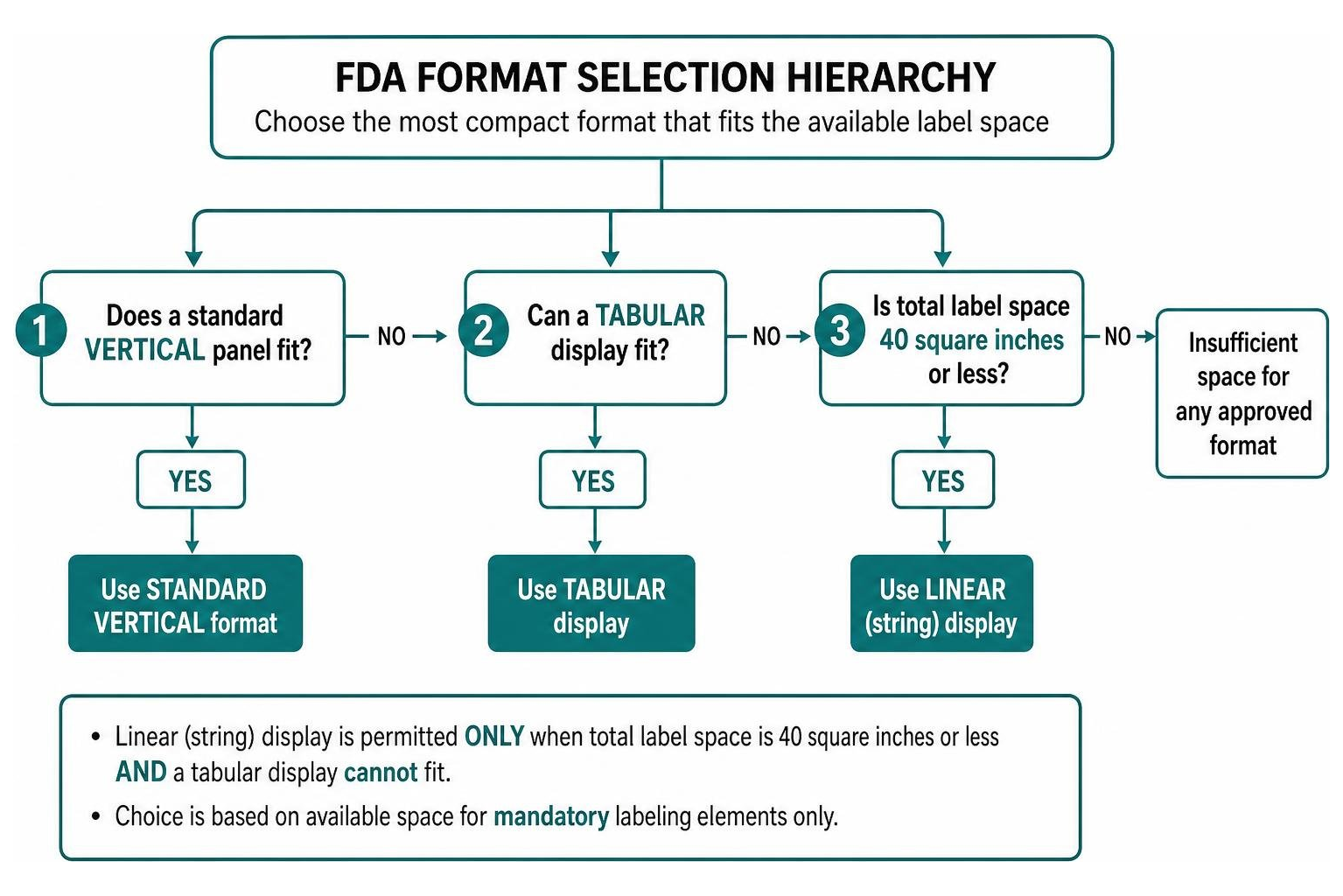
- Tabular Display: In a tabular layout, the visual hierarchy is split into two or more horizontal side-by-side blocks. The serving size and calorie declarations occupy the left side of the table, while nutrient values, % DVs, and the footnote run in two adjacent sub-columns to the right. This significantly reduces the vertical footprint of the label, making it suitable for wide, short packaging like snack pouches or tuna cans.
- Linear Display: The linear (or string) format presents nutrition information as a continuous paragraph of text. Nutrient lines are separated by centered bullet points or semicolons. The FDA permits a linear display only if the package has 40 square inches or less of total label space available and cannot fit a tabular display. You cannot simply choose a linear layout for aesthetic reasons if a tabular panel fits.
Meeting Nutrition Facts Panel Size Requirements Under Exemption Rules
For micro-packaging, the FDA provides specific relief under 21 CFR 101.9(j)(13). Packages with less than 12 square inches of total surface area available to bear a label are entirely exempt from displaying a Nutrition Facts panel, provided specific statutory conditions are met:
- The product packaging must include a statement of identity, net quantity of contents, ingredient declaration, allergen warnings, and manufacturer contact details.
- The label must provide an address or telephone number that consumers can use to obtain detailed nutritional information.
- The manufacturer, packer, or distributor must make no nutrient content claims (such as “Low Fat” or “High Protein”), health claims, or other nutritional marketing claims anywhere on the packaging or in accompanying advertising.
Small businesses selling under 100,000 units annually in the U.S. with fewer than 100 full-time employees may also qualify for the FDA Low Volume Small Business Exemption, which requires an annual online notification filing with the agency. For complex product lines requiring regulatory review, working with our labeling compliance consulting team can ensure your exemption eligibility is completely secure.
Frequently Asked Questions About Food Label Dimensions
Navigating packaging regulations often brings up specific operational questions. For additional common inquiries, explore our extensive FDA regulatory FAQ.
What happens if an exempt small package makes a nutrient content claim?
If an otherwise exempt small package (such as a package with less than 12 square inches of label space or an item produced by a qualifying small business) features any nutrient content claim, health claim, or structure/function claim, the exemption is immediately forfeited.
For example, if a miniature energy bite wrapper measuring 10 square inches adds “Good Source of Fiber” or “Keto Friendly” to the front display, the brand is legally required to include a complete Nutrition Facts panel. If a standard or tabular panel cannot physically fit due to the 12-square-inch constraint, the linear format must be used.
What is the absolute minimum font size allowed on very small packaging?
Under 21 CFR 101.2(c), the standard minimum letter height for mandatory information on food information panels is 1/16 inch (approximately 4.5 to 5-point type depending on font metrics).
However, for individual single-serve packages with 3 square inches or less of available label space (such as portion-control condiment packets or institutional single-serve dairy creamers), the minimum type size may be reduced to no less than 1/32 inch, provided all mandatory information remains clear, prominent, and legible.
Conclusion
Mastering nutrition facts panel size requirements is essential for moving consumer food and beverage products from the formulation bench to store shelves without running into regulatory hurdles. Whether your product requires a full standard vertical display, a dual-column layout for multi-serving snacks, or an alternative tabular format for compact packaging, precision is non-negotiable.
At Panelgea, we built a dedicated platform to eliminate labeling errors for growing brands, packaging designers, and CPG manufacturers the that all the compliance integrated. Our software automates FDA-compliant Nutrition Facts and Supplement Facts creation, runs real-time ingredient conflict and allergen checks, and exports crisp, editable SVG artwork scaled perfectly to your package dimensions and all for custom flexibility, for all the compliance options listed above.
Ready to streamline your regulatory packaging workflow? Get started today for FREE with the Panelgea automated nutrition labeling platform.