

If you sell food or dietary supplements in California, Proposition 65 decides whether your label needs a warning. The trigger isn’t simply whether a listed chemical is in your product. It’s how much of that chemical a consumer is exposed to per day.
Prop 65, formally the Safe Drinking Water and Toxic Enforcement Act of 1986, requires businesses to give a “clear and reasonable” warning before exposing people in California to chemicals known to cause cancer, birth defects or other reproductive harm. The list holds hundreds of chemicals. For food and supplement brands, four heavy metals cause most of the trouble: lead, cadmium, arsenic and mercury.
This guide covers who has to comply, which chemicals matter, how daily exposure is calculated, what the warning must say, and how to stay out of a 60-day notice.
This article is for general education and isn’t legal advice. Talk to Prop 65 counsel about your specific products.
Who Has to Comply
Prop 65 applies to any business with 10 or more employees whose products reach consumers in California. Businesses with fewer than 10 employees are exempt, and so are government agencies.
A few points catch brands off guard:
- You don’t need to be based in California. The law covers products sold there, including online orders shipped into the state.
- Employee count is company-wide. The 10-employee threshold counts your whole company, not just staff in California.
- Manufacturers carry most of the responsibility. The regulations put the primary duty to warn on manufacturers, distributors and importers. Retailers usually pass along the warnings you provide.
- Small brands still feel the pressure. Even if you’re exempt, retailers and distributors often require Prop 65 compliance or indemnity in their vendor agreements.
The Four Heavy Metals That Matter Most
Lead, cadmium, arsenic and mercury occur naturally in soil and water, and plants absorb them as they grow. That makes them hard to avoid in botanicals, minerals, cocoa, rice and seafood. Lead is the biggest concern, with a safe harbor of just 0.5 micrograms per day.
OEHHA, the state agency that runs Prop 65, sets a “safe harbor” level for many listed chemicals, including three of these four metals. Exposure below that level needs no warning. There are two kinds:
- NSRL (No Significant Risk Level) applies to chemicals listed for cancer.
- MADL (Maximum Allowable Dose Level) applies to chemicals listed for reproductive harm.
| Heavy metal | Safe harbor (µg/day, by mouth) | Common sources |
|---|---|---|
| Lead | 0.5 (MADL); 15 (NSRL) | Botanicals, cocoa, spices, minerals like calcium, protein powders |
| Mercury (methylmercury) | None adopted (settlements commonly use 0.3) | Fish, seafood, some supplements and traditional remedies |
| Inorganic arsenic | 10 (NSRL) | Rice, seaweed, some herbal ingredients |
| Cadmium | 4.1 (MADL) | Cocoa, leafy greens, seaweed, some botanicals |
When a metal has both levels, the lower one is usually the one that matters. For lead, that’s the 0.5 µg/day MADL. Mercury has no official safe harbor level, so there’s no regulatory number that clearly keeps you out of trouble. In practice, many Prop 65 settlements set 0.3 µg/day as the point where a warning is required.
Safe harbor values come from OEHHA’s published NSRL and MADL list. Check the current list before relying on a number, since values can change.
How Daily Exposure Is Calculated
A warning depends on daily exposure, not concentration alone. A product with a tiny amount of lead can still need a warning if people eat a lot of it every day.
Most enforcers and many settlements use the serving size and servings per day on your label:
Daily exposure (µg/day) = concentration (µg/g) × serving size (g) × servings per day
Lab results usually come in parts per million (ppm). For solids, 1 ppm equals 1 µg per gram, so you can use the ppm number directly.
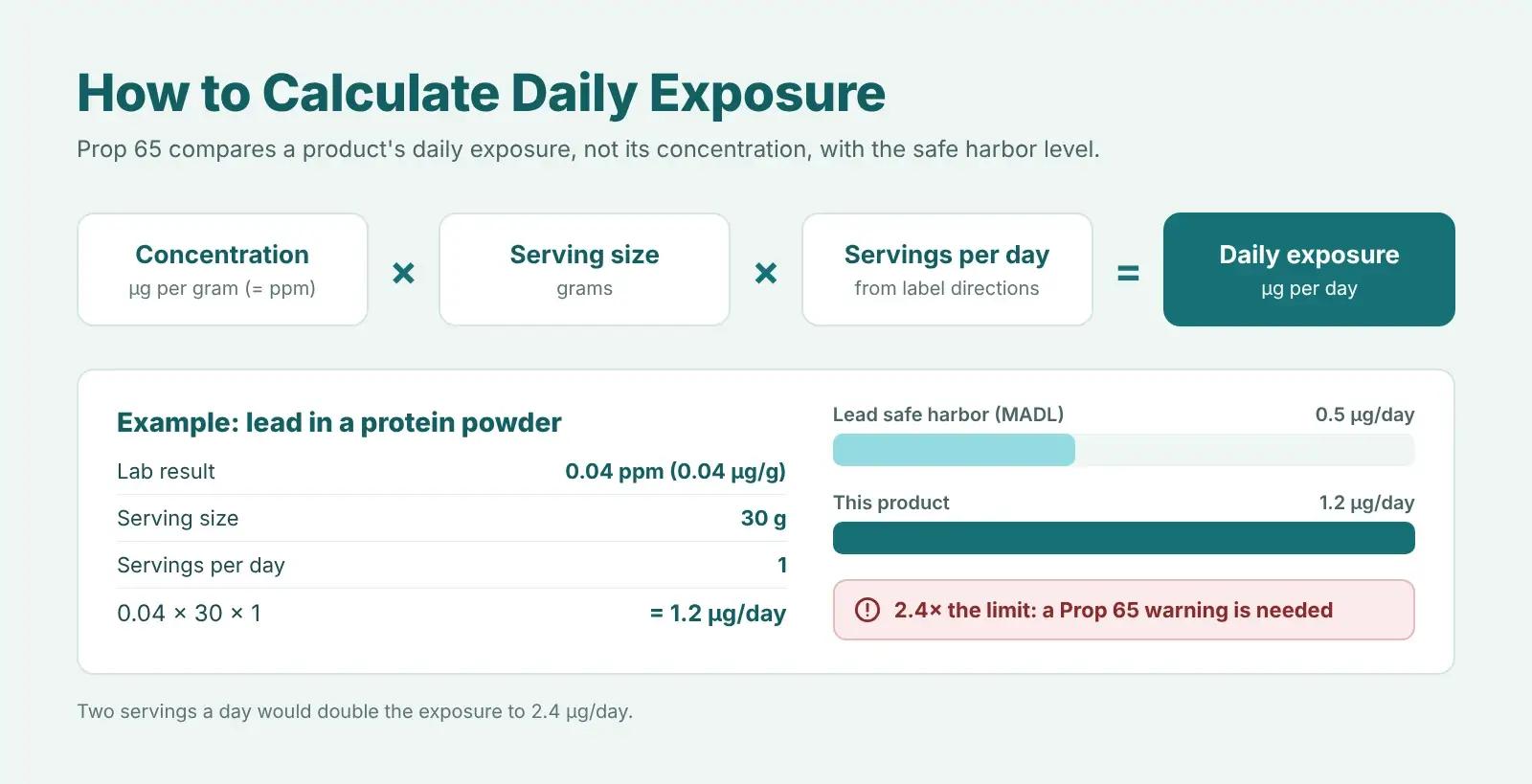
Worked Example: A Protein Powder
- Lab result: 0.04 ppm lead (0.04 µg/g)
- Serving size: 30 g
- Label directions: 1 serving per day
- Daily exposure: 0.04 × 30 × 1 = 1.2 µg/day
That’s well over lead’s 0.5 µg/day MADL, so this product would need a warning. If the directions said 2 servings per day, exposure would double to 2.4 µg/day.
Two Factors That Can Lower Your Number
- Average consumption. The regulations base exposure on the average consumer, not the maximum label serving every day. Food companies have won recent cases using average consumption data instead of the enforcer’s every-day calculation.
- Naturally occurring chemicals. Under 27 CCR § 25501, a chemical that occurs naturally in a food doesn’t count as an “exposure” to the extent you can prove it. The burden of proof is on you, and it’s hard to meet without solid data.
Both defenses take evidence and usually legal help. Most brands plan around the label-based calculation and treat these as backups.
What the Warning Must Say
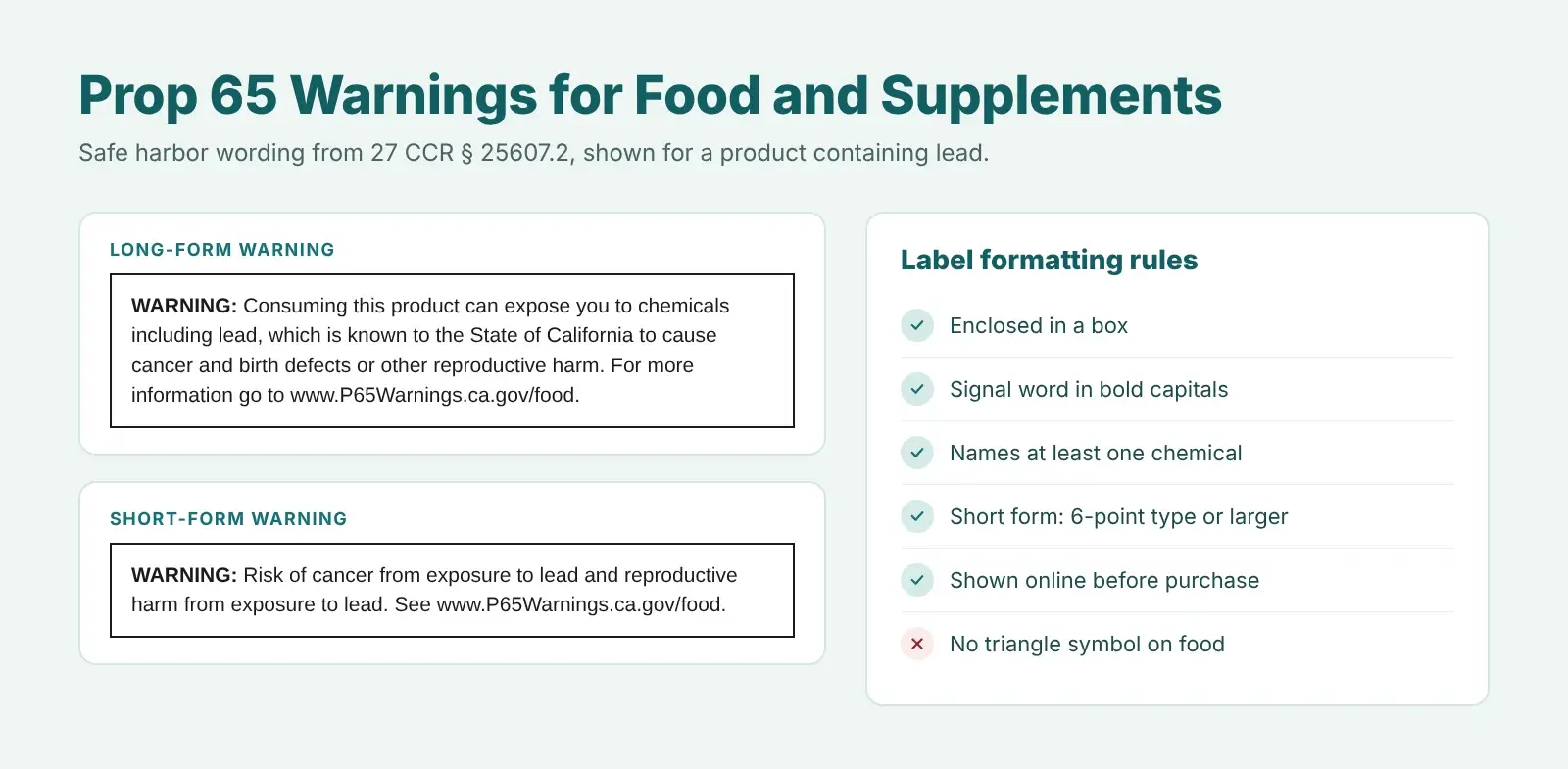
Food and supplements use their own “safe harbor” warning wording, set out in 27 CCR § 25607.2. Using that exact wording is the surest way to be treated as compliant.
Long-Form Warning
For lead, which is listed for both cancer and reproductive harm, the full-length warning reads:
WARNING: Consuming this product can expose you to chemicals including lead, which is known to the State of California to cause cancer and birth defects or other reproductive harm. For more information go to www.P65Warnings.ca.gov/food.
OEHHA publishes sample warnings for each case: cancer only, reproductive harm only, or both.
Short-Form Warning
Since January 1, 2025, food labels can use a short-form warning. The new short form names at least one chemical. Examples:
- WARNING: Cancer risk from exposure to [chemical]. See www.P65Warnings.ca.gov/food.
- WARNING: Risk of reproductive harm from exposure to [chemical]. See www.P65Warnings.ca.gov/food.
- WARNING: Risk of cancer from exposure to [chemical] and reproductive harm from exposure to [chemical]. See www.P65Warnings.ca.gov/food.
Products manufactured and labeled before January 1, 2028, may keep the older short form with no chemical named. Anything made on or after that date needs the new wording.
Formatting Rules for Food Labels
- The signal word can be “WARNING:”, “CA WARNING:” or “CALIFORNIA WARNING:”, in bold capital letters.
- On a food label, the warning must be set off from other text and enclosed in a box.
- Food warnings don’t use the yellow triangle symbol that appears on other consumer products.
- Short-form text must be at least 6-point type.
- If you sell online, the warning must also appear on the product page or before purchase.
How Prop 65 Is Enforced
Most Prop 65 cases are brought by private enforcers, not the state, and they start with a 60-day notice. Penalties can reach $2,500 per violation per day.
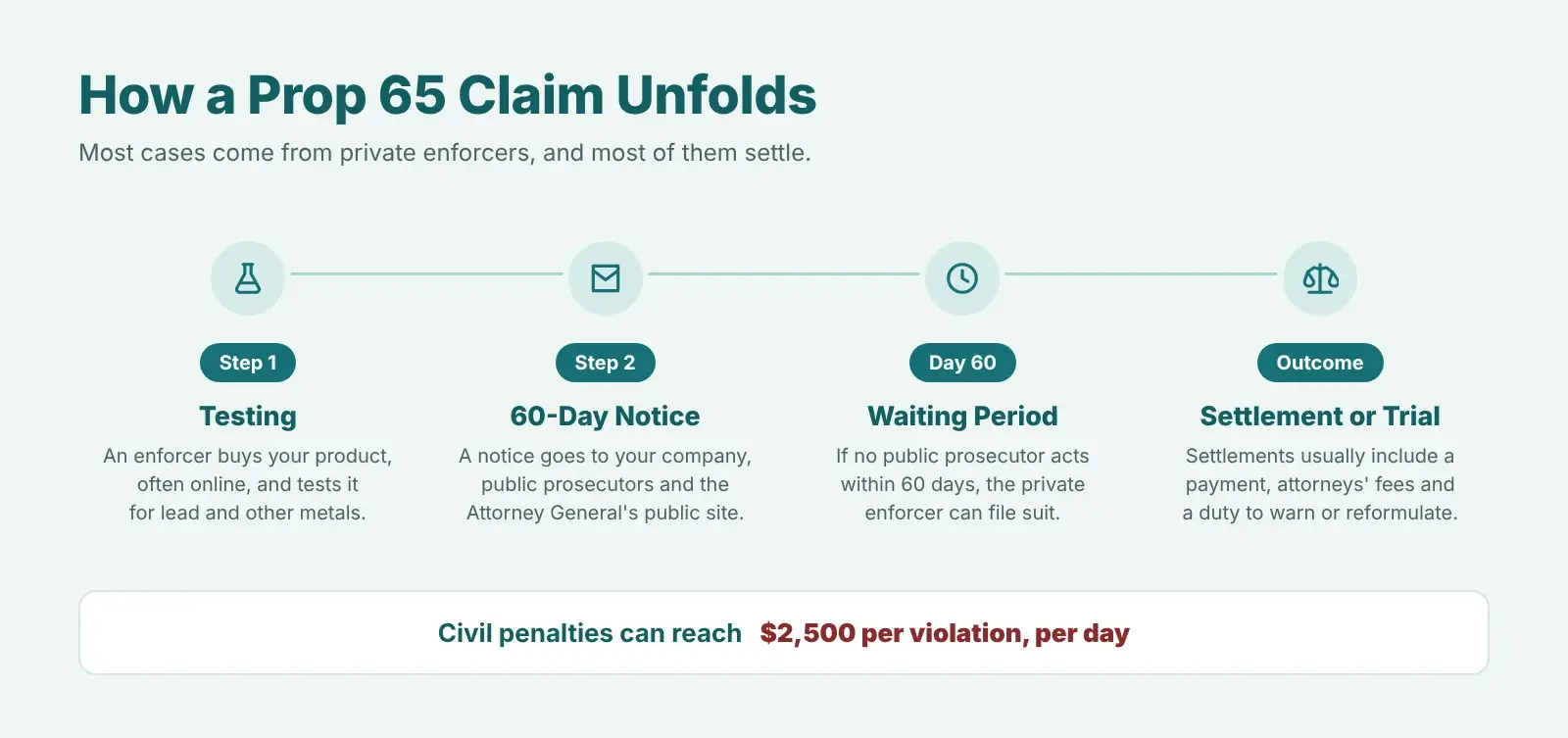
The usual sequence:
- Testing. An enforcer buys your product, often online, and has it tested for lead or other listed chemicals.
- 60-day notice. They send a notice of violation to your company and to public prosecutors, including the California Attorney General. The notice is posted publicly on the Attorney General’s website.
- Waiting period. If no public prosecutor takes up the case within 60 days, the private enforcer can file suit.
- Settlement or trial. Most cases settle. Settlements typically include a payment, the enforcer’s attorneys’ fees, and a commitment to warn or reformulate.
The enforcer doesn’t have to show anyone was harmed, only that an exposure above the safe harbor level happened without a warning. That’s why a single lab result can turn into a costly claim.
A Practical Prop 65 Compliance Plan
The goal is to know your daily exposure numbers before an enforcer does. Five steps get you there:
- Test finished products. Use an accredited lab and test the finished product, not just raw ingredients. Test enough lots to see how much results vary.
- Collect supplier data. Ask for heavy metal results on every certificate of analysis (COA), especially for botanicals, minerals, cocoa and protein sources.
- Calculate exposure from your label. Multiply each result by your serving size and the maximum servings per day on your directions. Compare it with the safe harbor levels.
- Decide: reformulate, warn, or document. If you’re over a limit, you can change ingredients or suppliers, adjust serving directions, or add a compliant warning. If you’re under, keep the math on file.
- Re-check whenever something changes. A new supplier, a reformulation or a new serving size changes your numbers. Retest at least once a year.
Keep records of all of it: lab reports, COAs, calculations and the reasoning behind your decision. If a 60-day notice arrives, that file is your first line of defense.
What Else Brands Should Know About Prop 65
Supplements Follow the Food Rules
Dietary supplements use the same food warning wording and the same /food web address. They often face more scrutiny, though, because botanicals and minerals tend to carry more lead.
Blanket Warnings Have Costs
Adding a warning to every product “just to be safe” can scare off shoppers and retailers. A warning also has to be accurate, so it should name a chemical that’s actually present. Most brands warn only where their numbers call for it.
A Warning Doesn’t Mean a Product Is Unsafe
The safe harbor levels are set well below the levels shown to cause harm. A warning means exposure is above California’s threshold, not that the product breaks federal food safety rules.
Online-Only Brands Are Covered Too
If you have 10 or more employees and ship to California customers, Prop 65 applies even if you only sell online. The warning has to appear on the product page or be shown before purchase, as well as on the package.
Where the Warning Goes on Your Label
The regulations don’t fix one spot, but the warning has to be easy to see before purchase. Many brands put it on the back panel near the Nutrition or Supplement Facts panel, in a box, at a legible size.
Conclusion
Prop 65 comes down to one number: daily exposure, compared with a safe harbor level. Know your test results, your serving size and your daily directions, and you’ll know whether you need a warning before anyone else tells you.
Your label and your Prop 65 math depend on the same data. The serving size and directions on your Nutrition or Supplement Facts panel set your exposure, so a change to one should trigger a fresh look at the other.
Panelgea helps food and supplement brands build FDA-compliant Nutrition and Supplement Facts panels from their own formulation data, with serving sizes and declarations kept in one place. Get started with Panelgea to keep your labels accurate as your formulas change.