

Build FDA-Compliant Food Packages From the Start
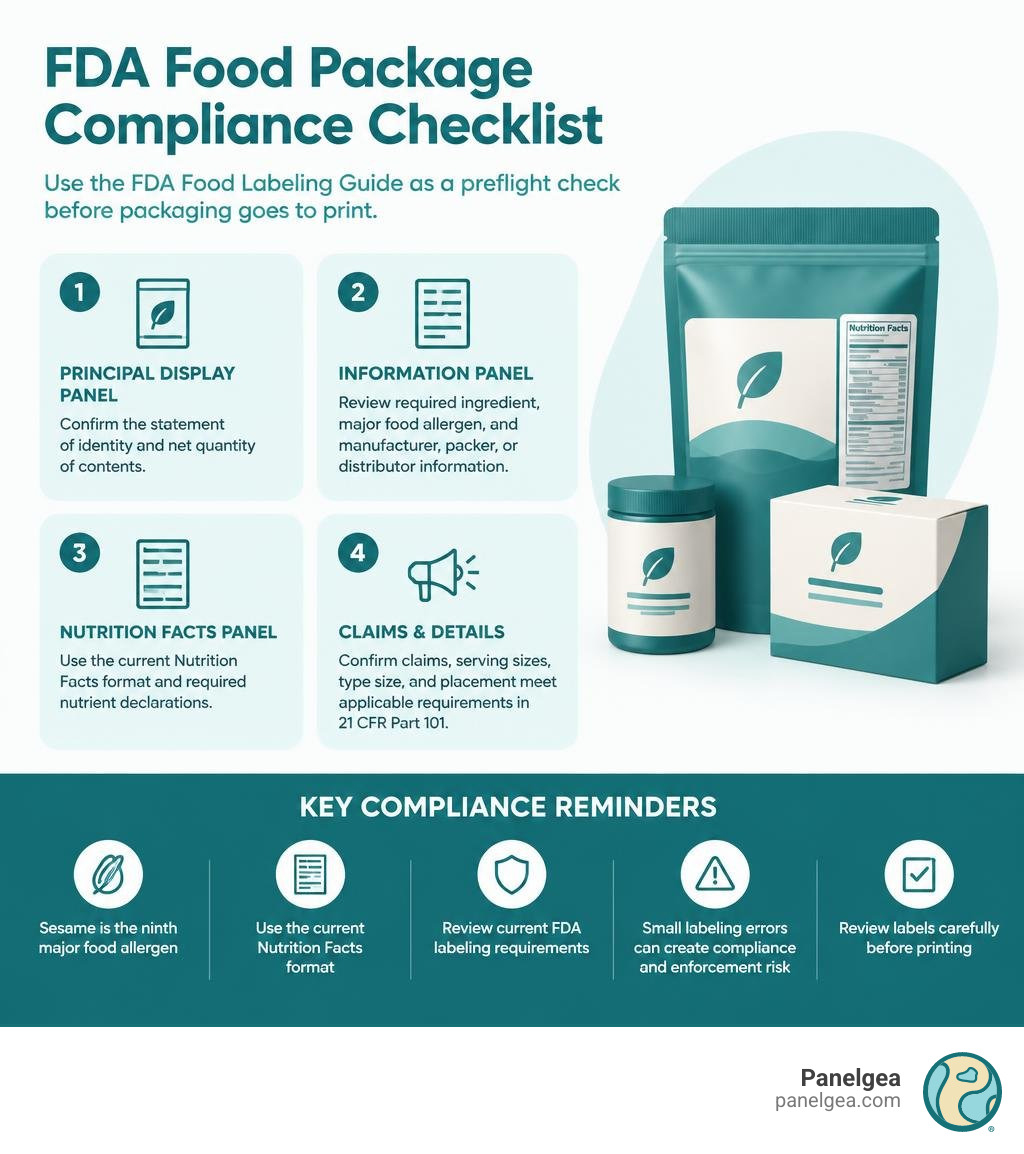
Use the FDA Food Labeling Guide as a preflight check before packaging goes to print. For most FDA-regulated packaged foods, confirm these essentials:
- A clear statement of identity and net quantity on the Principal Display Panel.
- A nearby Information Panel with the ingredient list, allergen disclosure, and business name and address.
- A current Nutrition Facts panel, including added sugars, vitamin D, and potassium when nutrition labeling is required.
- Claims, serving sizes, type size, and placement that meet the applicable rules in 21 CFR Part 101.
Small errors can make a food misbranded, trigger costly artwork changes, delay imports, or create enforcement risk. Current labels also need to account for sesame as the ninth major food allergen, the modern Nutrition Facts format, and FDA’s updated Compliance Program 7321.005 inspection priorities.
Mastering the FDA Food Labeling Guide: Core Packaging Panels and Layout Rules
Designing packaging that satisfies federal inspectors while still catching a shopper’s eye is a classic CPG balancing act. Under Title 21 of the Code of Federal Regulations (21 CFR Part 101), food labels are governed primarily by the Federal Food, Drug, and Cosmetic Act (FD&C Act) and the Fair Packaging and Labeling Act (FPLA). Navigating these rules begins with understanding how the FDA divides packaging real estate into specific functional panels.
The FDA designates two primary locations for mandatory text:
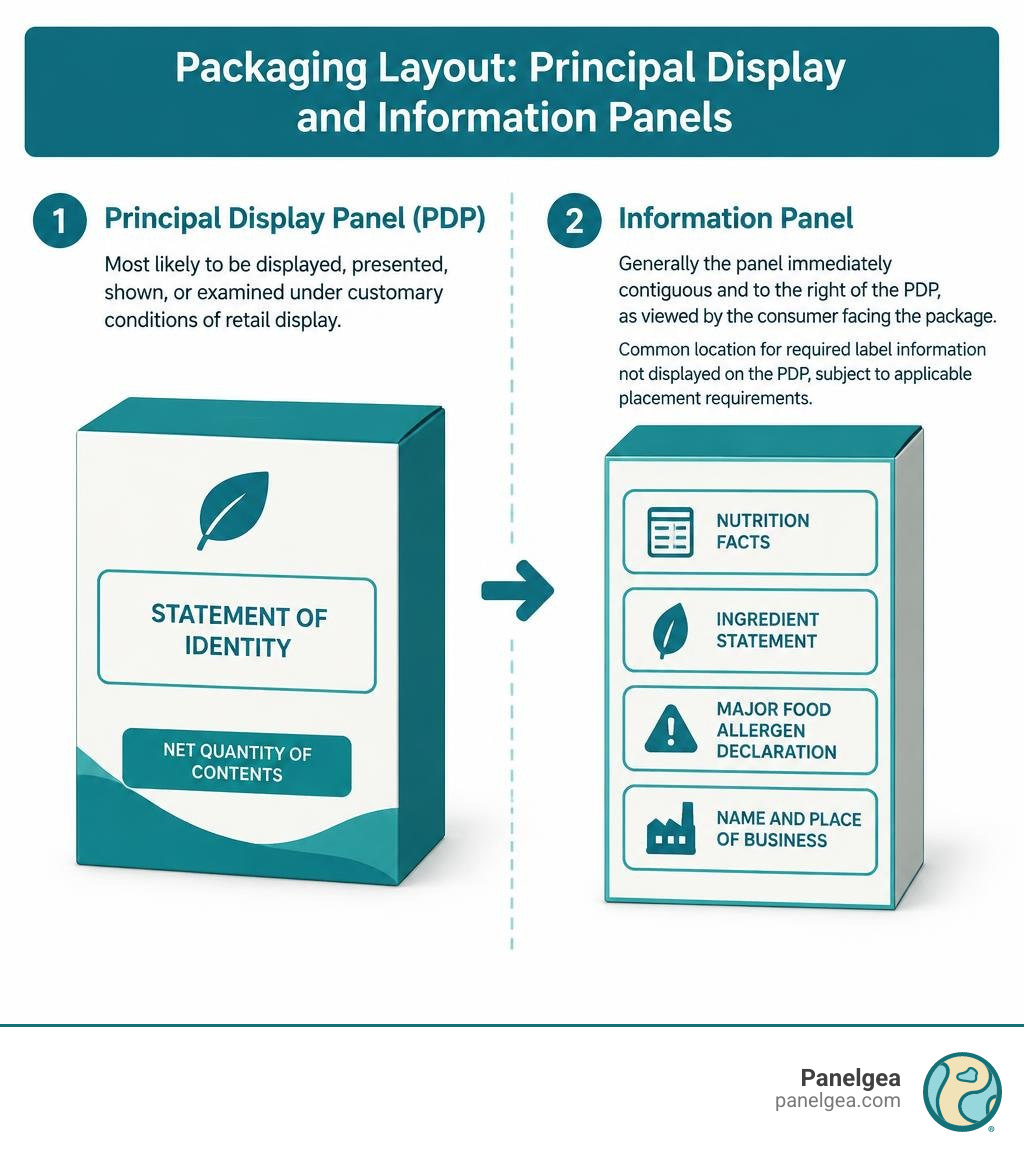
- The Principal Display Panel (PDP): The part of a label that is most likely to be displayed, presented, shown, or examined under customary conditions of display for retail sale (21 CFR 101.1).
- The Information Panel: The panel immediately contiguous and to the right of the PDP, as viewed by the consumer facing the package (21 CFR 101.2). If that surface is unusable, it can be the next consecutive panel to the right.
Calculating the total surface area of the PDP dictates typography rules across the package. For rectangular packages, it is simply height multiplied by width. For cylindrical containers, it equals 40% of the total surface area (height × circumference × 0.4). Establishing these dimensions early ensures compliance with the official Food Labeling Guide and avoids redesigns late in the production cycle.
Principal Display Panel (PDP) Dimensions and Mandatory Declarations
The front-facing PDP must carry two critical pieces of information: the Statement of Identity and the Net Quantity of Contents.
- Statement of Identity (21 CFR 101.3): This is the legal or common name of the food. If a standard of identity exists (e.g., “Cheddar Cheese” or “Peanut Butter”), you must use that exact title. In the absence of an official standard, use an accurate descriptive name or a fanciful name commonly understood by the public. Using an invented marketing moniker like “Protein Crunchies” without adding “Extruded Soy & Oat Snack” right below it renders the product misbranded. The identity statement must appear in bold type, parallel to the base of the container, and be reasonably sized relative to the largest text on the panel.
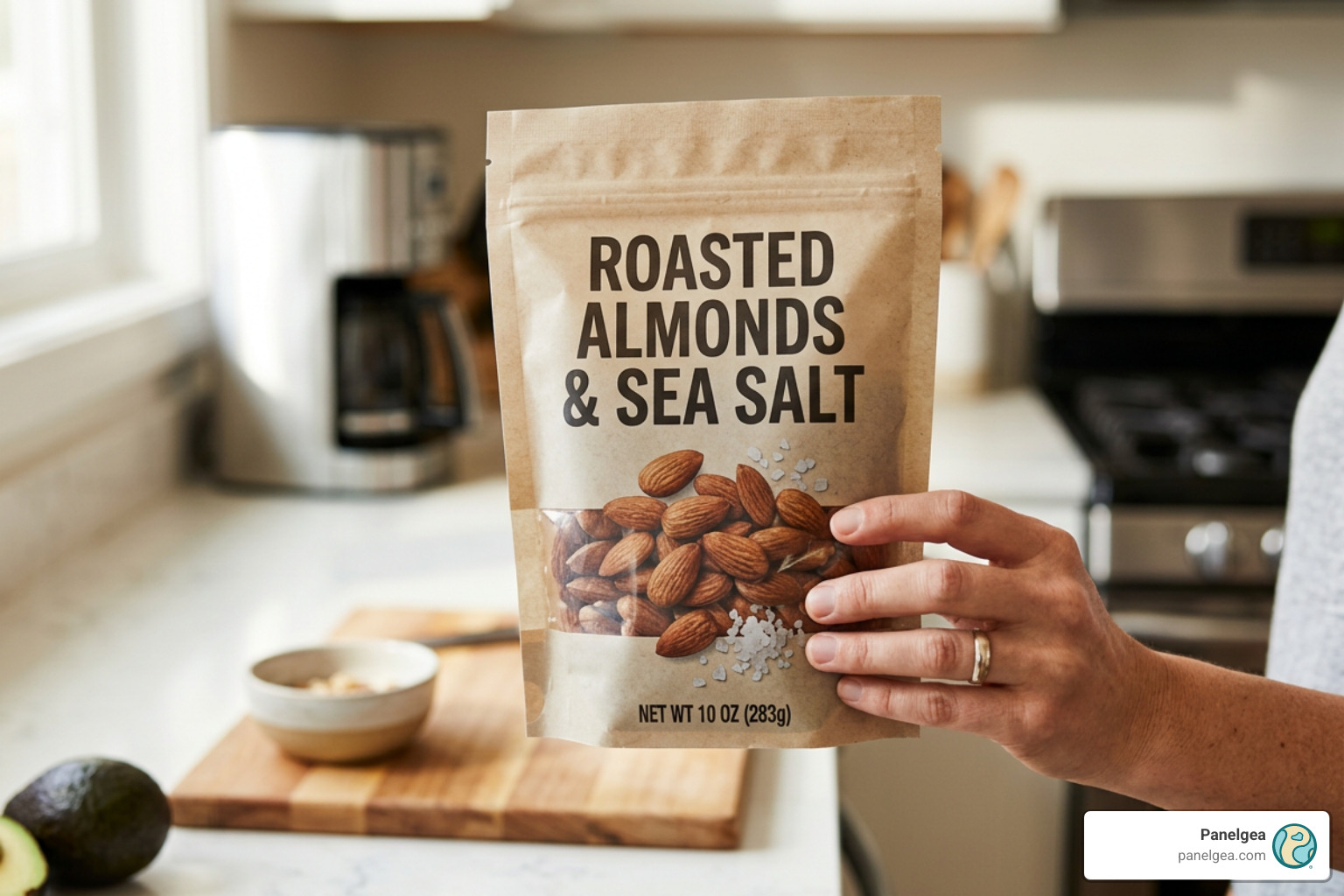
- Net Quantity of Contents (21 CFR 101.105): This declaration tells consumers how much product is inside. It must be positioned in the bottom 30% of the PDP, parallel to the base, with adequate clear space surrounding it. Under federal law, the net quantity must appear in both U.S. Customary (ounces, pounds, fluid ounces) and Metric units (grams, kilograms, milliliters, liters). For example:
Net Wt. 12 oz (340 g).
Minimum type height for the net quantity is tied directly to the area of the PDP:
- Less than or equal to 5 sq. in.: 1/16 in. (1.6 mm)
- Greater than 5 to 25 sq. in.: 1/8 in. (3.2 mm)
- Greater than 25 to 100 sq. in.: 3/16 in. (4.8 mm)
- Greater than 100 to 400 sq. in.: 1/4 in. (6.4 mm)
- Greater than 400 sq. in.: 1/2 in. (12.7 mm)
Information Panel Requirements Under the FDA Food Labeling Guide
The Information Panel is the label panel immediately to the right of the Principal Display Panel (PDP), as viewed by the consumer. When that panel is unusable or unavailable for required labeling, the applicable regulations provide for placement on the next available panel.
Required label information that does not appear on the PDP is commonly presented on the Information Panel, subject to the placement requirements applicable to each declaration. This may include the Nutrition Facts panel, ingredient statement, major food allergen declarations, and the name and place of business of the manufacturer, packer, or distributor.
Required information appearing on the Information Panel generally must be presented together without intervening non-required material that separates required labeling information.
Key requirements detailed in the Food Labeling and Packaging Workshop Reference Guide include:
- Ingredient Statement (21 CFR 101.4): Ingredients must generally be listed in descending order of predominance by weight. Ingredients composed of multiple components must also appropriately declare their sub-ingredients.
- Major Food Allergen Declaration: Major food allergens must be declared in accordance with applicable allergen-labeling requirements. Depending on the labeling approach used, allergens may be identified within the ingredient statement or through a separate “Contains” statement.
- Name and Place of Business (21 CFR 101.5): The label must identify the manufacturer, packer, or distributor and include the required place-of-business information. When the named business is not the manufacturer, an appropriate qualifying phrase such as “Manufactured for” or “Distributed by” must be used.
- Type Size Standards: Information required under § 101.2 generally must be prominent, conspicuous, and at least 1/16 inch (1.6 mm) in height, based on the lowercase letter “o” when upper- and lowercase letters are used, subject to applicable exceptions.
Nutrition Facts Panel Standards and Modern Regulatory Changes
Nutrition labeling underwent its most significant transformation following the Nutrition Labeling and Education Act (NLEA) when the FDA overhauled the Nutrition Facts panel. While compliance dates were phased in between 2020 and 2021, regulatory audits continue to uncover formatting and rounding inconsistencies across both domestic and imported goods.
Reviewing the regulatory context in the Food Labeling: Revision of the Nutrition and Supplement Facts Labels: Guidance for Industry helps teams align everyday packaging with FDA expectations.
Navigating Nutrition Panel Mandates with an FDA Food Labeling Guide
The modern Nutrition Facts panel reflects current dietary science and public health priorities:
| Label Element | Legacy Format (Pre-2016) | Modern Format (Current Mandatory Standard) |
|---|---|---|
| Calories | Standard bold text | Large, prominent bold font (minimum 16 pt for standard labels) |
| Calories from Fat | Mandatory | Removed completely (focus on fat type over total fat calories) |
| Added Sugars | Not declared | Mandatory in grams and % Daily Value (%DV) |
| Mandatory Micronutrients | Vitamin A, Vitamin C, Calcium, Iron | Vitamin D, Calcium, Iron, Potassium (quantitative amounts + %DV) |
| Voluntary Micronutrients | Vitamin D, Potassium | Vitamin A, Vitamin C, and other essential vitamins/minerals |
| Daily Values Reference | Based on 1968 RDIs | Updated based on modern dietary intake data (e.g., Sodium lowered to 2,300 mg) |
| Footnote Text | Lengthy explanation of 2,000/2,500 kcal diets | Concise statement explaining the meaning of % Daily Value |
A notable nuance involves alternative sweeteners and functional fibers. For instance, under current FDA enforcement discretion, allulose may be excluded from the amounts declared for Total Sugars and Added Sugars on the Nutrition Facts label. FDA also permits manufacturers to use 0.4 calories per gram (kcal/g) of allulose when calculating the caloric contribution of allulose in a serving of a product. This treatment reflects FDA’s current enforcement policy rather than an amendment to the underlying Nutrition Facts labeling regulations.
Similarly, isolated or synthetic non-digestible carbohydrates may be included in the Dietary Fiber declaration when they meet FDA’s definition of dietary fiber, including carbohydrates that FDA has determined have a physiological effect that is beneficial to human health. Examples recognized by FDA include inulin and inulin-type fructans, high amylose starch (resistant starch 2), resistant maltodextrin/dextrin, and beta-glucan soluble fiber, among others. Because eligibility depends on the specific carbohydrate and its characteristics, manufacturers should confirm that the particular fiber source qualifies under FDA’s dietary fiber requirements before including it in the declared Dietary Fiber amount.
Dual-Column Labeling, Serving Sizes (RACC), and Recordkeeping Rules
Serving sizes are legally grounded in Reference Amounts Customarily Consumed (RACC) under 21 CFR 101.12. Serving sizes reflect what consumers actually consume in a single sitting, not idealized dietary portions.
- Single-Serving Containers: Any package containing less than 200% of the applicable RACC must be labeled as a single serving, with all nutrition numbers calculated for the entire container.
- Dual-Column Labeling: Products packaged and sold individually that contain at least 200% and up to and including 300% of the applicable RACC generally require dual-column labeling, unless an applicable exception applies.

Because analytical testing methods cannot always differentiate between naturally occurring and added sugars (or isolated versus intrinsic fibers), manufacturers must maintain internal formulation records. Under 21 CFR 101.9(g)(10), companies must retain written records—including recipes, batch logs, and certificates of analysis—for at least 24 months after the food is introduced into interstate commerce.
Allergen Disclosures, Gluten-Free Standards, and Packaging Claims
FASTER Act Sesame Mandate and Major Allergen Declarations
Under the Food Allergen Labeling and Consumer Protection Act (FALCPA) and the Food Allergy Safety, Treatment, Education, and Research (FASTER) Act, the FDA recognizes nine major food allergens:
- Milk
- Eggs
- Peanuts
- Tree Nuts (specific species must be named, e.g., Almonds, Pecans, Walnuts)
- Wheat
- Fish (specific species must be named, e.g., Salmon, Cod)
- Crustacean Shellfish (specific species must be named, e.g., Shrimp, Crab)
- Soybeans
- Sesame (mandatory nationwide allergen under the FASTER Act)
Major food allergens must be declared in one of two formats:
- Parenthetically in the ingredient list: e.g., “Whey (Milk), Hydrolyzed Soy Protein (Soybean).”
- Through a “Contains” statement immediately following or adjacent to the ingredient list: e.g., “Contains: Milk, Soy, Sesame.” If a “Contains” statement is used, it must list all major allergens present in the product, even if they appear by name in the ingredient deck.
For gluten-free claims (21 CFR 101.91), products claiming “gluten-free,” “no gluten,” or “without gluten” must contain less than 20 parts per million (ppm) of gluten. The food cannot contain any raw gluten-containing grain (wheat, rye, barley) unless it has been processed to remove gluten below the 20 ppm threshold.
Regulating Nutrient Content, Structure/Function, and Health Claims
Adding marketing claims introduces specific statutory requirements under 21 CFR 101 Subpart D:
- Nutrient Content Claims: Explicit claims like “Low Fat,” “High Fiber,” or “Sugar-Free” are strictly defined by regulation. For example, “Low Fat” requires 3g or less of total fat per RACC. Furthermore, nutrient content claims cannot be displayed in a font size more than twice the size of the Statement of Identity.
- Health Claims (21 CFR 101.14): These statements describe a relationship between a substance and reduced risk of a disease (e.g., “Adequate calcium throughout life may reduce the risk of osteoporosis”). Authorized health claims require Significant Scientific Agreement (SSA) or an authoritative statement from a scientific body. Qualified Health Claims rely on emerging evidence and require specific explanatory language approved through an FDA petition.
- Structure/Function Claims: These claims describe the role of a substance in affecting the normal structure or function of the human body. For conventional foods, structure/function claims generally must relate to effects derived from the food’s nutritive value and must be truthful and not misleading. Unlike dietary supplement structure/function claims, conventional food claims are not subject to the notification and disclaimer requirements established under 21 U.S.C. 343(r)(6) for dietary supplements. For example, a conventional food containing calcium might state that “Calcium supports strong bones,” provided the claim is appropriately substantiated and otherwise complies with applicable labeling requirements.
Regulatory Jurisdictions, Label Exemptions, and Front-of-Package Trends
Food labeling in the United States involves multiple regulatory bodies and ongoing policy adjustments. Knowing which agency has jurisdiction over your product line is the first step in building a compliant label.
FDA vs. USDA FSIS Jurisdiction and Nutrition Labeling Exemptions
While the FDA oversees roughly 80% of the food supply, the United States Department of Agriculture’s Food Safety and Inspection Service (USDA FSIS) regulates meat, poultry, and certain processed egg products.
Certain businesses and product types may qualify for nutrition labeling exemptions under 21 CFR 101.9(j):
- Low-Gross-Sales Exemption: Certain businesses may qualify for an exemption from nutrition labeling requirements if they have annual gross sales of not more than $500,000, or annual gross sales of foods to consumers of not more than $50,000, provided the applicable conditions of 21 CFR 101.9(j)(1) are met.
- Low-Volume Product Exemption: A food product may separately qualify for a nutrition labeling exemption when the person claiming the exemption employs fewer than an average of 100 full-time equivalent employees and sells fewer than 100,000 units of that product in the United States during a 12-month period. This exemption generally requires an annual notice to FDA and is subject to the additional eligibility requirements of 21 CFR 101.9(j)(18).
- Foods of No Nutritional Significance: Items providing negligible amounts of all mandatory nutrients (less than 1g carbs/protein, zero fat, etc.)—such as plain unsweetened coffee, tea, and pure culinary spices—do not require a full Nutrition Facts panel.
- Retail-Prepared Foods: Ready-to-eat foods prepared and packaged entirely on-site at bakeries, delis, or restaurants are generally exempt from mandatory panel formatting.
Proposed Front-of-Package ‘Nutrition Info Box’ and Compliance Program 7321.005
In January 2025, FDA issued a proposed rule that would require a standardized “Nutrition Info” box on the front of most packaged foods. The proposed box would provide consumers with an at-a-glance indication of the relative amounts of saturated fat, sodium, and added sugars, categorizing each nutrient as “Low,” “Med,” or “High.” The proposal is intended to complement, rather than replace, the Nutrition Facts label. Because this remains a proposed rule, the Nutrition Info box is not currently a mandatory federal labeling requirement.
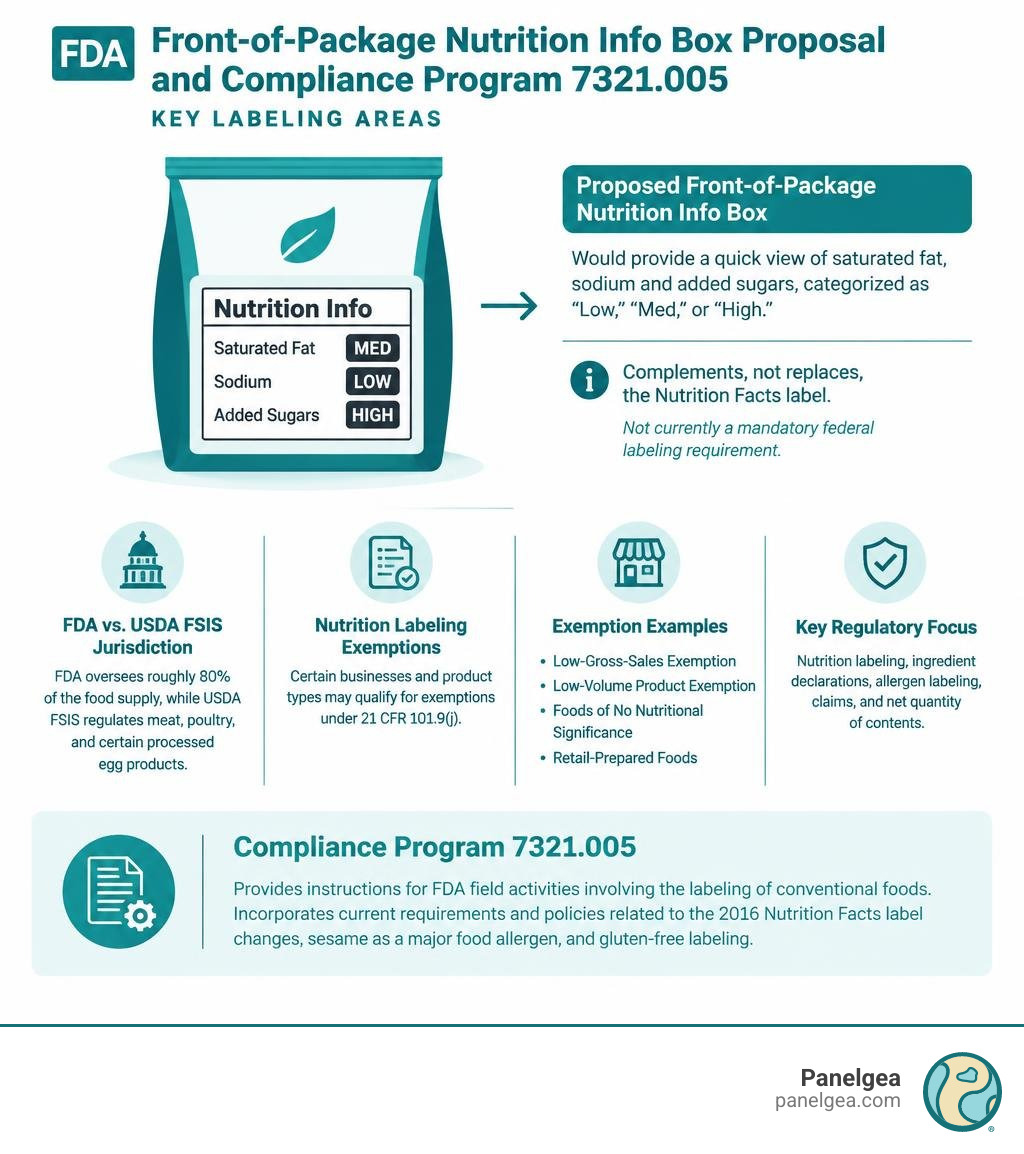
FDA’s Compliance Program 7321.005, General Food Labeling Requirements and Labeling-Related Sample Analysis – Domestic and Import, provides instructions for FDA field activities involving the labeling of conventional foods. The updated program incorporates current requirements and policies related to areas such as the 2016 Nutrition Facts label changes, sesame as a major food allergen, and gluten-free labeling. It also addresses FDA evaluation of general food labeling requirements, including nutrition labeling, ingredient declarations, allergen labeling, claims, and net quantity of contents.
Frequently Asked Questions About FDA Food Labeling
Does the FDA pre-approve food labels before commercial distribution?
No. The FDA does not maintain a pre-market label approval system for conventional food or dietary supplement packaging. Full legal responsibility rests on the manufacturer, packer, and distributor to comply with 21 CFR Part 101 before distributing goods in interstate commerce. Non-compliant labels risk warning letters, import alerts, border detentions, or mandatory market recalls.
How must single-ingredient sugars like honey and maple syrup declare added sugars?
Under the 2018 Farm Bill and FDA guidance, pure single-ingredient sugars and syrups (such as 100% pure maple syrup, honey, and agave nectar) are not required to declare gram amounts on the “Includes Added Sugars” line. However, they must still declare the percent Daily Value (%DV) for Added Sugars. Brands may place a dagger symbol (†) beside the %DV leading to a clarifying footnote explaining that the sugars are naturally occurring in pure honey or syrup.
What are the recordkeeping requirements for dietary fiber and added sugars?
Because analytical methods cannot always independently verify certain nutrient declarations, FDA requires manufacturers to maintain records that substantiate those declarations when specified under 21 CFR 101.9(g). These recordkeeping requirements apply to particular nutrients and circumstances, such as certain declarations of dietary fiber, added sugars, vitamin E, and folate/folic acid, rather than serving as a general recordkeeping requirement for every nutrient on every food label. Required records must provide sufficient information to verify the declared amount and generally must be maintained for at least two years after the food is introduced or delivered for introduction into interstate commerce and made available to FDA upon request.
Conclusion
Developing compliant packaging requires careful coordination across formulation data, typography, panel dimensions, and federal guidelines. With active field checks under Compliance Program 7321.005 and upcoming initiatives like Front-of-Package nutrition labeling, packaging compliance requires steady, repeatable review processes.
At Panelgea, we built our SaaS compliance platform to take the guesswork out of labeling for food, beverage, and dietary supplement brands. Our system integrates ingredient data, automated allergen identification, and dynamic panel formatting to help users efficiently generate Nutrition Facts and Supplement Facts panels aligned with applicable FDA labeling requirements.
Whether you are launching a new product line or auditing an established portfolio, our team is here to help. Reach out to schedule expert labeling consulting and compliance review and build packaging that moves smoothly from design to retail shelves.