
Core Anatomy: Supplement Facts vs. Nutrition Facts Under 21 CFR 101.36
Navigating the federal legal landscape can feel like untangling holiday lights, but knowing whether your product requires a Nutrition Facts panel or a Supplement Facts panel is the absolute baseline of compliance. Conventional foods and beverages fall squarely under 21 CFR § 101.36 – Nutrition labeling of dietary supplements. and 21 CFR 101.9, whereas dietary supplements are governed strictly by 21 CFR 101.36 under the Dietary Supplement Health and Education Act (DSHEA).
The differences between these two panels are far more than skin-deep:
- Zero-Amount Reporting: On a standard food Nutrition Facts panel, you are required to list mandatory nutrients (such as Total Fat, Sodium, or Added Sugars) even if the amount is zero. In stark contrast, a Supplement Facts panel cannot list zero amounts. If a nutrient is not present in a measurable quantity, it must be left off the panel entirely.
- Dietary Ingredient Allowances: Supplement Facts panels allow you to list specialty dietary ingredients that do not have established Reference Daily Intakes (RDIs) or Daily Reference Values (DRVs)—such as ashwagandha, lutein, or CoQ10. Conventional Nutrition Facts panels strictly forbid listing these non-RDI substances.
- Source and Plant Part Declarations: A Supplement Facts panel permits—and often requires—identifying the specific chemical source (e.g., “as ascorbic acid”) and the exact botanical plant part (e.g., “root”, “leaf”, or “aerial parts”) alongside the Latin binomial. Nutrition Facts panels prohibit botanical plant part descriptors.
The chart below outlines these regulatory distinctions side-by-side:
| Feature | Nutrition Facts (21 CFR 101.9) | Supplement Facts (21 CFR 101.36) |
|---|---|---|
| Governing Regulation | 21 CFR 101.9 | 21 CFR 101.36 |
| Listing Zero-Amount Nutrients | Mandatory for required core nutrients | Prohibited unless required for a nutrient content claim. |
| Non-RDI/DRV Ingredients | Not permitted in the facts box | Permitted and required if present |
| Botanical Plant Parts | Prohibited | Required (e.g., leaf, root, bark) |
| Proprietary Blends | Not allowed | Allowed with total weight & descending list |
| Ingredient Source Listing | Handled in separate ingredient statement | Permitted inside panel (e.g., as zinc oxide) |
Understanding this structural baseline prevents the costly mistake of printing a food layout on a dietary product, which immediately misbrands your SKU in the eyes of the FDA.
Real-World Supplement Facts Examples Across Product Categories
To understand how these rules function outside the legal textbooks, we must evaluate specific product formulations. Real-world labels must juggle chemical forms, proprietary complexes, active weights, and specific statutory safety warnings.
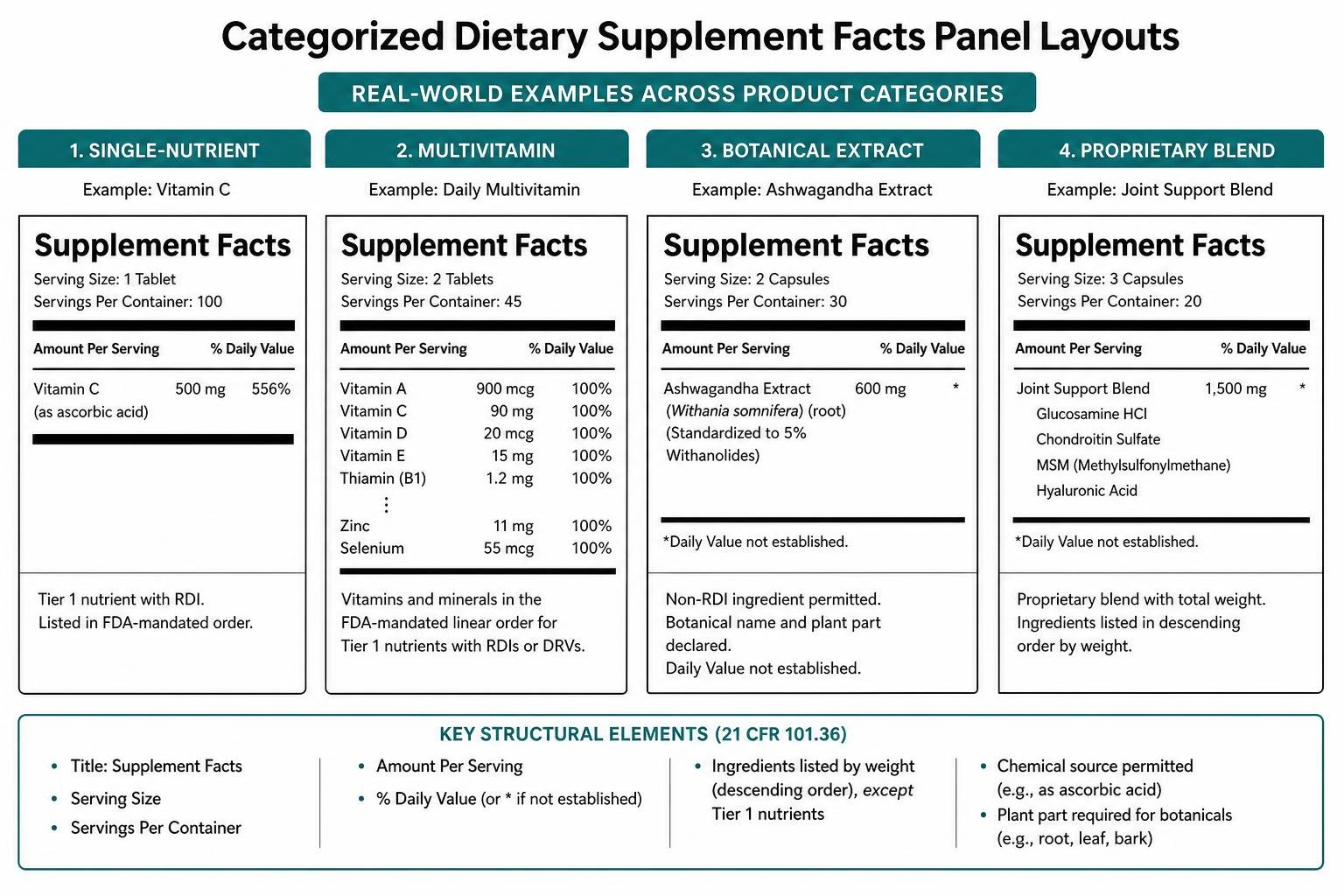
Single-Nutrient and Multivitamin Supplement Facts Examples
Multivitamins and single-nutrient products represent Tier 1 dietary ingredients—substances with established RDIs or DRVs. Under 21 CFR 101.36(b)(2), these nutrients cannot be arranged randomly or strictly by descending weight; they must follow a strictly codified linear order established by the FDA.
The mandatory sequence begins with calories and macronutrients, followed by vitamins and minerals in this exact progression:
- Vitamin A
- Vitamin C
- Vitamin D
- Vitamin E
- Vitamin K
- Thiamin (Vitamin B1)
- Riboflavin (Vitamin B2)
- Niacin
- Vitamin B6
- Folate
- Vitamin B12
- Biotin
- Pantothenic Acid
- Choline
- Minerals (starting with Calcium, Iron, Phosphorus, Iodine, Magnesium, Zinc, Selenium, Copper, Manganese, Chromium, Molybdenum, Chloride, Sodium, Potassium, and Fluoride)
In modern labeling, units of measure must reflect modernized FDA metrics. Vitamin A must be declared in micrograms of Retinol Activity Equivalents (mcg RAE), not raw International Units (IUs). Folate must be declared in micrograms of Dietary Folate Equivalents (mcg DFE), with the specific synthetic folic acid contribution noted in parentheses if applicable. Vitamin D must appear in mcg, though historical IUs can be placed optionally in parentheses alongside it (e.g., 25 mcg (1,000 IU)).
When formulating multivitamins, declared quantities must represent the pure elemental weight of the active nutrient, not the gross weight of the compound. If your formula includes 500 mg of Calcium Carbonate, you must declare the actual elemental Calcium yielded (typically ~200 mg), accompanied by the source descriptor: Calcium (as calcium carbonate) 200 mg.
Botanical and Proprietary Blend Supplement Facts Examples
Formulators often combine standardized herbal extracts into specialized complexes. Under FDA rules, dietary ingredients without established Daily Values are classified as “other dietary ingredients” (Tier 2) and must be placed below a heavy horizontal bar separating them from Tier 1 vitamins and minerals.
When utilizing a proprietary blend to protect an intellectual formulation, specific structural rules apply:
- The blend must be clearly designated with a name like “Proprietary Blend” or an appropriately descriptive term (e.g., “Herbal Energy Complex”).
- The total quantitative weight of the entire blend per serving must be declared on the primary line.
- The constituent ingredients must be indented below the blend name in strict descending order of predominance by weight.
- The % Daily Value column for the blend must display a symbol (such as an asterisk
*or dagger†) that points to the mandatory bottom footnote:*Daily Value (DV) not established.
Crucially, brands cannot use proprietary blends to hide Tier 1 nutrients that have established Daily Values. If your blend contains 50 mg of Vitamin C or 15 mg of Zinc, those nutrients cannot be concealed within the proprietary weight; they must be pulled into Tier 1 and fully declared with their respective % DV.
Furthermore, botanicals must always specify the plant part used (e.g., root, aerial parts, leaf, seed) and indicate whether the ingredient is an extract or raw powdered material.
Specialty Prenatal Supplement Label Layout
Prenatal supplements are among the most heavily scrutinized formulations in the CPG landscape. A classic clinical example can be seen in the Altrixa OB Tablets PRENATAL/POSTNATAL Dietary Supplement, which illustrates critical labeling touchpoints:
- Folate vs. Folic Acid: Prenatal formulas often incorporate advanced forms such as L-5-Methyltetrahydrofolate (L-5 MTHF) alongside or in place of synthetic folic acid to optimize bioavailability, requiring detailed mcg DFE breakdown calculations.
- Targeted % Daily Values: Prenatal labels must calculate Daily Values based on the specific reference intake established for Pregnant and Lactating Women rather than general adults.
- Mandatory Iron Poisoning Warning: Because prenatal formulations contain significant concentrations of iron, federal statute 21 CFR 101.17(e) legally mandates an exact, boxed warning statement:
WARNING: Accidental overdose of iron-containing products is a leading cause of fatal poisoning in children under 6. Keep this product out of reach of children. In case of accidental overdose, call a doctor or poison control center immediately.
Additionally, under the Poison Prevention Packaging Act (16 CFR 1700.14), any dietary supplement packaging containing a total of 250 mg or more of elemental iron across the entire container must utilize child-resistant packaging closures.
Regulatory Formatting and Typography Rules Under 21 CFR 101.36
Designing an FDA-compliant label requires graphic precision. FDA inspectors check font sizes, line weights, and box enclosures just as rigorously as active nutrient levels.
When establishing your print dielines, ensure your layout adheres to these physical rules:
Box Border and Hairlines: The entire Supplement Facts panel must be enclosed in a distinctive outer box rule (typically 0.5 point line weight). Centered horizontal hairlines separate individual dietary ingredients.
Heavy Horizontal Bars: Distinct heavy bars (7 pt line weight) must be placed:
- Directly beneath the Servings Per Container line (above column headers).
- Directly beneath the last Tier 1 (established Daily Value) nutrient, separating it from Tier 2 botanicals/other ingredients.
Medium Horizontal Bars: Medium weight bars (3 pt line weight) must be placed:
- Directly beneath the column headings (Amount Per Serving / % Daily Value).
Type Size Hierarchy:
- The title “Supplement Facts” must be set in bold, larger type than any other text inside the panel (typically a minimum of 8 to 9 points, scaling larger for large packages).
- Column headings (Amount Per Serving, % Daily Value) and general body text must be set in a clear, legible font no smaller than 6 points (with 8 points being the standard baseline for full-sized packaging).
- Footnotes must be no smaller than 6 points.
Excipients and Inactive Ingredients: Non-dietary ingredients—such as flow agents (silicon dioxide), binders (microcrystalline cellulose), lubricants (magnesium stearate), capsule shells (gelatin, hypromellose), and artificial colorings—must never appear inside the boxed Supplement Facts panel. They must be placed strictly below or adjacent to the box under a separate “Other Ingredients:” heading.
To eliminate layout guesswork and format errors, brands can stop guessing calories and build accurate nutrition labels fast using purpose-built compliance tools.
Compliance Pitfalls: Functional Beverages, Allergen Rules, and Penalties
Liquid functional formulations exist on a hazardous regulatory boundary. When developing ready-to-drink functional beverages, brands must explicitly choose whether to market the product as a conventional liquid food (using Nutrition Facts) or as a dietary supplement (using Supplement Facts).
The FDA evaluates product positioning based on the total context of marketing:
- Packaging and Serving Size: A 16-fluid-ounce can designed to quench thirst suggests a conventional beverage, making a Supplement Facts panel inappropriate. Liquid supplements are typically packaged in small dropper bottles, concentrated single-dose shots (e.g., 2 fl oz), or multi-dose liquid bottles with calibrated droppers.
- Terminology: Using words like “beverage”, “drink”, “juice”, “sparkling water”, or “soda” on the display panel legally anchors the product as a food under 21 CFR 101.9. Dietary supplements should use terms like “liquid supplement” or “dietary supplement.”
- Regulatory Filings and Disclaimers: If you make structure/function claims for a dietary supplement (e.g., “Supports cognitive focus”), you must formally submit a Structure/Function Claim Notification to the FDA within 30 days of initial commercial marketing. Furthermore, the packaging must display the mandatory statutory disclaimer:
These statements have not been evaluated by the Food and Drug Administration. This product is not intended to diagnose, treat, cure, or prevent any disease.
Food allergen declarations under the Food Allergen Labeling and Consumer Protection Act (FALCPA) and the FASTER Act are also mandatory for dietary supplements. If your product contains any of the 9 major food allergens (milk, eggs, fish, crustacean shellfish, tree nuts, peanuts, wheat, soybeans, and sesame), they must be clearly stated in the ingredient statement or in an immediate “Contains:” declaration adjacent to the panel.
The financial fallout of ignoring these guidelines is severe. Non-compliance with FDA regulations may lead to warning letters, mandatory retail recalls, product seizures, import alerts, and substantial civil monetary fines. A simple typographic error or miscalculated serving size can easily trigger tens of thousands of dollars in carton scrap, pre-press delays, and legal remediation fees. To avoid these traps, modern CPG brands are turning toward the future of compliance software to validate complex formulations before print tooling.
Frequently Asked Questions About Supplement Facts Panels
When can Servings Per Container be omitted from a supplement facts label?
Under 21 CFR 101.36(b)(1)(ii), the “Servings Per Container” declaration may be omitted only if the total number of servings is identical to the net quantity of contents statement on the principal display panel. For example, if a bottle’s net quantity is stated as “60 Capsules” and the recommended serving size is “1 Capsule”, the servings per container is obvious and may be excluded. However, if the serving size is “2 Capsules” in a 60-capsule bottle, the label must explicitly state “Servings Per Container: 30”.
How must proprietary blends format individual ingredient quantities?
Under DSHEA and 21 CFR 101.36(c), proprietary blends must declare the aggregate quantitative weight of the entire blend per serving on the main blend header line. Individual constituent ingredients are then indented below the blend name and listed strictly in descending order of predominance by weight. Individual weight values for each component are not required, but you cannot use a blend to obscure vitamins or minerals that possess established RDIs/DRVs.
What is the mandatory warning statement required for iron-containing supplements?
Under 21 CFR 101.17(e), any dietary supplement in solid or liquid form containing iron must feature the following exact warning, displayed prominently within a bordered box or in bold type:
WARNING: Accidental overdose of iron-containing products is a leading cause of fatal poisoning in children under 6. Keep this product out of reach of children. In case of accidental overdose, call a doctor or poison control center immediately.
Because accidental overdose of iron-containing products is a leading cause of fatal poisoning in children under 6, this warning is strictly enforced by FDA field inspectors and cannot be modified or paraphrased.
Conclusion
Building compliant dietary supplement labels requires aligning raw ingredient documentation, chemistry, typography, and federal regulations. Whether you are standardizing single-vitamin dosages, balancing complex botanical extracts, or formatting multi-tiered prenatal formulas, your labels must withstand intense regulatory scrutiny.
At Panelgea, we help brands eliminate packaging errors by automating the generation of fully compliant Supplement Facts and Nutrition Facts panels. Our platform handles complex nested proprietary blends, verifies real-time Daily Values, detects allergens, and exports press-ready, editable vector SVG artwork that seamlessly integrates into your packaging dielines. Run your formulations through an automated compliance check today to ensure every panel you send to print is built to pass inspection.