

FDA Labeling Requirements for Food: Start With the Non-Negotiables
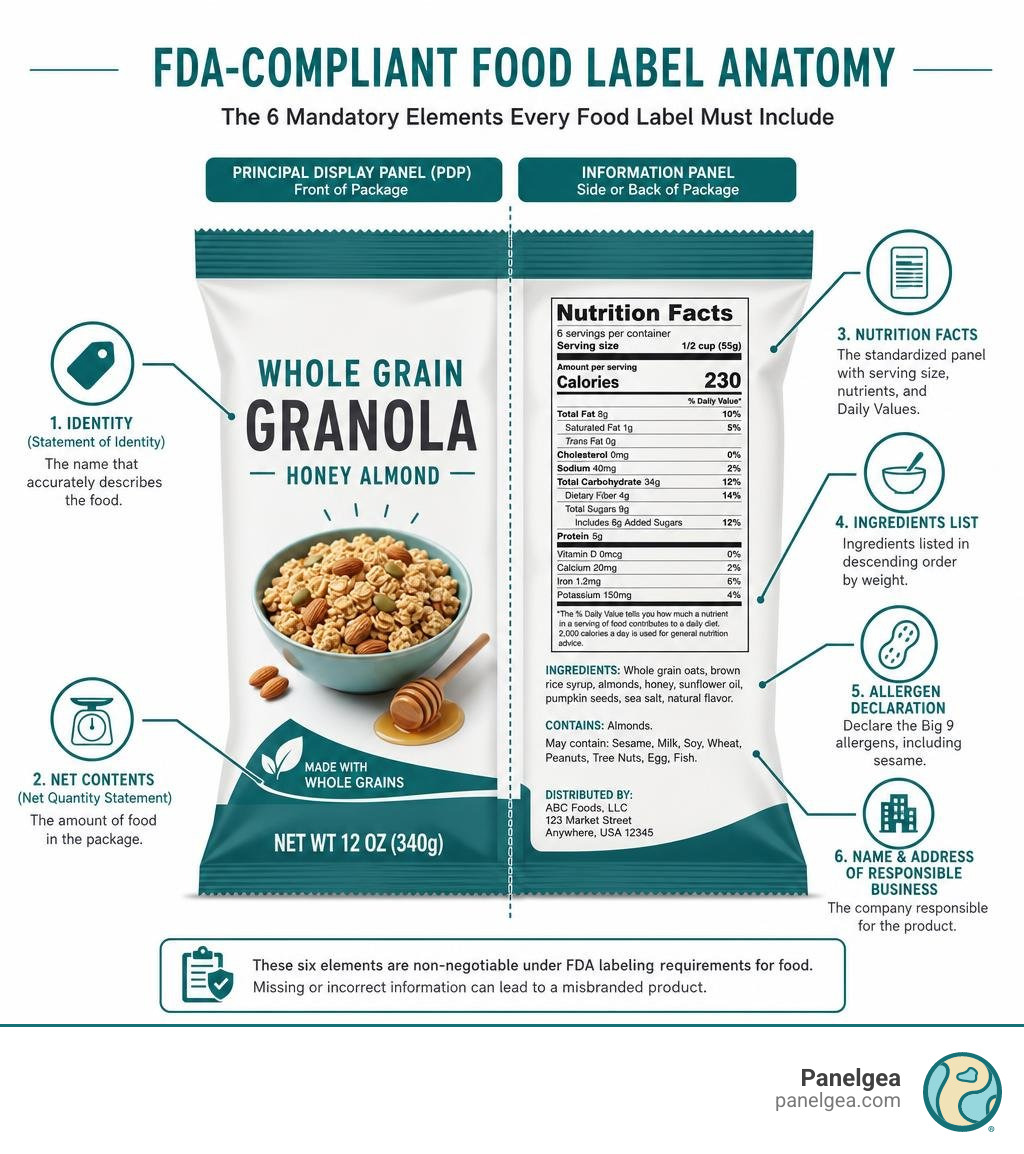
To meet FDA labeling requirements for food, most packaged foods need a compliant statement of identity, net quantity statement, Nutrition Facts label, ingredient list, major allergen disclosure, and the name and address of the responsible business. Put the food name and net contents on the front-facing Principal Display Panel (PDP); place the Nutrition Facts, ingredients, allergens, and business information together on the adjacent Information Panel.
A practical pre-print check is simple:
- Confirm the product name accurately describes the food.
- List ingredients by weight, from greatest to least.
- Declare the Big 9 allergens, including sesame.
- Build the current Nutrition Facts panel using the correct serving size, nutrients, Daily Values, and rounding.
- Review every voluntary claim, such as “low fat” or “gluten-free,” against its FDA definition.
These details matter because an incomplete or misleading label can make a food legally misbranded. FDA oversight now also reflects major modern changes, including sesame’s status as the ninth major allergen and the updated Nutrition Facts format with added sugars, vitamin D, and potassium.
I am Brandon M Griffin, CEO of REJIMUS, Inc., with more than 25 years of leadership in food, dietary supplement, cosmetic, and OTC regulatory strategy. My team here at REJIMUS, Inc. specializes in different areas of the regulations governing products and ingredients in these sectors. Our work on FDA labeling requirements for food includes formulation compliance evaluations, label reviews, claims development, claims substantiation, and software to generated compliant Nutrition and Supplement Facts panels, which we will break down step by step below.
Core FDA Labeling Requirements for Food: The Mandatory Elements
When we dissect federal food packaging laws, we primarily look at the Federal Food, Drug, and Cosmetic Act (FD&C Act), the Fair Packaging and Labeling Act (FPLA), and the Nutrition Labeling and Education Act (NLEA). These statutory pillars, codified under 21 CFR Part 101, exist to ensure consumer transparency and prevent misbranding. The FDA’s core guidelines span well over 130 pages of dense regulatory text, but every compliant package boils down to five fundamental mandatory elements distributed across two specific panels according to established FDA Food Labeling Guide standards.
| Label Element | Primary Purpose | Required Panel Placement | Minimum Statutory Reference |
|---|---|---|---|
| Statement of Identity | Accurately names the food item | Principal Display Panel (PDP) | 21 CFR § 101.3 |
| Net Quantity of Contents | States total weight, measure, or numerical count | Principal Display Panel (PDP) (Bottom 30%) | 21 CFR § 101.7 / FPLA |
| Nutrition Facts Panel | Discloses macro/micronutrients, servings, and %DV | Information Panel (or PDP) | 21 CFR § 101.9 |
| Ingredient Statement | Discloses all ingredients in descending weight | Information Panel (or PDP) | 21 CFR § 101.4 |
| Allergen Declaration | Identifies presence of any “Big 9” major food allergens | Information Panel (or PDP) | 21 U.S.C. 343(w) / FALCPA / FASTER Act |
| Name & Place of Business | Identifies the manufacturer, packer, or distributor | Information Panel (or PDP) | 21 CFR § 101.5 |
Statement of Identity and Common Food Names
The Statement of Identity is the legal, standardized, or common name of your food. Under 21 CFR § 101.3 and 21 CFR Part 102, this cannot be replaced by a fanciful brand name alone. For example, while your brand name might be “Morning Crunch,” the legal statement of identity must clearly read “Toasted Oat Cereal.”
When designing the statement of identity:
- It must appear in prominent bold type on the Principal Display Panel.
- It must generally be oriented parallel to the base on which the package rests.
- It should have a type size reasonably related to the most prominent printed matter on the PDP, generally at least half the size of the largest print.
- If a standard of identity exists in 21 CFR (such as for “Milk Chocolate,” “Mayonnaise,” or “Cheddar Cheese”), the product must meet those exact compositional criteria to use that name.
- If a food resembles a traditional food but is nutritionally inferior (containing lower amounts of essential vitamins, minerals, or protein), it must carry the word “Imitation” in the exact same type size and prominence immediately preceding the traditional food name.
Net Quantity of Contents Declaration
The net quantity statement tells the consumer how much product is inside the package, excluding wrapper and packaging tare weight.
To comply with the FPLA and 21 CFR § 101.7:
- Placement: It must appear distinctly in the bottom 30 percent of the Principal Display Panel.
- Orientation: It must be printed parallel to the base of the package.
- Dual Declaration: The statement must include both U.S. Customary units (ounces, pounds, fluid ounces) and Metric units (grams, kilograms, milliliters, liters). For example:
Net Wt. 12 oz (340 g)or16 fl oz (473 mL). - Measurement Type: Solids, semi-solids, and viscous materials must be declared in terms of weight (prefixed by “Net Wt.”), whereas liquids must be declared in liquid measure (e.g., “Net 12 fl oz”).

Packaging Layout: Principal Display Panel vs. Information Panel
A compliant packaging layout depends on understanding the spatial relationship between the Principal Display Panel (PDP) and the Information Panel defined in FDA General Food Labeling Provisions under 21 CFR 101.1.

Surface Area Calculations and FDA Labeling Requirements for Food
The area of the Principal Display Panel dictates the minimum font sizes required for various mandatory label elements, particularly the net quantity of contents. Calculating this surface area depends entirely on the physical geometry of the container:
- Rectangular Containers: Multiply the full height by the full width of the chosen front side ($Area = Height \times Width$).
- Cylindrical Containers: Under 21 CFR § 101.1, the PDP area is strictly defined as 40 percent of the product of the container’s height times its circumference ($Area = 0.40 \times Height \times \pi \times Diameter$).
- Irregular Shaped Packages: Calculated as 40 percent of the total container surface area, unless there is an obvious, distinct flat display surface (such as the top lid of a triangular cheese wheel).
- Exclusions: When calculating the PDP area, we must exclude container tops, bottoms, can flanges, bottle necks, and package shoulders.
The resulting square inches determine the minimum type size for the net quantity statement:
- $\le 5\text{ sq. in.}$: 1/16 in. (1.6 mm)
- $> 5\text{ to } \le 25\text{ sq. in.}$: 1/8 in. (3.2 mm)
- $> 25\text{ to } \le 100\text{ sq. in.}$: 3/16 in. (4.8 mm)
- $> 100\text{ to } \le 400\text{ sq. in.}$: 1/4 in. (6.4 mm)
- $> 400\text{ sq. in.}$: 1/2 in. (12.7 mm)
Placement Rules and the Prohibition Against Intervening Material
The Information Panel is defined under 21 CFR § 101.2 as the label surface immediately contiguous and to the right of the PDP as faced by the consumer. If that panel is unusable, the next contiguous panel to the right may be used.
The Information Panel must house the Nutrition Facts panel, Ingredient Statement, Allergen Declaration, and Name and Place of Business together.
The FDA strictly enforces the prohibition against intervening material: no non-mandatory information—such as marketing copy, UPC barcodes, recipe ideas, or promotional seals—may be placed between these mandatory statements.
Furthermore, all Information Panel text must maintain a minimum type size of at least 1/16 inch (1.6 mm), measured using the vertical height of the lowercase letter “o”. The typography must maintain high visual contrast against the background and cannot exceed a height-to-width ratio of 3:1.
Nutrition Facts Panel and Allergen Labeling Standards
Modern nutritional labeling under eCFR Title 21 Part 101 reflects significant scientific and regulatory modernization. Additionally, field audits under FDA Compliance Program 7321.005 (“General Food Labeling Requirements and Labeling-Related Sample Analysis – Domestic and Import”) strictly review these panels during routine facility and border inspections.
Modern Nutrition Facts Formatting, Daily Values, and Serving Sizes
The modern Nutrition Facts label features distinct visual hierarchies:
- Serving Sizes & RACC: Serving sizes must reflect what people customarily consume, based on Reference Amounts Customarily Consumed (RACC) tables in 21 CFR § 101.12, rather than arbitrary manufacturer recommendations.
- Single-Serving vs. Dual-Column Containers: If a package contains between 200% and 300% of the applicable RACC, it must provide a dual-column label presenting nutrition information “per serving” and “per container/unit.” Packages containing less than 200% of the RACC are labeled as a single serving.
- Bold Calorie Display: Calories are set in oversized, bold type to draw immediate visual attention. “Calories from Fat” is eliminated.
- Added Sugars: Must be indented beneath Total Sugars, declared in grams and as a percent Daily Value (%DV).
- Mandatory vs. Voluntary Micronutrients: Vitamin D (mcg) and Potassium (mg) are mandatory alongside Calcium (mg) and Iron (mg). Vitamins A and C are voluntary unless added as fortifications.
- Rounding Rules: Specific mathematical rules apply (e.g., calories $<5\text{ cal}$ round to $0$; $5\text{–}50\text{ cal}$ round to the nearest $5$; $>50\text{ cal}$ round to the nearest $10$).
Big 9 Allergen Declarations Under FALCPA and the FASTER Act
The Food Allergen Labeling and Consumer Protection Act (FALCPA), expanded by the Food Allergy Safety, Treatment, Education, and Research (FASTER) Act of 2021, governs the declaration of major food allergens. These Big 9 allergens account for 90 percent of all documented food allergies:
- Milk
- Eggs
- Fish (e.g., Cod, Salmon, Tuna)
- Crustacean shellfish (e.g., Shrimp, Crab, Lobster)
- Tree nuts (e.g., Almonds, Walnuts, Pecans, Cashews, Coconut)
- Wheat
- Peanuts
- Soybeans
- Sesame (Enacted under the FASTER Act)
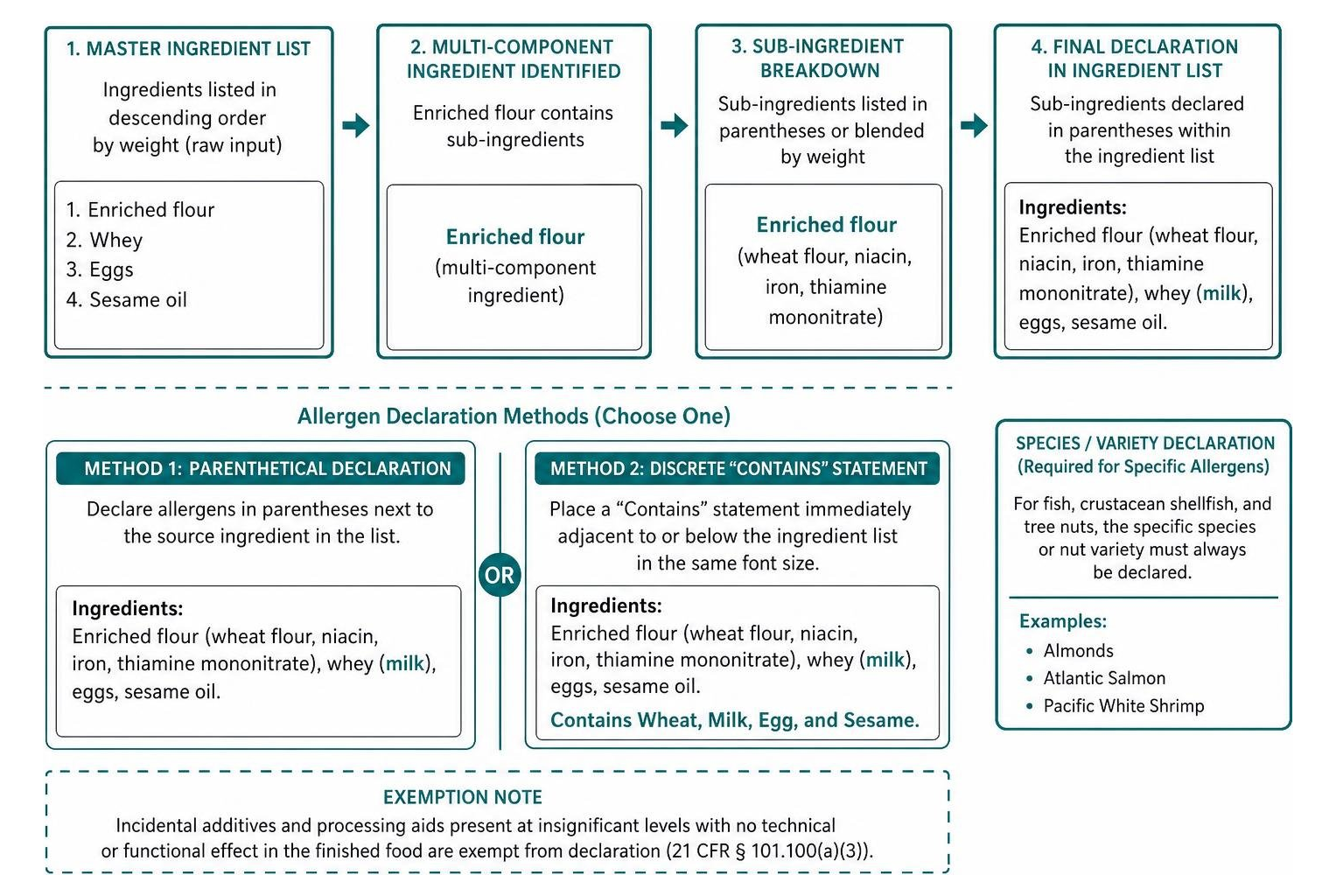
Allergens must be declared using one of two approved methods:
- Method 1: Parenthetical Declaration in the Ingredient List:
Ingredients: Enriched flour (wheat flour, niacin, iron, thiamine mononitrate), whey (milk), eggs, sesame oil. - Method 2: Discrete ‘Contains’ Statement: Placed immediately adjacent to or below the ingredient list in the same font size:
Contains Wheat, Milk, Egg, and Sesame.
Note: For fish, crustacean shellfish, and tree nuts, the specific species or nut variety must always be declared (e.g., “Almonds,” “Atlantic Salmon,” “Pacific White Shrimp”).
Ingredient Lists, Claims, and Packaging Exemptions
A product’s ingredient list provides a transparent accounting of everything inside the package, down to incidental processing aids.
Formatting the Ingredient Statement
- Descending Order by Weight: Ingredients must be listed by their common or usual names in descending order of predominance based on their unbaked or raw input weight ($Weight_{Ing1} > Weight_{Ing2} > Weight_{Ing3}$).
- Sub-Ingredients: Multi-component ingredients (like chocolate chips or enriched flour) must be declared either by listing their sub-ingredients in parentheses:
Semi-sweet chocolate (sugar, chocolate liquor, cocoa butter, soy lecithin)or by blending each individual sub-component into the master list by weight. - Incidental Additives & Processing Aids: Substances present at insignificant levels that have no technical or functional effect in the finished food (e.g., anti-caking processing aids used on equipment) are exempt from declaration under 21 CFR § 101.100(a)(3).
Key Exemptions to FDA Labeling Requirements for Food
Certain foods qualify for full or partial exemptions from mandatory nutrition labeling:
- Small Business Exemption: Retailers and manufacturers with annual gross sales of less than $500,000, or total food sales to consumers under $50,000, provided no nutritional claims are made.
- Low-Nutrient Foods: Plain coffee beans, loose-leaf teas, unsweetened flavor extracts, and pure culinary spices that contain insignificant quantities of all required nutrients.
- Small Packages: Packages with less than 12 square inches of total available label space are exempt from bearing a Nutrition Facts panel, provided a telephone number or address is supplied for consumers to request nutrition details.
- FDA-Regulated Single-Ingredient Game Meats: Certain commercial wild game meats under FDA oversight (such as deer, rabbit, quail, ostrich, and wild turkey) are exempt from standard mandatory nutrition tables.
- Bulk Containers & Foodservice: Foods shipped in bulk containers destined for commercial processing, repacking, or institutional food service.
Voluntary Health Claims and Percentage Juice Rules
When adding voluntary marketing statements, specific FDA regulatory guardrails apply:
- Nutrient Content Claims: Terms like “Low Fat” ($\le 3\text{g}$ per RACC), “Sugar-Free” ($< 0.5\text{g}$ per RACC), or “Good Source of Fiber” ($10\text{–}19\%$ DV) have explicit legal thresholds.
- Gluten-Free Claims: Under 21 CFR § 101.91, foods bearing a “gluten-free” claim must contain less than 20 parts per million (ppm) of gluten.
- Percent Juice Declarations: Under 21 CFR § 101.30, any beverage that purports to contain fruit or vegetable juice (through imagery, flavor names, or vignettes) must display a percentage juice declaration near the top of the Information Panel (e.g.,
Contains 15% Juice).- Mixed juice drinks must qualify their names if characterizing juices are diluted (e.g., “Raspcranberry Flavored Juice Drink”).
- Concentrates reconstituted with water must calculate percentage based on statutory Brix levels under 21 CFR § 101.30(h)(1).
Frequently Asked Questions About FDA Food Labeling
What is the difference between FDA and USDA food labeling rules?
The FDA regulates labeling for approximately 80% of the domestic food supply, including produce, seafood, dairy, baked goods, snacks, beverages, and dietary supplements.
Conversely, the USDA Food Safety and Inspection Service (FSIS) oversees domestic and imported meat (beef, pork, lamb), poultry, and processed egg products. USDA-regulated labels frequently require prior label approval (sketch approval) before entering retail distribution, whereas the FDA does not pre-approve food labels prior to market entry.
When is a qualifying phrase like “Manufactured for” required?
Under 21 CFR § 101.5, the label must state the name and place of business of the manufacturer, packer, or distributor.
If the company listed on the packaging is not the entity that physically manufactured the food (such as when utilizing a co-packer or contract manufacturing facility), the business name must be qualified by an explanatory phrase that reveals the connection, such as:
"Manufactured for [Company Name]""Distributed by [Company Name]""Packed for [Company Name]"
The address must include the street address, city, state, and ZIP code. However, if the business is openly listed in a current city or telephone directory, the street address may be omitted, leaving only the city, state, and ZIP code.
What is the FDA uniform compliance date for new food labeling rules?
To prevent food manufacturers from needing to execute costly packaging overhauls every few months, the agency utilizes an established regulatory mechanism announced in the Federal Register Uniform Compliance Date notice.
The FDA sets a uniform compliance date roughly every two years, giving manufacturers a predictable runway to deplete existing inventory. For final food labeling rules published between January 1, 2025, and December 31, 2026, the FDA established January 1, 2028, as the uniform compliance date. Products introduced into interstate commerce on or after that date must fully comply with newly finalized labeling regulations.
Conclusion
Navigating federal food labeling requirements demands precision across typography, mathematical calculations, panel geometry, and allergen compliance. Overlooking small details—such as improper RACC serving calculations, missing a “Big 9” allergen declaration like sesame, or violating the prohibition against intervening material—can quickly expose a brand to regulatory warning letters, import detentions, or costly product misbranding recalls.
Achieving total audit readiness requires harmonizing your packaging directly with 21 CFR Part 101 and FDA Compliance Program 7321.005 guidelines. By leveraging a robust automated facts panel software platform like Panelgea, with integrated compliance checks for every required aspect of a given label, CPG brands and food manufacturers can streamline Supplement and Nutrition Facts generation, automate complex nested blend calculations, verify allergen disclosures, and export compliant, print-ready SVG artwork without the regulatory headaches.