

Food startups often encounter severe regulatory hurdles when creating packaging and artwork. The most critical mistakes include failing to disclose use of ingredients or components, omitting major food allergens under FALCPA/FASTER Act rules, confusing conventional Nutrition Facts with Supplement Facts panels, or using volume-to-gram measurements that distort batch weights. The biggest mistake is with being over reliant on theoretical nutritional values rather than actual laboratory nutritional analysis on the final formula or recipe. Understanding these errors is essential for FDA compliance and consumer safety.
Mistake 1: Failing to List Ingredients or present accurately in order of Predominance of Weight, including for Disclose Sub-Ingredients
Under FDA regulations (specifically 21 CFR §101.4), all ingredients in a conventional food or beverage must be listed on the information panel in descending order of predominance by weight. That sounds straightforward, but it trips up emerging food startups constantly. The most frequent compliance violation occurs when brands fail to properly account for compound ingredients and their underlying sub-ingredients.
If you purchase an ingredient that is made of multiple smaller components—such as chocolate chips, soy sauce, enriched flour, or royal icing—you cannot simply write “chocolate chips” or “royal icing” on your retail label. The law requires you to disclose every single sub-component.
For instance, writing Royal Icing alone is non-compliant. Instead, the correct parenthetical declaration must read:
Royal Icing (Sugar, Meringue Powder, Water)
This rule applies whether you are scaling into major retail distribution or operating under local cottage food regulations. While some cottage food laws in the U.S. allow home-based entrepreneurs to sell baked goods, candies, and granolas directly to consumers, state departments of agriculture still require strict descending-weight parenthetical breakdowns for every compound item used.
When you prepare your formulation, you must stop guessing calories and build accurate nutrition labels fast by tracking the exact weight of each raw constituent before mixing.
Handling Complex Formulation Breakdown
Formulating complex foods requires looking closely at moisture loss and the differences between raw batch weight and final package weight. Ingredients must be ordered based on their weight at the time they are added to the batch.
If you add 50 pounds of water to a dough formulation, water might be the second heaviest raw ingredient going into the mixer. Even if 80% of that water evaporates during baking, its position in the ingredient statement is determined by its initial formulated weight, unless specific regulatory exceptions apply.

Here is how common formulation mistakes compare against fully compliant declarations:
| Product Concept | Non-Compliant Ingredient Declaration | Compliant FDA Ingredient Declaration | Why It Fails |
|---|---|---|---|
| Artisan Chocolate Chip Cookies | Enriched Flour, Sugar, Butter, Chocolate Chips, Eggs, Vanilla, Baking Soda, Salt. | Enriched Flour (Wheat Flour, Niacin, Reduced Iron, Thiamine Mononitrate, Riboflavin, Folic Acid), Sugar, Butter (Cream, Salt), Semi-Sweet Chocolate Chips (Sugar, Unsweetened Chocolate, Cocoa Butter, Soy Lecithin, Natural Vanilla Extract), Eggs, Vanilla Extract, Sodium Bicarbonate, Salt. | Fails to disclose sub-ingredients of enriched flour, butter, and compound chocolate chips. Uses unapproved common name for baking soda. |
| Glazed BBQ Jerky | Beef, BBQ Sauce, Brown Sugar, Salt, Spices. | Beef, BBQ Sauce (Tomato Puree [Water, Tomato Paste], Distilled Vinegar, Cane Sugar, Molasses, Salt, Mustard Flour, Spices, Garlic Powder), Brown Sugar, Salt, Black Pepper, Onion Powder. | “BBQ Sauce” is a compound mixture requiring full parenthetical disclosure down to secondary sub-ingredients. “Spices” was listed generically when specific spices needed isolation. |
| Decorated Sugar Cookies | Flour, Sugar, Shortening, Eggs, Royal Icing, Food Coloring. | Enriched Bleached Flour (Wheat Flour, Malted Barley Flour, Niacin, Iron, Thiamine Mononitrate, Riboflavin, Folic Acid), Sugar, Vegetable Shortening (Palm Oil, Soybean Oil), Whole Eggs, Royal Icing (Powdered Sugar [Sugar, Cornstarch], Water, Meringue Powder [Egg Whites, Sugar, Acacia Gum]), Red 40 Lake, Yellow 5. | Omits sub-ingredients for royal icing and enriched flour. Leaves artificial colors listed as generic “Food Coloring.” |
Mistake 2: Overlooking Major Allergens and FALCPA/FASTER Act Rules

Failing to properly declare major food allergens is the number one cause of FDA food recalls in the United States. Under the Food Allergen Labeling and Consumer Protection Act (FALCPA) and the FASTER Act, food manufacturers must clearly identify all major food allergens present in their products.
As of recent regulatory updates, the FDA recognizes 9 major food allergens:
- Wheat
- Milk
- Eggs
- Peanuts
- Tree nuts (specific species must be named, e.g., Almonds, Pecans, Walnuts, Coconut)
- Soybeans
- Fish (specific species must be named, e.g., Wild Salmon, Cod, Tuna)
- Crustacean shellfish (specific species must be named, e.g., Crab, Lobster, Shrimp)
- Sesame (added officially under the FASTER Act)
A common pitfall is forgetting to declare allergens hidden inside compound ingredients or processing aids. For example, Worcestershire sauce often contains anchovies (fish), and standard baking sprays frequently contain soy lecithin (soy).
If you use a “Contains” statement, it must list all major allergens present in the product, even if they are already named in the ingredient list. You cannot mention milk in the ingredients and then only write Contains: Wheat below it.
Furthermore, voluntary advisory statements such as “May Contain Traces of Peanuts” or “Manufactured in a facility that processes Tree Nuts” cannot be used as a substitute for Good Manufacturing Practices (GMPs) or proper allergen controls. State health and agricultural inspectors will quickly flag improper allergen declarations on direct-to-consumer and retail packaged goods alike.
Mistake 3: Confusing Conventional Food Panels With Dietary Supplement Facts
Many modern wellness brands cross the line between conventional foods and dietary supplements without realizing that the regulatory frameworks governing them are entirely distinct. This includes not just for what correct panel is required, but also the use of certain claims and other critical formatting differences, including, but not limited to the use of Dietary Ingredients versus Food Ingredients.
Conventional foods and beverages are regulated under 21 CFR §101.9 and require a Nutrition Facts panel. Dietary supplements are governed under 21 CFR §101.36 and require a Supplement Facts panel. Putting the wrong panel on your product can lead directly to warning letters, product seizures, or mandatory retail pullbacks.
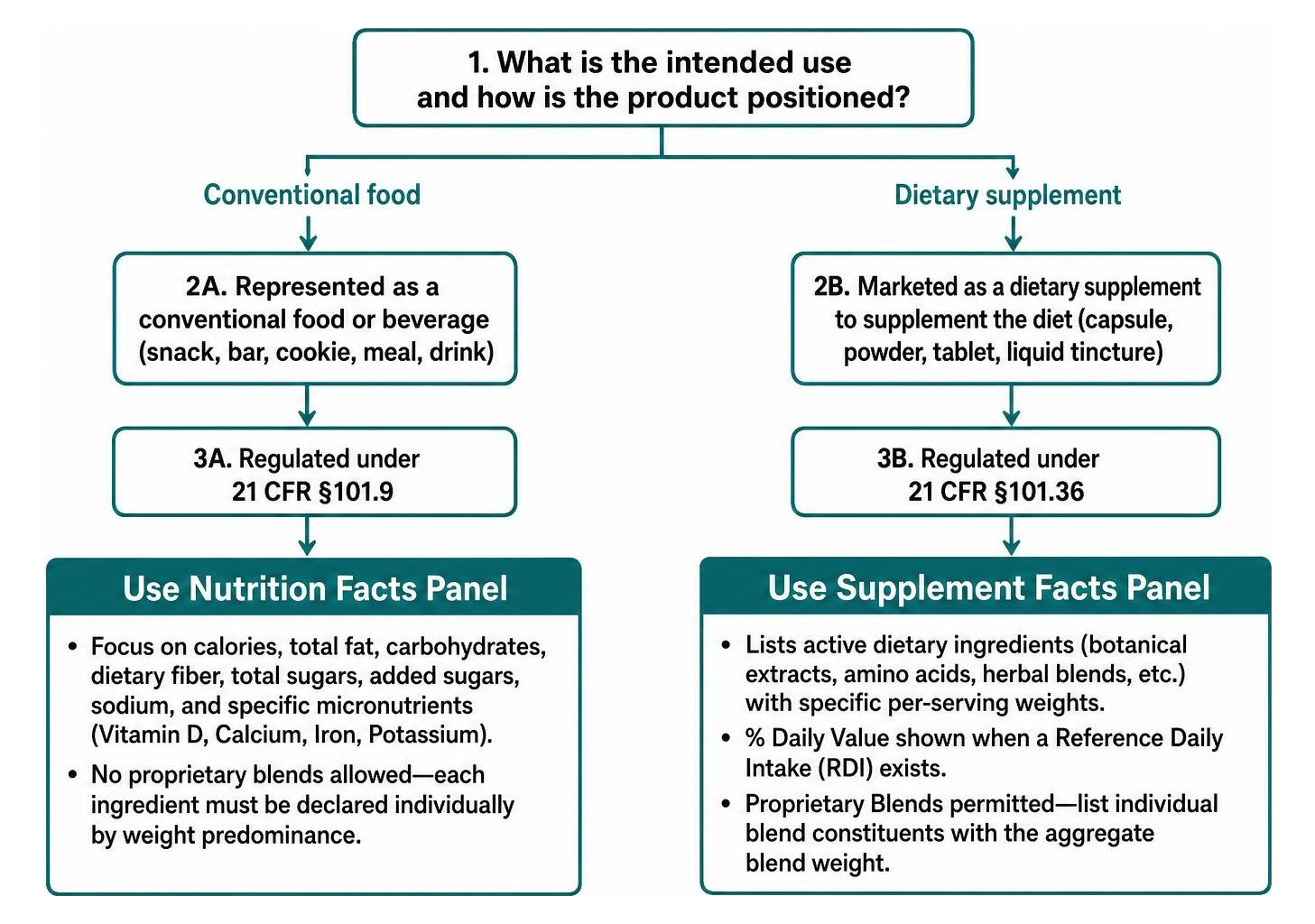
Here are the key structural and legal differences:
- Product Identity and Positioning: If your product is represented as a conventional food (such as a beverage, snack bar, cookie, or meal replacement), it must carry a Nutrition Facts label. If it is marketed specifically as a dietary supplement in capsule, powder, tablet, or liquid tincture form to supplement the diet, it should have a Supplement Facts panel. While there are some overlapping food forms, e.g. gummy or bar, some are clearly defined.
- Nutrient and Active Ingredient Declarations: Nutrition Facts panels focus heavily on calories, total fat, carbohydrates, dietary fiber, total sugars, added sugars, sodium, and specific mandatory micronutrients (Vitamin D, Calcium, Iron, and Potassium). In contrast, Supplement Facts panels list active dietary ingredients (like botanical extracts, amino acids, or herbal blends) with specific per-serving weights, regardless of whether a standard Reference Daily Intake (RDI) or Daily Value (% DV) exists.
- Proprietary Blends: Dietary supplements permit the use of “Proprietary Blends,” where you list individual blend constituents alongside the aggregate blend weight in order of predominance, which also requires specific fact panels formatting and presentation. Conventional foods never allow proprietary blends; every ingredient must be declared individually by weight predominance.
- Excipients and Inactives: On a Supplement Facts panel, inactive ingredients, binders, and capsule shells are declared below the panel under an
"Other ingredients:"line item. On a conventional food label, every single ingredient is integrated directly into the main ingredient statement.
If you are developing a functional food or beverage, you can review our step-by-step tutorials to understand how formulation ingredients dictate label layout.
How an Ingredient Label Generator Eliminates Costly Compliance Errors
Manually calculating nutritional profiles, translating recipes into complex parenthetical statements, and adjusting for RDI percentages is slow and prone to human error. Most online tools either charge $20 to $200 per recipe or force you into limited and albeit rigid templates that fail to export print-ready packaging artwork, requiring additional modifications or graphic design re-builds, which then add additional legal and regulatory reviews i.e. more time and money.
Using a modern, dedicated ingredient facts panel generator removes the guesswork by automating formulation math, cross-referencing regulatory standards, and providing clean vector SVG exports that drop right into your packaging designer’s prepress workflow.
Automating Sub-Ingredient Breakdowns
When designing packaged foods, manually unspooling compound ingredients like enriched flour, chocolate coatings, spice blends, and seasonings takes hours of cross-referencing spec sheets.
An advanced platform connects directly to databases like the USDA FoodData Central, which houses over 600,000 raw foods, commodity items, and branded ingredients.
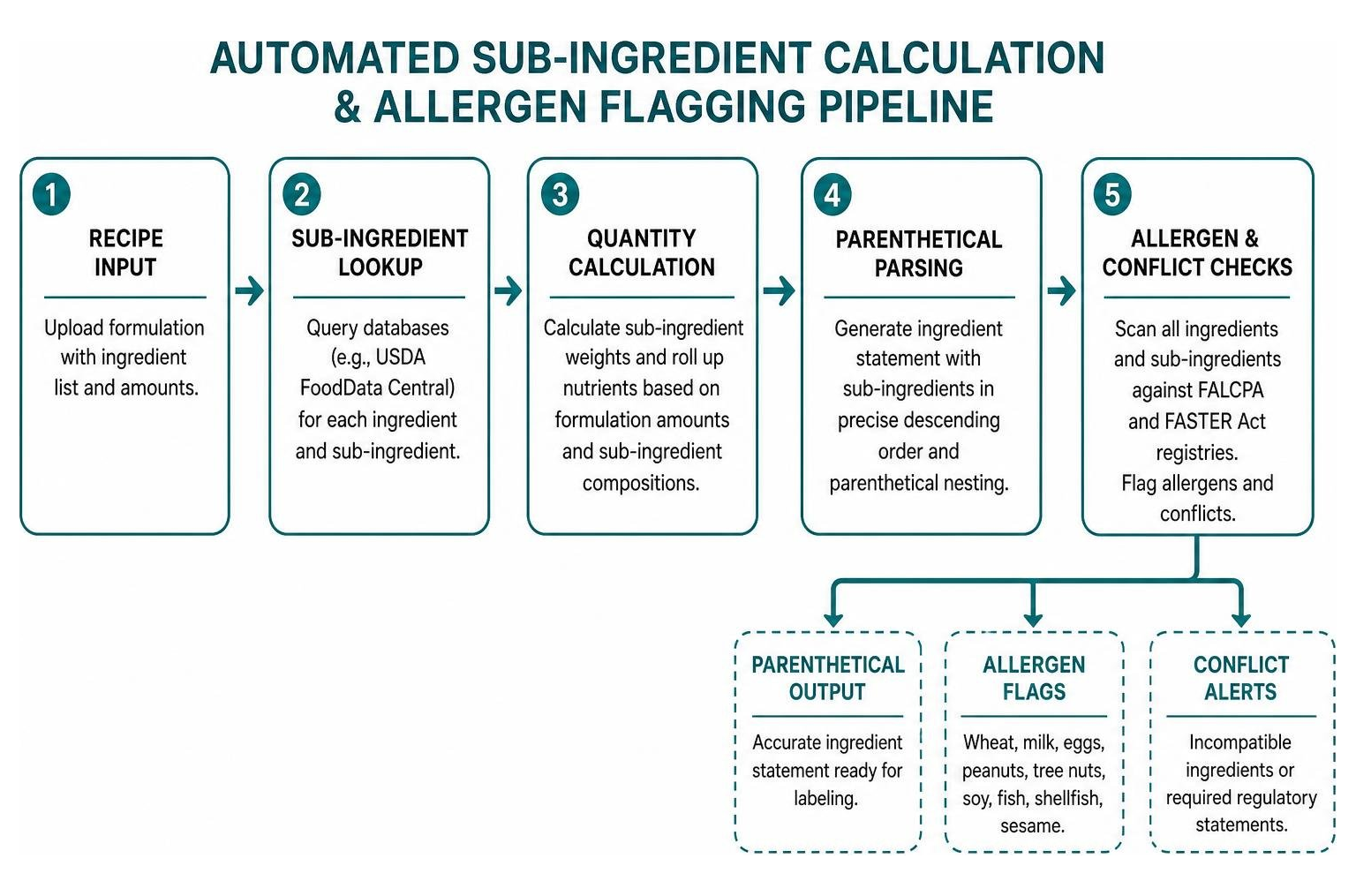
This automated pipeline provides three major safeguards:
- Parenthetical Parsing: Automatically nests compound elements in precise descending order without manual typing mistakes.
- Automated Allergen Detection: Scans every ingredient and sub-ingredient against the FALCPA and FASTER Act registries to flag wheat, milk, eggs, peanuts, tree nuts, soy, fish, shellfish, and sesame instantly.
- Conflict Checks: Flags ingredients that cannot be combined or that require specific regulatory qualifying statements under FDA standards of identity.
If you have questions about standard identity rules or compound nesting, our FAQ breaks down common edge cases.
Preventing Volume-to-Gram Measurement Flaws
One of the largest hidden culprits behind inaccurate ingredient and nutrition labels is relying on volume measurements instead of mass. In a commercial kitchen or small bakery, measuring in cups, tablespoons, or fluid ounces introduces massive variances.
Standard volume measures can vary in weight by 20% to 30% depending on how tightly packed an ingredient is. Consider flour:
- 1 cup of sifted all-purpose flour: ~100 grams
- 1 cup of unsifted, packed all-purpose flour: ~150 grams or more
That 50% jump completely distorts your formulation’s descending weight order, throws off your calculated caloric density, and invalidates your Nutrition Facts panel.
Furthermore, formulation changes during thermal processing—such as water loss during baking or the fact that boiling can reduce water-soluble vitamins (like B vitamins and vitamin C) by 15% to 55%—make mass-based calculations essential.
An intelligent labeling platform converts all your measurements into exact gram weights, normalizes batch totals, adjusts for yield loss, and generates an exact, FDA-compliant declaration every single time.
Frequently Asked Questions About Food Ingredient Labeling
How are sub-ingredients formatted on an FDA ingredient declaration?
Sub-ingredients must be listed parenthetically immediately after the common or usual name of the compound ingredient, arranged in descending order of predominance by weight within that compound mixture.
For example, if you use enriched flour, the format must be:
Enriched Flour (Wheat Flour, Niacin, Reduced Iron, Thiamine Mononitrate, Riboflavin, Folic Acid)
If a sub-ingredient itself contains components (such as a chocolate chip containing soy lecithin), secondary parentheses or brackets should be used:
Cookie Dough (Enriched Flour [...], Semi-Sweet Chocolate Chips [Sugar, Chocolate, Cocoa Butter, Soy Lecithin])
What are the 9 major food allergens required on US food labels?
Under FALCPA and the FASTER Act, the 9 major food allergens that must be clearly disclosed are:
- Wheat
- Crustacean shellfish (e.g., shrimp, crab, lobster)
- Eggs
- Fish (e.g., salmon, cod, tuna)
- Peanuts
- Milk
- Tree nuts (e.g., almonds, pecans, walnuts, cashews, coconut)
- Soybeans
- Sesame
Allergens can either be declared within the ingredient statement itself using their common food source names or listed in a separate Contains: statement placed immediately adjacent to the ingredient list.
When is a product required to use Supplement Facts instead of Nutrition Facts?
A product must carry a Supplement Facts panel (regulated under 21 CFR §101.36) when it is legally marketed and sold as a dietary supplement intended to add nutritional value to the diet, rather than as a conventional food or sole item of a meal.
Dietary supplements are typically delivered in forms like capsules, tablets, softgels, powders, or liquid drops, and they may include dietary ingredients like botanicals, probiotics, herbs, amino acids, and enzymes.
If the product is represented as a conventional food (e.g., snack bar, cookie, RTD canned beverage) it must carry a standard Nutrition Facts panel. Some exceptions exist around certain forms, but then not only do all the other labeling regulations apply, but also the method of manufacture whereby Dietary Supplements are regulated under 21 CFR Part 111, and conventional foods fall under 21 CFR Part 117.
Most notably, under these respective regulations, the testing becomes critical. Most fact panel creators or recipe builders currently available on the market focus on the user to manually input nutritional values or simply know the rules, and present only limited options for output. The focus of such tools is usually to interpret costing to aid in ordering or supply chain management, rather than true and proper regulatory compliance which it the real need. Or get a “facts panel” that is good enough. Now whether the user is allowed to manually input ingredient nutritional values or import ingredient nutritional value in order to predict or calculate theoretical nutritional values or if such can utilize actual laboratory nutritional analysis remain a very big issue in the CPG industry. Often manufacturers, formulators and even brand owners are in a rush to print labels, and with the formulations not finalized at scale or commercial production, actual test values on the finish products differ from theoretical ones calculated from just ingredient values. True protein values, sugar amounts, class 1 nutrient values, certain content claims, and other nutrient values for components that may have stability challenges are all areas that traditional facts panel calculators completely miss or fail to make users aware of, leaving brands open to substantial legal and regulatory risks, especially for dietary supplements.
Conclusion
Formatting compliant ingredient lists and nutrition panels is not just a regulatory hurdle—it is a foundational pillar of building a trustworthy, scalable CPG brand. A single misdeclared allergen, unlisted compound sub-ingredient, or incorrect panel format can lead to costly packaging reprints, retail chargebacks, or serious FDA enforcement action.
By moving away from error-prone spreadsheets and manual calculations, food startups can scale their product lines with complete confidence. Explore how Panelgea streamlines your packaging workflow with fully automated ingredient breakdowns, real-time USDA database integrations, guaranteed regulatory checks, and print-ready vector artwork exports built for commercial packaging success.