

Understanding FDA on Sugar Regulations and Labeling Standards
Under the statutory framework established in 21 CFR 101.9, the modern nutrition panel requires an explicit declaration of Added Sugars positioned directly beneath the line for Total Sugars. The mandate was designed to eliminate the ambiguity of previous panel formats, where naturally occurring carbohydrates and processed sweeteners were lumped together into a single number.
According to official guidance on Added Sugars on the Nutrition Facts Label | FDA, Total Sugars represents the sum of all intrinsic, naturally occurring sugars alongside any processed or refined sweeteners present in the product. Naturally occurring sugars include compounds like lactose found in fluid dairy ingredients and fructose occurring naturally in whole fruits and vegetables. Because public health agencies do not recommend restricting whole-food intrinsic sugars, there is no established Percent Daily Value (%DV) for Total Sugars.
In contrast, Added Sugars are defined as sugars that are introduced during food preparation, packaging, or commercial processing. This category includes:
- Free mono- and disaccharides such as commercial sucrose, glucose, and dextrose
- Packaged table sugars, syrups, and honey
- Sugars from concentrated fruit and vegetable juices that exceed the single-strength Brix baseline
- Chemically modified nutritive carbohydrates
From a regulatory standpoint, standard table sugar (sucrose) is classified as a nutritive sweetener under CAS Registry Number 57-50-1, evaluated in Select Committee on GRAS Substances (SCOGS) Report No. 69, and affirmed as Generally Recognized as Safe under 21 CFR 184.1854 as indexed in the FDA Substances Added to Food (formerly EAFUS) database.
The agency created specific accommodations for single-ingredient sweeteners such as pure honey, pure maple syrup, and bags of granulated table sugar. Labeling a bottle of 100% pure maple syrup with “Includes 50 g Added Sugars” caused widespread consumer confusion by implying that foreign sucrose had been added to an unadulterated product. Under current compliance guidance, single-ingredient sweeteners are not required to print the text declaration on the gram line, but they must still declare the %DV alongside a clarifying footnote. This footnote explains that the product contributes a specific gram amount of sugar toward the recommended 50-gram daily intake ceiling.
Technical Stance of the FDA on Sugar in Juice Concentrates and Syrups
Formulating with fruit and vegetable derivatives introduces technical math to label compliance. Under the FDA Draft Guidance on Added Sugars and Juice Concentrates, sugars from concentrated juices must be declared as Added Sugars to the extent that they exceed the natural sugar levels found in an equivalent volume of 100% single-strength juice.
To calculate these values, food technologists compare the Brix concentration of the ingredient against the standard minimum Brix values codified in 21 CFR 101.30:
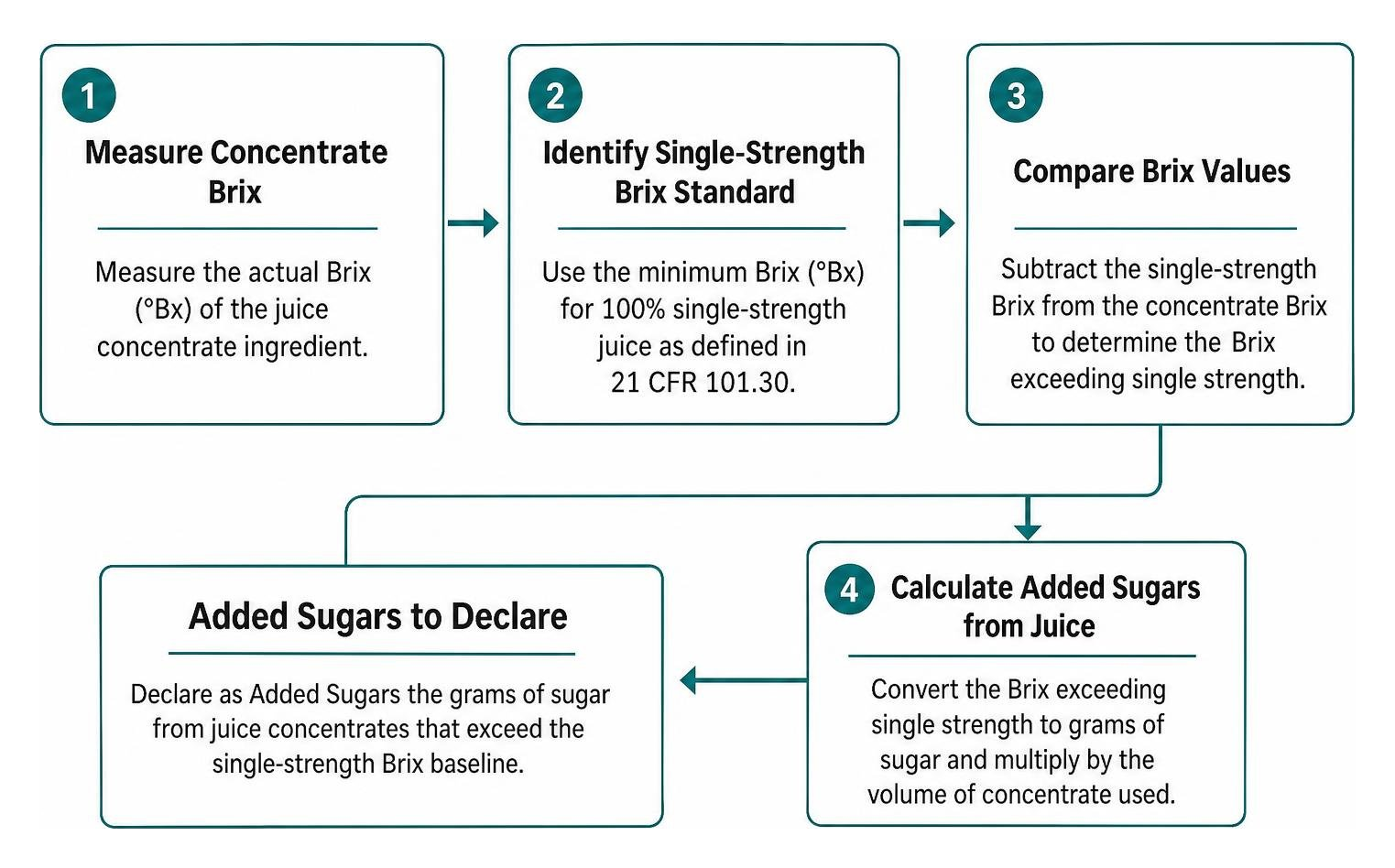
When developing a multi-fruit beverage blend containing apple, mango, and pear concentrates, developers must determine the baseline sugar volume for each juice component at single strength. Any excess dissolved solids contributed by the concentrate count toward the added sugar total.
Whole fruit purees, fruit pastes, pulps, and dried fruit powders are excluded from the Added Sugars definition as long as they retain all edible components (such as dietary fiber and essential pulp) of the whole fruit. If insoluble solids and pectin are stripped away during processing, the resulting liquid is regulated strictly as a concentrate.
Processing steps that involve moisture loss—such as baking, roasting, or extrusion—require dynamic mathematical adjustments. If a baked snack formulation uses single-strength fruit juice as a liquid ingredient and 50% of the product’s total water evaporates in the oven, the residual fruit solids become concentrated within the finished matrix. Under FDA calculation protocols, all finished product water is assumed to reconstitute the juice solids. Any residual juice sugar that cannot be reconstituted back to single-strength Brix within the final moisture state must be declared as Added Sugars.
Under 21 CFR 101.9(g)(10), commercial manufacturers must maintain written manufacturing records, batch sheets, and analytical assay verifications for at least two years to substantiate their declared Added Sugars values during agency inspections.
Dietary Limits, Health Outcomes, and Economic Impacts
The scientific justification for the 2016 labeling overhaul stems from the Dietary Guidelines for Americans, which advises limiting added sugar intake to less than 10 percent of total daily calories. On a standard 2,000-calorie reference diet, this limit corresponds to 50 grams (200 calories) per day. For most Americans, the main sources of added sugars are sugar-sweetened beverages, baked goods, desserts, and sweets. Consuming too much added sugars can make it difficult to meet nutrient needs while staying within calorie limits.
Economic modeling indicated that the policy carried an 80% probability of being net cost-saving within five years of implementation. Furthermore, restricting discretionary sugar intake reduces the incidence of excess adiposity, mitigating downstream risks for obesity-related conditions, including roughly 122,000 common cancer diagnoses tied to excess body weight annually.
Current Policy of the FDA on Sugar Daily Values and Limits
To simplify consumer decision-making, the FDA established the 5/20 rule as an interpretive benchmark for Percent Daily Value:
- 5% DV or less (≤ 2.5 g) indicates a product is a LOW source of added sugars.
- 20% DV or more (≥ 10.0 g) indicates a product is a HIGH source of added sugars.
Cardiometabolic research shows that liquid added sugars—primarily delivered via sugar-sweetened beverages (SSBs)—present a distinct metabolic risk compared to solid food matrices. Liquid sugars are digested rapidly without triggering satiety hormones, driving hepatic de novo lipogenesis and elevated visceral adiposity. Because a single 20-ounce carbonated beverage can deliver over 60 grams of added sugar (120% DV), public health interventions remain centered on reducing liquid sweetener volumes across retail and commercial foodservice environments.
Industry Reformulation Hurdles and Sweetener Transparency

Reducing added sugars in commercial consumer packaged goods is rarely as simple as dialing down sweetener volumes. In industrial food science, sucrose is a multi-functional workhorse that provides critical physical and preservative properties beyond basic sweetness:
- Freezing Point Depression: In dairy and plant-based frozen desserts, sugar controls ice crystal nucleation. Removing sugar produces a hard, unpalatable texture unless replaced with specialized bulking polyols.
- Water Activity ($a_w$) and Preservation: Sugar binds free water molecules, lowering water activity to inhibit microbial proliferation in shelf-stable jams, dressings, and bakery fillings.
- Browning and Maillard Reactions: Reducing sugars supply the carbonyl groups necessary for non-enzymatic browning and caramelization, creating signature crust colors and flavor profiles in baked goods.
- Viscosity and Mouthfeel: Sucrose provides physical bulk and thickness. Eliminating it creates a thin mouthfeel that requires hydrocolloids (xanthan, guar, acacia gums) or soluble corn fibers to restore.
To replace sugar’s bulk and sweetness, formulators rely on alternative sweetener systems:
- High-Intensity Sweeteners (Food Additives): Sucralose, Acesulfame Potassium (Ace-K), Aspartame, Saccharin, Neotame, and Advantame.
- GRAS Plant Extracts: High-purity Steviol Glycosides (Reb A, Reb M, Reb D) and Luo Han Guo (Monk Fruit) extracts.
- Polyols (Sugar Alcohols): Erythritol (0.2 kcal/g), Xylitol (2.4 kcal/g), Maltitol (2.1 kcal/g), and Sorbitol (2.6 kcal/g).
- Rare Sugars: Allulose, which provides 70% of the sweetness of sucrose but yields only 0.4 kcal/g. Under FDA guidance, allulose is exempt from declaration as Total Sugars or Added Sugars, though it must still be accounted for under Total Carbohydrates. However, it is very important to note the most recent civil legal actions being filed for use of such ingredients relative to label content claims.
The surge in alternative sweetener use prompted regulatory pushback regarding consumer transparency. Trade groups filed the U petition, calling for clearer front-of-package declarations when non-nutritive sweeteners are used to achieve sugar-reduction claims.
Under 21 CFR 101, making front-of-package claims requires strict regulatory adherence:
- “Reduced Sugar”: The product must contain at least 25% less sugar per Reference Amount Customarily Consumed (RACC) compared to an appropriate reference food.
- “No Added Sugar”: No sugar or sugar-containing ingredients can be added during processing. If the finished food is not low-calorie (i.e., does not achieve a 25% calorie reduction), it must feature an explicit disclaimer: “Not a low calorie food” or “Not for weight control.”
Future Policy Initiatives: Front-of-Package Labeling and Health Equity
As part of the White House National Strategy on Hunger, Nutrition, and Health, federal agencies—including the FDA, USDA, and HHS—are advancing policies to curb population-level chronic disease rates. Over 3,300 stakeholders and public health professionals participated in the FDA’s virtual public meeting on strategies to reduce added sugars consumption, highlighting the need for modernized labeling frameworks and clear educational programs.
A key regulatory initiative is the development of a standardized, mandatory Front-of-Package (FOP) Nutrition Info Box. Moving critical nutrition data from the back panel to the primary display panel helps bridge the gap for busy shoppers, who spend an average of just 35 seconds evaluating a product before purchase:
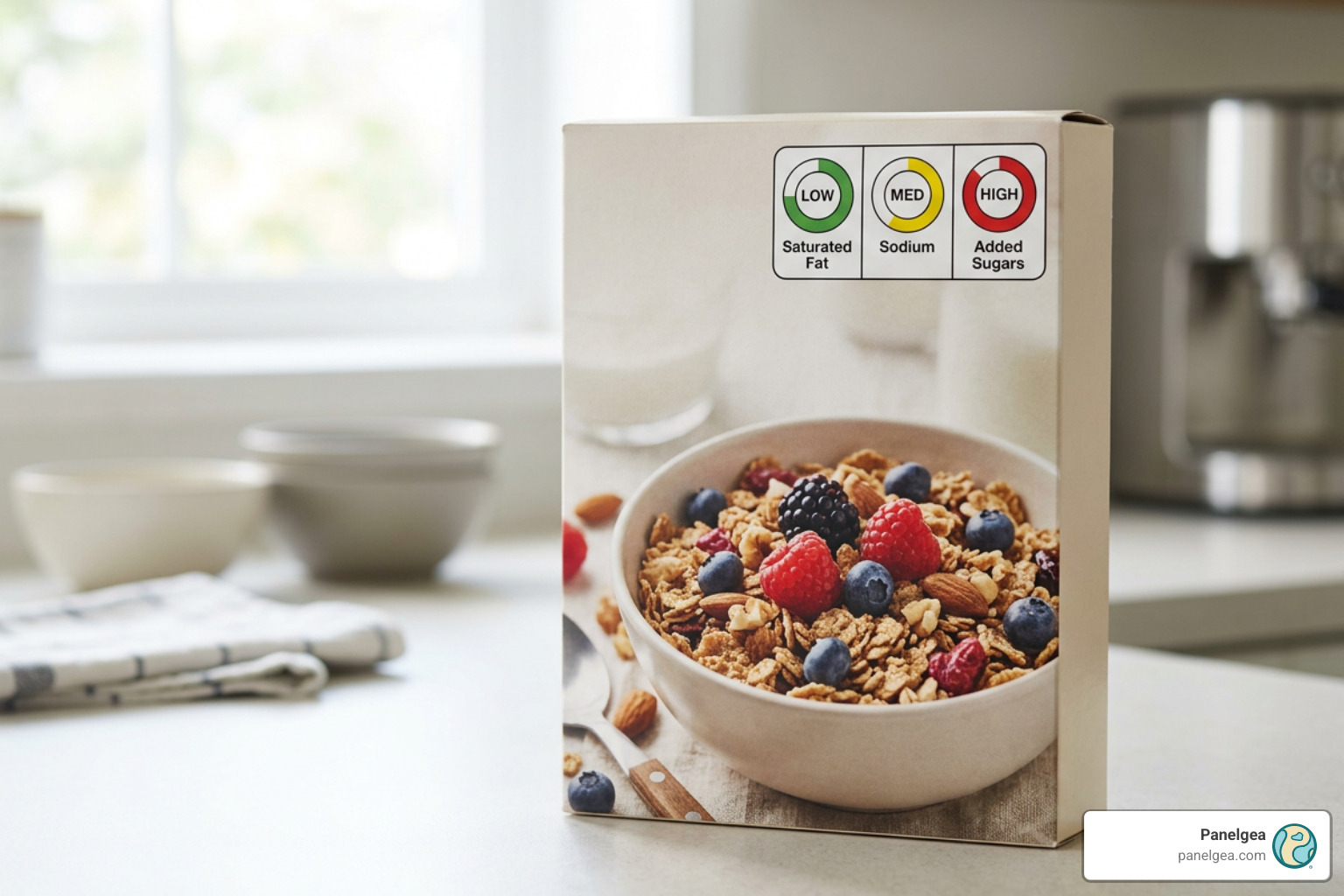
Unlike international schemes that use stop-and-go color schemes (such as the UK traffic light model), the FDA’s proposed framework relies on interpretive text indicators (“Low”, “Med”, and “High”) anchored to established %DV cutoffs for three core nutrients to limit: Saturated Fat, Sodium, and Added Sugars.
Current rulemaking plans propose requiring the standardized FOP box within the top third of a package’s Principal Display Panel (PDP), while maintaining clear visual separation from standard net quantity and statement of identity fields. Small packages under 12 square inches and dietary supplements regulated under Supplement Facts rules are proposed to remain exempt from mandatory FOP formatting.
Federal initiatives are also expanding beyond packaged grocery items to address health equity. Chronic disease burdens associated with added sugar consumption—including type 2 diabetes and hypertension—disproportionately impact lower-income demographics and food-desert communities. Emerging public health strategies include:
- Evaluating added sugar disclosure thresholds for chain restaurant menus.
- Deploying multi-language visual educational tools (such as physical sugar cube displays) in community clinics to tangibly demonstrate sweetness concentrations.
- Encouraging water substitution programs in public school districts to displace sugar-sweetened beverages.
Frequently Asked Questions About FDA Sugar Regulations
What is the maximum daily limit for added sugars under FDA rules?
The FDA Daily Value (DV) for added sugars is 50 grams per day for adults and children aged 4 and older, based on a standard 2,000-calorie reference diet. This threshold matches the Dietary Guidelines for Americans recommendation that discretionary calories from added sweeteners account for less than 10 percent of total daily energy intake (equivalent to 200 calories).
Why are pure honey and maple syrup exempt from listing added sugar grams directly?
Single-ingredient sweeteners like 100% pure maple syrup, raw honey, and pure cane sugar do not contain external added sugars. To prevent consumers from believing these pure products had adulterating sugars introduced during bottling, the FDA updated its guidance. Manufacturers are permitted to omit the direct gram amount on the indented added sugars line, provided they declare the %DV and include a standardized footnote explaining the product’s caloric contribution to daily intake limits.
How does the FDA distinguish between whole fruit purees and concentrated juices?
The distinction depends on whether the ingredient retains the nutritional and physical matrix of the whole edible fruit. Whole fruit purees, pulps, and whole fruit powders maintain their natural fiber and solids, so their sugars are classified as naturally occurring intrinsic sugars (Total Sugars). However, if juice is filtered, stripped of its pulp, and concentrated beyond the minimum single-strength Brix values established in 21 CFR 101.30, any excess sugars above that single-strength threshold must be calculated and declared as Added Sugars.
Conclusion
Managing modern FDA sugar labeling rules requires a balance of precise food science, accurate recipe mathematical modeling, and rigorous compliance recordkeeping under 21 CFR 101.9(g)(10). As regulatory agencies transition toward mandatory Front-of-Package interpretive labeling and compliant facts panel presentations, with expanded enforcement around alternative sweetener claims, CPG brands must maintain complete visibility across every ingredient, concentrate, and bulking agent in their supply chain.
Automating these formulation workflows removes the risk of miscalculating Brix thresholds or improperly formatting complex facts panels. If your brand requires specialized regulatory support and compliant regulatory tools to review technical information, perform recipe conversions, audit label portfolios, or prepare for upcoming FOP rules, explore our expert food labeling consulting services to ensure guaranteed compliance across your entire product line.