

Pick the Right Dietary Supplement Label Maker for Faster Launches
Key Features to Demand in a Modern Supplement Facts Generator
Selecting the right label or facts panel creation software requires looking past basic text formatting. In the modern CPG landscape, your software must serve as an active compliance engine, not just an illustration tool. Automating this step eliminates the manual friction that slows down go-to-market timelines, mitigates legal and regulatory risks, fast tracks production time, allowing brands to reduce label creation time by up to 80% compared to traditional, manual methods that are error prone and inconsistent.
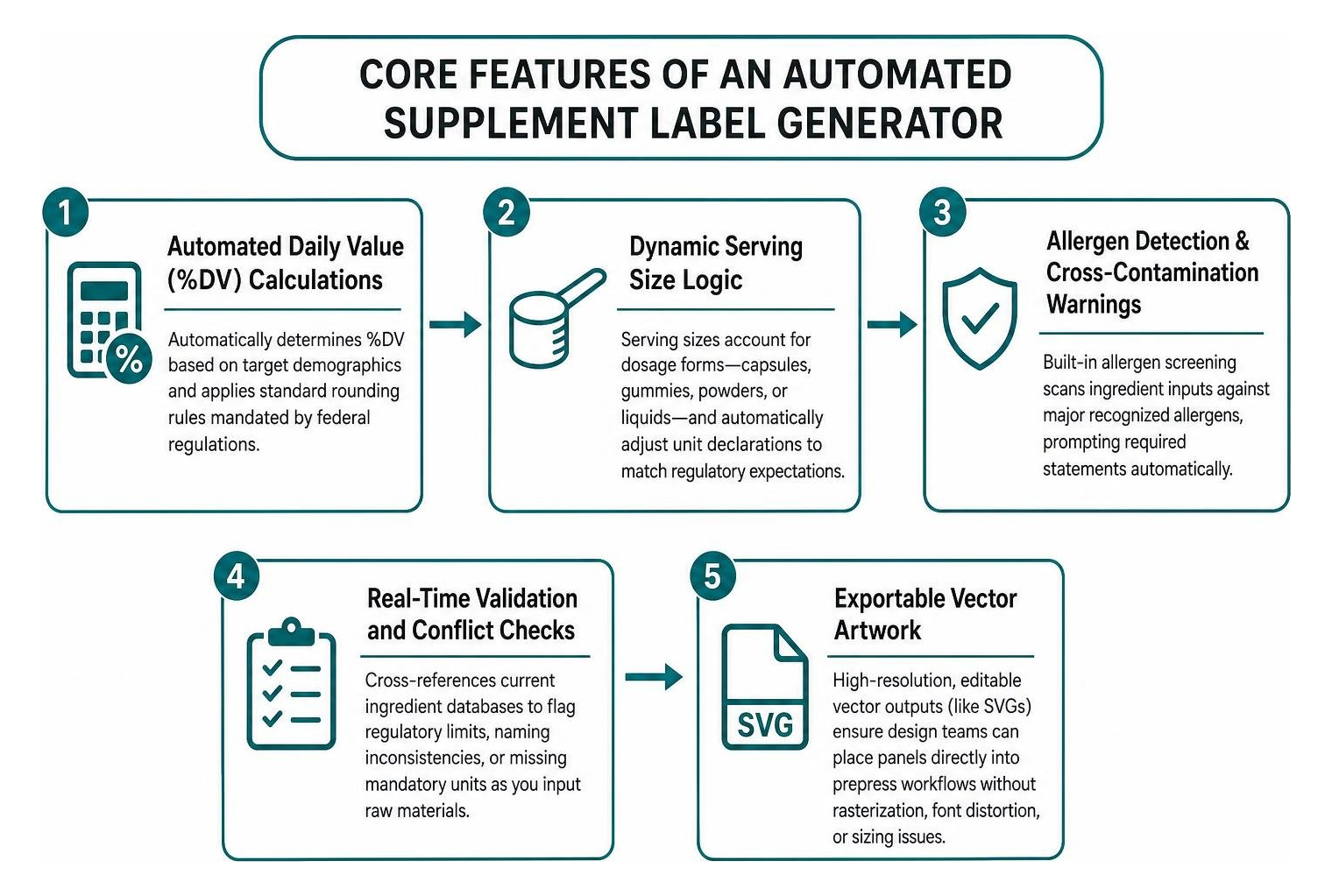
To safeguard your brand and accelerate production, demand these core capabilities:
- Automated Daily Value (%DV) Calculations: The platform should automatically determine %DV based on target demographics (e.g., adults, pregnant women, infants, or children under four) and apply standard rounding rules mandated by federal regulations. This prevents common rounding calculation errors that occur when converting raw analytical data into compliant integer percentages.
- Dynamic Serving Size Logic: Serving sizes must account for dosage forms—whether capsules, softgels, gummies, powders, or liquids—and automatically adjust unit declarations to match regulatory expectations. The software should handle both single-serving declarations and dual-column formats when packaging contains multiple recommended intakes.
- Allergen Detection & Cross-Contamination Warnings: Built-in allergen screening scans ingredient inputs against major recognized allergens (such as milk, egg, fish, crustacean shellfish, tree nuts, wheat, peanuts, and sesame), prompting required statutory statements automatically.
- Real-Time Validation and Conflict Checks: As you input raw materials, the platform must cross-reference current ingredient databases to flag regulatory limits, formatting challenges, naming inconsistencies, or missing mandatory units before packaging design files are finalized.
- Exportable Vector Artwork: Properly built and formatted high-resolution, editable vector outputs (like SVGs) ensure design teams can place panels directly into prepress workflows without rasterization, font distortion, or sizing issues.
Understanding your software requirements helps you evaluate transparent software pricing based on your catalog’s scale and complexity.
Managing Proprietary Blends with a Supplement Facts Generator
Proprietary blends are essential for safeguarding formulation intellectual property, but they introduce unique regulatory hurdles. Under federal rules, you are not required to disclose the exact quantitative amount of every individual component within a blend. However, you must state the total aggregate weight of the entire blend, list all sub-ingredients in descending order of predominance by weight, and properly declare botanical parts or nested ingredients. And if your formulated proprietary blend contains a blend within, the nested blend has further challenges with formatting display and nutrient calculations. Tools that only allow a user to format such information without taking into account all of the regulatory considerations and requirements, leave notable risk to users and brands when it comes to label finalization and approval.
When using a modern supplement facts generator, handling proprietary blends involves:
- Proprietary Blend Ingredient Tracking: The system calculates the aggregate blend weight while tracking underlying sub-components to ensure the descending order remains exact, even if raw material suppliers change or sub-ingredient ratios shift during formulation updates, inclusive of their respective nutritional values.
- Botanical Specificity: For herbal components, regulations require listing the common or usual name alongside the specific plant part used (e.g., leaf, root, aerial parts, bark, or seed). The software should enforce this disclosure before letting you finalize the panel.
- Quantitative vs. Non-Quantitative Declarations: Components within the blend must clearly display their qualitative presence without confusing consumers or inspectors about which amounts are explicitly measured versus aggregate totals.
- Standardized Extract Disclosures: When proprietary blends include standardized botanical extracts, the software must allow users to properly note potency percentages, extraction ratios, and active marker compounds alongside the specific herbal entry.
Streamlining FDA Compliance via an Automated Supplement Facts Generator
Dietary supplement panels are strictly governed by FDA Dietary Supplement Guidance and 21 CFR 101.36. The FDA estimates that approximately 70% of dietary supplement labels contain at least one inaccuracy. Non-compliance is not merely an aesthetic issue; it can trigger warning letters, costly product recalls, customs detentions, and fines of up to $10,000 per violation.
An automated generator enforces structural and visual rules seamlessly:
- Strict Font Formatting and Hierarchy: Ensuring the title “Supplement Facts” is set in the largest type size on the panel, with clear, legible typefaces for nutrients and botanicals, adhering to minimum point size requirements across small-package exemptions.
- Line Weight and Border Specifications: Mandating standard hairline rules and prominent heavy bars (such as the mandatory 3-point line separating core nutrients from unestablished components, and the enclosing box borders).
- Automated Rule-Checking: Preventing common errors like misplacing zero-value nutrients, omitting necessary footnotes (such as the standard Daily Value not established symbol
†), or miscalculating caloric contributions from macronutrient sources.
Supplement Facts vs Nutrition Facts: Essential Labeling Differences
While standard foods and beverages use Nutrition Facts panels, dietary supplements are regulated under distinct statutory provisions. Understanding these differences prevents structural errors that trigger regulatory scrutiny and distribution delays.
| Feature | Nutrition Facts Panel (21 CFR 101.9) | Supplement Facts Panel (21 CFR 101.36) |
|---|---|---|
| Governing Regulation | 21 CFR 101.9 | 21 CFR 101.36 |
| Unestablished %DV Ingredients | Not permitted in the panel | Permitted and flagged with a symbol (e.g., †) |
| Botanicals & Plant Parts | Listed only in the ingredient statement | Listed directly inside the panel with plant parts |
| Mandatory Nutrients | Must declare 14 mandatory core nutrients | Only declare nutrients present at reportable levels |
| Serving Size Determinant | Reference Amounts Customarily Consumed (RACC) | Manufacturer’s recommended serving for use |
| Proprietary Blends | Not permitted within the facts panel | Permitted with aggregate weight and listed ingredients |
| Structure-Function Claims | Rare; heavily restricted | Common; requires standard statutory disclaimer |
| Zero-Value Declarations | Mandatory for required nutrients even at 0g | Prohibited from listing nutrients present at zero levels |
In a Nutrition Facts panel, every item listed must have an established nutritional baseline recognized by standard dietary guidelines. In contrast, Supplement Facts panels allow dietary ingredients—such as probiotics, botanicals, enzymes, and amino acids—that do not have established Reference Daily Intakes (RDIs) or Daily Recommended Values (DRVs). When these ingredients are included, the panel must denote that the %DV has not been established.
Furthermore, dietary supplement labeling mandates specific ordering conventions. Nutrients with established RDIs/DRVs (known as (b)(2)-dietary ingredients like Vitamin C, Calcium, or Zinc) must be listed above a heavy 3-point dividing bar. Dietary ingredients without established daily values (known as (b)(3)-dietary ingredients like Ashwagandha root extract or CoQ10) must appear beneath this bar, followed by the explicit symbol referencing the footnote stating that daily values are not established.
Best Practices for Faster Supplement Launches and Zero Errors
To accelerate time to market while protecting brand equity, establish a structured label verification pipeline and collaboration with the manufacturer, designer (and printer) that minimizes human error at every stage of the formulation and design process:
- Sync Formulations with Batch Records: Ensure that the quantitative inputs inside your generator mirror your active master manufacturing records (MMRs) and certificates of analysis (COAs). Discrepancies between physical laboratory assays and declared label values create serious regulatory liabilities during FDA facility audits.
- Standardize Nomenclature Across Catalogs: Maintain consistent chemical forms and botanical Latin binomials across product lines. An automated platform helps standardize naming (e.g., specifying “Ascorbic acid” or “Zinc gluconate”) to satisfy statutory ingredient identification requirements.
- Run Prepress Quality Audits: Before sending vector artwork to the printer, verify that the bounding box dimensions match your actual packaging die lines and that line weights hold up across physical substrates, shrink sleeves, and label stocks.
- Leverage Expert Regulatory Support: For novel ingredients or complex multi-tiered formulations, pairing automated software with specialized regulatory consulting ensures peace of mind before high-volume print runs.
- Train Your Team Continuously: Review step-by-step interactive tutorials covering label formatting guidelines to help internal design, regulatory, and quality teams identify discrepancies early in the development timeline.
Frequently Asked Questions About Dietary Supplement Labeling
What is the main difference between a Supplement Facts and Nutrition Facts panel?
The primary difference lies in the types of ingredients permitted and how serving sizes are determined. Nutrition Facts panels are restricted to conventional foods and require listing mandatory macronutrients and micronutrients based on FDA-set RACC guidelines. Supplement Facts panels allow dietary ingredients without established % Daily Values (such as herbal extracts, specialized enzymes, and bioactive peptides) and base serving sizes on the manufacturer’s suggested use rather than a standardized reference amount.
How do label tools calculate serving sizes and daily values?
Automated tools maintain built-in Reference Daily Intake (RDI) and Daily Recommended Value (DRV) tables for various target consumer demographics. When you input the raw amount of a nutrient per serving (e.g., 90 mg of Vitamin C or 15 mcg of Vitamin D3), the software runs unit conversions, checks rounding rules according to regulatory thresholds, and generates the exact % Daily Value relative to target consumer groups, including adjustments for international unit (IU) to metric conversions.
Can label software export print-ready vector artwork?
Yes. Professional label generators export clean, print-ready SVG files. Provided these file types are formatted properly, this ensures lines, text boxes, and dividers maintain exact regulatory proportions and font point sizes without resolution loss when handed off to packaging designers, prepress engineers, or commercial printers. If required, these can be easily edited preserving all formatting requirements to fit a unique packaging constraint or configuration.
What happens if a supplement label does not comply with 21 CFR 101.36?
Non-compliant labels are deemed misbranded under Section 403 of the Federal Food, Drug, and Cosmetic Act. Misbranded supplements can lead to FDA 483 inspection observations, Warning Letters, import alerts that hold shipments at port, mandatory product recalls, and severe financial penalties that damage brand reputation and commercial distribution agreements.
Conclusion
The dietary supplement sector represents a rapidly expanding market, growing from $152.4 billion in 2023 toward a projected $308.3 billion by 2032. However, increased market opportunity brings heightened regulatory enforcement. Manual calculations and static design files leave brands vulnerable to costly labeling mistakes and delayed product rollouts.
By integrating automated label generation into your development cycle, you ensure end-to-end compliance, protect brand integrity, and accelerate launch timelines. Take control of your packaging workflow today and build compliant supplement labels with Panelgea.